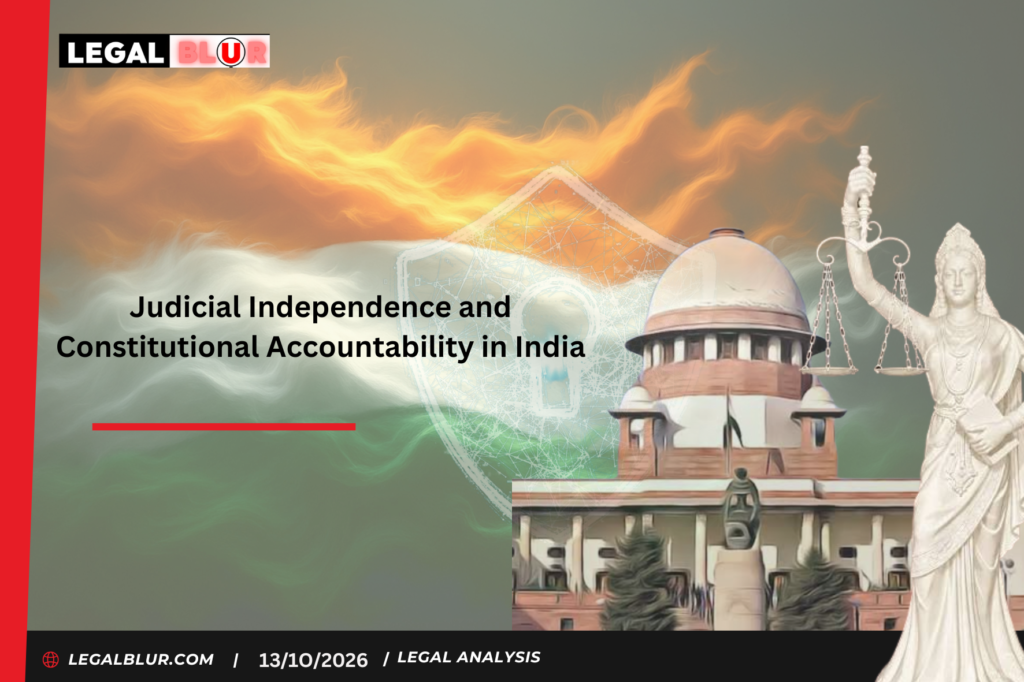
This article is written by Jain Mohit. This article examines judicial independence and accountability in India, focusing on the Supreme Court’s role in protecting fundamental rights, checking executive power, and upholding constitutional values while addressing challenges to public confidence and access to justice.
Introduction
Judicial independence is one of the pillars of Indian democracy, ensuring the liberties of its people. Judicial review is done by the judiciary of India, especially by the Supreme Court, to ensure that the government does not engage in misconduct.
Some of the recent decisions made by the Supreme Court regarding rights issues, election disputes, and federalism do question the impartiality of the judiciary in a democracy like India and its ability to check misuse of power by the executive. This article seeks to discuss if the judiciary checks the government, protects the rights of people, and restores faith in democracy.
Constitutional foundations of judicial independence and accountability
The Indian constitution envisages judicial independence as a method of preventing the abuse of state authority. The Supreme Court and the High Court have a duty to uphold the constitution.
protect fundamental rights, and keep the executive organs under control.
The doctrine of separation of power presumes that administrative, legislative, and judicial activities must be segregated to avoid power misuse. Moreover, by Article 50, the judicial system shall be kept free from the executive in the state’s public employment. Finally, the judicial independence principle has been enshrined in the Indian constitution by the
Supreme Court advocate on record in the association v. union of India
as a part of its basic structure in Kesavananda Bharati v. State of Kerala, in 1973.
However, judicial independence is not achieved through this mechanism since the court is answerable for its decisions under the law. Thus, judicial accountability is key to judicial independence because
Judicial accountability ensures that the court delivers its decisions under the law.
This mechanism will also help to uphold the image of the judiciary as an arm of
the government responsible for the rule of law.
The Supreme Court and the issue of constitutionality
The constitutional credibility of the Supreme Court is defined by its ability to interpret
the constitutionality of laws and offer appropriate remedies. Its stand on politically sensitive issues often defines the boundaries of statecraft and the scope of civil redress.
In Association of Union Reforms v. Union of India (2024),
The Supreme Court invalidated the electoral bonds scheme on grounds of transparency and citizens’ right to know.
Meanwhile, in Re: Article 370 of the constitution (2023)—the ruling on the Jammu and Kashmir autonomy issue—
has exacerbated the controversy over the federal structure and the separation of powers.
Constitutionality, it seems, is a matter of context and depends on the court’s approach rather than the government’s leverage.
At the same time, politically sensitive cases are at risk of being delayed for too long,
which diminishes the judiciary’s capacity to deliver on rights protection. Consequently, the Supreme Court needs to articulate its constitutional positions in a timely manner to ensure the effectiveness of remedies.
The judiciary and the shadow of executive
Judicial independence is a necessary condition for ensuring accountability of the executive to the constitution. By upholding judgments that annul acts of the government that contravene the constitution or the statute,
Indian courts assert their independence.
However, there are concerns that in attempting to adopt a judiciary-friendly approach,
Reforms have been made that seek to undermine the separation of power.
The independence of the judiciary is also connected to issues of judicial appointment, transfer, and administrative practices. In the NJAC case (2015),
the Supreme Court ruled that the NJAC was unconstitutional because judicial independence is a basic feature of the constitution.
However, a government-friendly approach to or avoidance of the issue does not
necessarily indicate that the judiciary is under the control of the executive.
In a democracy, the judiciary is expected to remain independent in its decisions
, including policy judgments, as long as they are within the constitutional framework.
Nevertheless, the primary concern is that the judiciary does not become excessively deferential to
the government in areas where it should exercise its authority to check and balance.
Upholding judicial independence will require transparency in decision-making,
as well as ensuring that checks and balances take place, which will enhance accountability.
Government mistakes and responsibilities: Is the judiciary watching over the Modi government?
The judiciary plays an important role in ensuring that the union government fulfills its constitutional and legal duties. The issues of judicial review of the government decisions affecting civil rights, public administration, and democratic institutions are particularly pertinent under Prime Minister Modi.
The Supreme Court’s recent ruling in Association for Democratic Reforms v. Union of India (2024) and its impact on the Electoral Bonds Scheme illustrate the judiciary’s ability to assess the government’s action for compliance with the constitution.
Yet, there is a need to ensure that the union government is held accountable in cases where its actions or omissions may violate citizens’ rights.
At the same time, however, the judiciary has to differentiate between the outright constitutional violations and policy or administrative mistakes within the government’s competence. Therefore, the central issue to focus on is whether the judiciary’s interventions are sufficient to prevent public authorities from failing in their duties to the citizens. A closer examination of the judiciary’s rulings in specific cases and the weight of evidence supporting that is required to evaluate the issue. It is important to distinguish between constitutional wrongdoings and policy-to-administrative failures that the government may be obliged to correct itself.
Landmark judgements and contemporary constitutional controversies
The decision of the Supreme Court on issues relating to political funding, federalism, electoral institutions, and personal liberty has an important bearing on the question of judicial independence and constitutional accountability in India. The cases of the Association for Democratic Reforms v. Union of India (2024) on electoral bonds, In Re: Article 370 of the Constitution (2023), and Anoop Branwal v. Union of India (2023) relating to election commission appointments illustrate the nuanced interplay between the issue of governance and constitutional rights.
A similar concern arises from the courts’ ruling on the Prevention of Unlawful Activities Act and long detention as a violation of Article 21. It is therefore pertinent to review these landmark judgments with a view to analyzing the courts’ standpoint on the question of federalism, electoral accountability, and the right of citizens against the backdrop of government’s stance, citizen impact, and remedies available to the citizens. This will help situate the debates on alleged judicial bias in context without overestimating the significance of any one factor.
Judicial conduct, institutional responsibility, and public confidence
Judicial conduct, transparency, and accountability are important to maintain public confidence in the Indian judiciary. The judges should be able to deliver justice with independence, objectivity, professional competence, and integrity. Transparent case allocation, good governance, and appropriate channels of accountability can help reinforce judicial independence and institutional integrity without undermining judicial autonomy.
In a constitutional democracy, the freedom to criticize judicial decisions is available to everyone, which can be exercised by individuals as well as institutions in accordance with the law.
Public confidence is about judicial independence, and the importance of maintaining the confidence is for the judiciary to enjoy by virtue of its autonomy.
Fundamental Rights, Dissent, and the Citizens’ Right to Question Power
India’s democratic framework of fundamental rights enumerated in articles 19(1)(a), 19(1)(b), and 21 seeks to protect and promote the fundamental freedom of the people.
The obligation of the judiciary to protect and promote these freedoms by reviewing the action of the state that seeks to restrict criticism and dissent of any kind and peaceful assembly as guaranteed by the constitution can not be stressed enough.
The problem arises in the case of adjournment of such matters.
where the courts’ timing is being needlessly wasted in cases concerning the fundamental rights of the people.
It becomes the duty of the judiciary to uphold the freedom and power of the people against the action of the state.
Hardships faced by advocates and challenges to access of justice
Young and first-generation advocates encounter financial hardships.
limited opportunities, and challenges in accessing legal resources, while delays in court cases, litigation costs,
and complex procedures are additional barriers to justice for advocates and litigants.
Improving the system of legal aid and making justice accessible and affordable are imperative to accelerate. The Indian justice system and make it more equitable.
Judicial independence or institutional deference
Judicial independence calls for reviewing the government’s decisions
in order to ensure that its actions do not violate any of the fundamental rights.
Therefore, while delayed hearings, as well as the inconsistent and insufficient assessment,
are factors that may cast a shadow on the judicial review process,
they do not directly indicate the executive’s ability to intervene in the judiciary.
Conclusion
The strength of any government is not just the powers given to various organs of state
but also the responsibilities to these organs to the people.
In particular, the judiciary has a duty to protect and defend the rights of Indians,
to apply laws, and to control the actions of the executive. At the same time, there are problems of judicial backlogs, different approaches to similar cases, and lack of accessibility. These and many other issues should be subject of reforms in order to achieve the ideal democracy.
Massive criticism of the judiciary does not mean democracy’s rejection of its principles; on the contrary,
by analyzing the mistake of the courts, it is possible to find ways to improve their performance .
However, it should be emphasized that the judiciary in its decisions
should not side with one of the players in the constitutional struggle for power but act as its neutral moderator.