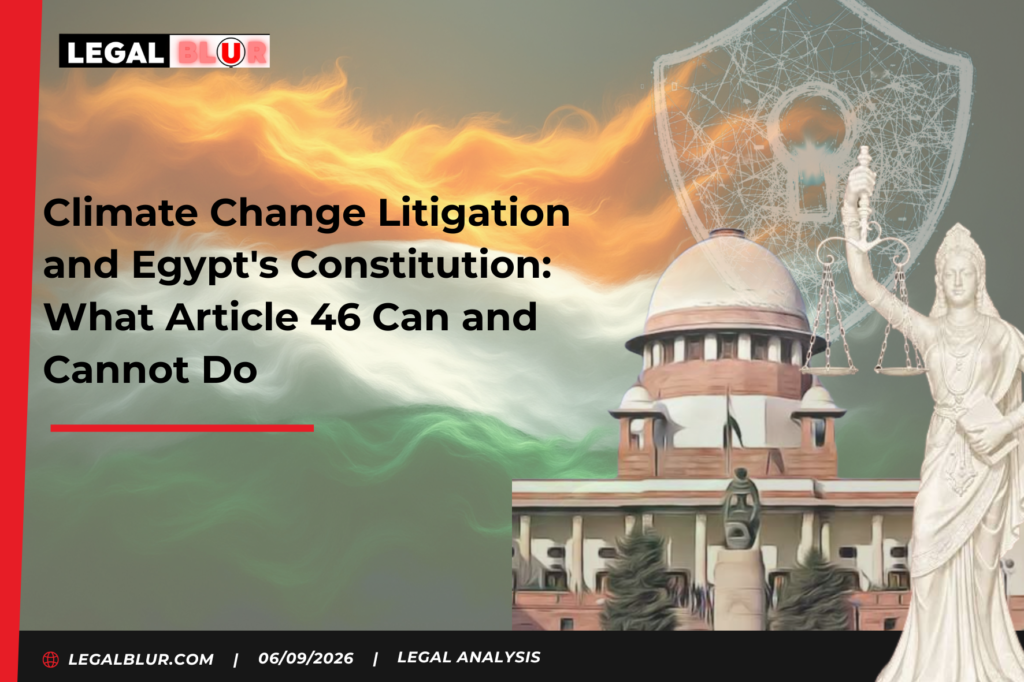
What Article 46 Can and Cannot Do
This Article is written by Al-Zahraa Ahmed Elsenbawy — Alexandria University. This Article Discusses “A Dutch environmental group started the trend by suing its own government; by 2024 the European Court of Human Rights had issued a ruling binding forty-six states at once”.
Introduction
“For most of the twentieth century, courts stayed out of climate policy. Furthermore, legislatures negotiated it, and international bodies coordinated it, while judges mostly deferred”. That has changed in Europe, and fairly quickly. A Dutch environmental group started the trend by suing its own government; by 2024 the European Court of Human Rights had issued a ruling binding forty-six states at once.
As a result, courts became willing to say that a weak climate policy can violate rights already written into existing law.
The consequences reach past Europe. States that run their climate policy through strategy papers
And finance-conditional pledges rather than binding statutes now face an uncomfortable question, and Egypt is one of them.
It isn’t simply whether the ambition is high enough. It’s whether the underlying legal system could even entertain a claim of the kind Dutch, German, and Swiss courts have already heard.
This article traces that doctrinal line -from Urgenda Foundation v. State of the Netherlands, through Neubauer v. Germany, to Verein KlimaSeniorinnen Schweiz v. Switzerland.
Therefore, before turning to a narrower question:
- Does the Constitution of the Arab Republic of Egypt hold the same raw material that made those cases possible?
- And does the National Climate Change Strategy 2050 sit outside judicial reach no matter what the text says?
Could Egypt’s Constitution Support Climate Litigation?
Start with the text, because the comparison holds up better than expected.
1. Article 46 of the Egyptian Constitution
Article 46 of the Egyptian Constitution gives every person the right to a sound, healthy environment.
It also gives environmental protection a national duty.
And requires the state to use natural resources rationally while guaranteeing future generations’ rights to that same environment [4].
That final clause is doing the heavy lifting. It reads a lot like Article 20a of the German Basic Law.
An obligation running toward people who don’t exist yet, the same textual hook on which Neubauer was decided.
Therefore, on paper, Egyptian constitutional law already has a right.
That could support the claim that indefinitely deferred, finance-conditional targets push an unfair burden onto future generations.
2. Constitutional Review And Access To Court
However, whether anyone could put that right to use is a separate question, and it hinges on a distinction that’s easy to blur: a constitutional right, a state obligation, and an enforceable remedy are three different things. Article 46 gives Egypt the first two without much argument. What it doesn’t hand over automatically is the third. A right only becomes enforceable once some court has jurisdiction, some litigant has standing, and some remedy exists to grant. Germany’s Neubauer claimants had all three lined up. Egyptian law arranges things differently for what is, on paper, the same underlying right.
Constitutional review in Egypt sits exclusively with the Supreme Constitutional Court, and getting there isn’t direct. Law No. 48 of 1979 doesn’t let individuals file a free-standing constitutional complaint. The constitutional question has to come up inside a case already pending before an ordinary or administrative court, and that court has to refer it up [5].
Some Egyptian scholars read this referral model broadly enough to cover legislative omissions as well as legislative acts; however, that reading has never actually been tested against Egypt’s climate framework, and it would face two problems even if it were. Review under this model is subsequent, meaning it looks at laws already in force, and it’s genuinely unclear whether a policy document like the Strategy would count as reviewable at all, as opposed to a statute or regulation. And without a direct complaint mechanism, a litigant still needs an existing dispute to hang the constitutional question on. Additionally, outside the constitutional track, there’s a narrower option.
Environment Law No. 4 of 1994 lets people challenge decisions of the Egyptian Environmental Affairs Agency before the Administrative Court of the State Council [6]. That’s a genuine judicial forum, but its reach stops at individual administrative decisions. It wouldn’t extend to the sufficiency of a national strategy or an NDC target.
A claimant could argue a specific project lacked adequate impact assessment. They couldn’t argue, through this route alone, that Egypt’s overall emissions trajectory falls short constitutionally, which is really what Neubauer and KlimaSeniorinnen were about.
The supranational layer that mattered so much in Europe is largely closed off here too. Egypt is not a party to the European Convention on Human Rights, so KlimaSeniorinnen doesn’t apply directly. Egypt has signed the Protocol establishing the African Court on Human and Peoples’ Rights, but hasn’t deposited the declaration under Article 34(6) that would let individuals or NGOs bring cases straight to that court [7]. Without it, an Egyptian claimant’s only regional option is a communication to the African Commission, and the Commission’s findings are recommendations, not orders.
So there’s a real gap between what the law says and what a court could actually do about it. Substantively, Egypt’s Strategy has the same weaknesses that sank Germany’s 2019 statute: no binding, economy-wide target, and its firmest commitments tied to finance the state doesn’t control. Institutionally, Egypt lacks the machinery that let European claimants convert that weakness into a court order – a direct complaint route, a court willing to treat a strategy document as reviewable, a supranational tribunal with compulsory jurisdiction. Neither gap should be read as final.
No Egyptian court has turned down a claim like this, and the lack of precedent may say more about the lack of an accessible route than about how the claim would fare on the merits.
Case Laws
1. Urgenda Foundation v. State of the Netherlands
The Dutch Supreme Court decided Urgenda Foundation v. State of the Netherlands on 20 December 2019, and the case laid the groundwork for everything that followed [1]. Urgent, an environmental foundation, sued the state with close to nine hundred co-plaintiffs, arguing the government’s emissions targets fell well short of protecting citizens from foreseeable harm. The issue was fairly narrow: could a court order a more ambitious target by relying on international human rights instruments, without any domestic statute specifying that number? The Court said it could.
Therefore, Articles 2 and 8 of the European Convention on Human Rights, it held, obliged the Netherlands to cut emissions by at least twenty-five percent by the end of 2020, against a 1990 baseline. The size of that cut wasn’t especially dramatic. What mattered was the principle: existing rights guarantees, with no new climate-specific right required, could impose a real mitigation obligation on a state.
2.Neubauer v. Germany
However, Germany went further two years later. Neubauer v. Germany, decided by the Federal Constitutional Court on 24 March 2021, involved young claimants challenging the Federal Climate Protection Act of 2019 because its targets stopped at 2030 [2].
Unlike Urgenda, this wasn’t a fight over whether a number was big enough. It was a fight over how the law was built.
The claimants said that by leaving the post-2030 period unspecified, the statute quietly shifted the burden of steep future cuts onto people too young at the time to have any say in it.
Basic Law
The Court agreed, holding that this omission breached the claimants’ rights under
Article 2(2) of the Basic Law, read alongside Article 20a, the state’s duty to protect the natural foundations of life for future generations.
It didn’t strike the law down outright -it told the legislature to fill in the post-2030 pathway, which the Bundestag did within weeks.
The distinguishing feature of Neubauer is its intertemporal reasoning: a government cannot satisfy its obligations today by quietly deferring the hard part to a future parliament.
3. Verein KlimaSeniorinnen Schweiz and Others v. Switzerland
Then, in April 2024, came the biggest development yet. The Grand Chamber of the European Court of Human Rights decided Verein KlimaSeniorinnen Schweiz and Others v. Switzerland, a case brought by a group of elderly Swiss women particularly vulnerable to heat [3].
They argued that Switzerland’s climate policy put their Convention rights at risk, and that domestic courts had refused to look at the substance of the claim at all. The Grand Chamber sided with them on both points, finding a breach of Article 8 because of gaps in the regulatory framework, including the absence of any quantified national carbon budget, and a breach of Article 6(1) because domestic courts had blocked meaningful review. The finding itself wasn’t a huge leap past Urgenda and Neubauer. What set it apart was its reach: since the Court sits above forty-six Convention states, its reading of Article 8 now functions as a standard any domestic court in that system can invoke against a government without a quantified, enforceable emissions trajectory.
Put the three together and a fairly clear line runs through them. Urgenda showed that existing rights instruments, without new climate legislation, could support a climate obligation. Neubauer carried the same idea into purely domestic constitutional law and added intertemporal fairness as a new tool. KlimaSeniorinnen pushed that reasoning up to the supranational level, converting what had been persuasive precedent into a binding interpretation across a whole regional system. Each case also chips away at the argument that climate policy is a purely political matter beyond judicial reach. Legislatures keep their discretion over how emissions get cut, but not over whether to set a meaningful target at all, and not over whether an aspirational strategy document with no binding numbers attached is good enough.
Conclusion
None of this means Egypt’s climate framework is vulnerable to a lawsuit right now. It means the framework has the same substantive weaknesses – a non-binding target and commitments contingent on outside finance – that courts elsewhere eventually treated as constitutionally inadequate once they had the chance to examine them closely. The missing piece in Egypt isn’t language. Article 46’s promise to future generations sits comfortably next to Article 20a as a textual basis for an intertemporal claim. The missing piece is procedure: a direct route to review, a court prepared to treat a strategy as reviewable, and binding oversight of the kind the Convention gives through the ECtHR. For now, that gap exposes the Strategy to criticism in the court of public opinion well before it exposes the state to legal liability.
The bigger lesson may sit one step before Neubauer rather than inside it. Germany had a binding statute, the Federal Climate Protection Act, years before a court found that statute constitutionally lacking [8]. If Egypt has a comparable path toward accountability, it probably starts with turning the Strategy into binding legislation with fixed, unconditional targets, and only later, if that legislation proves insufficient, moves toward the indirect constitutional mechanisms already on the books. Skip the first step, and the second one has nothing to work with.
Frequently Asked Questions
1. What did the Urgenda case require the Dutch government to do?
It ordered a cut of at least twenty-five percent in greenhouse gas emissions by the end of 2020, measured against 1990 levels, based on the state’s duty of care under Articles 2 and 8 of the European Convention on Human Rights.
2. Did the German court in Neubauer strike down the entire Climate Protection Act?
No, only the provisions covering the post-2030 period were found unconstitutional. The legislature filled in the missing pathway within weeks.
3. Does the KlimaSeniorinnen ruling apply outside Switzerland?
In practice, yes. A Grand Chamber ruling on Article 8 sets an interpretive standard for all forty-six states bound by the Convention, not only Switzerland.
4. Does Egypt’s Constitution contain a right comparable to Germany’s Article 20a?
In text, yes. Article 46 guarantees a healthy environment and extends it to future generations. What’s missing isn’t the wording but the mechanism; Egypt has no direct constitutional complaint procedure like the one that got the Neubauer claimants into court.
5. Could a Neubauer-style case actually be brought in Egypt today?
Not as a standalone claim. It would need to ride along an existing case before an ordinary or administrative court -a challenge to a specific permit before the State Council, for example -with the constitutional question raised incidentally inside that dispute.
References
1. Urgenda Foundation v. State of the Netherlands, ECLI:NL:HR:2019:2007 (Neth. S. Ct. Dec. 20, 2019), official English translation: link
2. Neubauer v. Germany, BVerfG, 1 BvR 2656/18, Mar. 24, 2021 (Ger.), official English translation: link
3. Verein KlimaSeniorinnen Schweiz v. Switzerland, App. No. 53600/20, Eur. Ct. H.R. (Apr. 9, 2024), HUDOC: link
4. Constitution of the Arab Republic of Egypt, 2014 (as amended 2019), art. 46, English translation: link
5. Law No. 48 of 1979 Concerning the Supreme Constitutional Court (Egypt), overview and provisions: link
6. Environment Law No. 4 of 1994, as amended by Law No. 9 of 2009 (Egypt), art. 25, English text: link
7. Protocol to the African Charter on Human and Peoples’ Rights on the Establishment of an African Court on Human and Peoples’ Rights, art. 34(6), official text: link
8. Federal Climate Protection Act (Bundes-Klimaschutzgesetz), 2019 (Ger.), as amended 2021/2024, official English translation: link