This article is written by Ayushman Anand, VIPS-TC, VSLLS.
Keywords: Implied Copyright Abandonment, Copyright Act 1957, Digital Licensing, Fair Dealing, Public Domain
Introduction
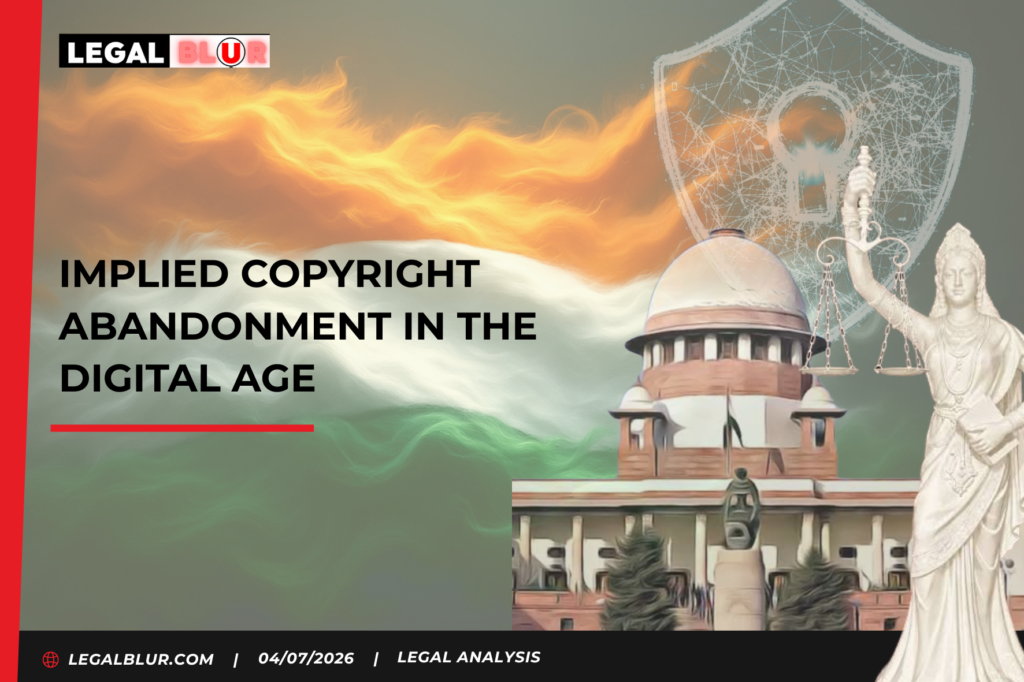
This article proposes implied copyright abandonment as a theoretical framework to explain a growing disconnect between copyright law and digital sharing practices, and evaluates whether Indian copyright law should recognize, reject, or regulate such a concept.
When an author uploads photographs to Instagram, publishes across LinkedIn and blogs, and posts code on GitHub, something legally uncomfortable happens. The author retains copyright under every applicable statute, but millions of users develop a working assumption that these works are available for free use. This assumption is not legally grounded, but it is pervasively reinforced by the architecture of sharing platforms and constitutes a genuine gap between legal doctrine and internet culture that Indian courts and lawmakers must address.
The Traditional Copyright Framework
The Copyright Act, 1957 grants authors exclusive rights under Section 14 to reproduce, publish, communicate, translate, and adapt a work. These rights vest upon creation, without registration, and endure for the author’s lifetime plus sixty years under Section 22. The Act recognises three mechanisms for sharing rights: assignment (Sections 18-19), licensing (Section 30), and compulsory licensing in specific circumstances (Sections 31-32). Fair dealing under Section 52 permits limited use for research, criticism, and reporting current events but these exceptions are narrow and purpose-specific. Nothing in the 1957 Act contemplates implicit surrender of rights through online publication. The default is clear: sharing is not licensing, and publication is not abandonment.
The Internet Reality
Instagram’s Terms of Service grant Meta a royalty-free, sublicensable licence to use content posted on the platform. GitHub’s Terms permit viewing and forking of public repositories, which many developers interpret, incorrectly, in the absence of an explicit open-source licence, as permission to incorporate code into their own projects. Reddit’s repost culture, Pinterest’s curation model, and LinkedIn’s article-sharing functionality all encourage redistribution. None of these interactions transfers the original copyright. Yet the dominant online assumption is that sharing equals permission. “If it’s on the internet, it’s free to use” is a social norm, not a legal principle and unlike most social norms, this one generates routine, invisible infringement daily.
Case Laws
Eastern Book Company v. D.B. Modak, (2008) 1 SCC 1
The Supreme Court reaffirmed that copyright is a creature of statute, and that exclusive rights under Sections 14 and 17 vest in the author by reason of creation alone, independent of how widely the work is circulated. A work uploaded to a public blog and shared across platforms retains the same copyright protection as one locked in a drawer. Wider dissemination does not dilute the right; this foundational principle is the bedrock on which any analysis of implied copyright abandonment in India must begin.
Amarnath Sehgal v. Union of India, 2005 (30) PTC 253 (Del)
Justice Pradeep Nandrajog held that an author’s moral rights under Section 57 survive even where copyright has vested in another party and the author has surrendered physical possession of the work. The Government, which held copyright in Sehgal’s mural, could not destroy it without the sculptor’s consent. The digital analogue is direct: an author who has posted a work online and lost practical control of its spread has not surrendered moral rights, still less the economic rights copyright provides. Loss of control is not abandonment.
Field v. Google Inc., 412 F.Supp.2d 1106 (D. Nev. 2006)
A US District Court held that website owners who did not deploy robots.txt exclusion protocols had granted Google an implied licence to cache their pages. The court required specific knowledge of the caching mechanism and deliberate failure to opt out not mere publication. This is one of the strongest judicial recognitions of an implied licence arising from online conduct from any major jurisdiction, and even it falls far short of abandonment: it created a limited, revocable permission within a specific technical context, not a general public right.
Svensson v. Retriever Sverige AB, Case C-466/12 (CJEU, 13 February 2014)
The CJEU held that hyperlinking to a work already freely accessible online does not constitute a “communication to the public” requiring separate authorisation. Critics have argued this implies that making content freely available online narrows the author’s subsequent control. But the Court stopped well short of recognising abandonment or implied consent beyond this single narrow right representing the outer limit of what internet accessibility can legally imply.
Google LLC v Oracle America Inc. (US Supreme Court, 2021)
In Google LLC v. Oracle America Inc. (2021), the United States Supreme Court held that Google’s reuse of portions of Oracle’s Java API constituted fair use under U.S. copyright law. Although the decision turned on the unique doctrine of fair use under U.S. law rather than implied abandonment, it demonstrates that modern digital copyright disputes are increasingly resolved through carefully defined statutory exceptions rather than assumptions that online publication diminishes copyright ownership. The judgment reinforces that digital accessibility alone does not extinguish exclusive rights.
Implied Licence, Consent, Or Nothing?
Three positions compete. First, posting with knowledge of reuse creates an implied licence under the Field approach, narrow, conduct-specific, and revocable. Second, mass online sharing creates implied consent limiting enforcement of a position no court has adopted. Third, online sharing creates no implied right; the position Indian, US, UK, EU, and Australian law uniformly support. Creative Commons licences, legally valid under Section 30, represent the correct mechanism for broad sharing. The problem is that most online content carries no such licence, yet is treated as freely available, generating routine infringement that neither authors nor platforms address.
The emergence of generative artificial intelligence further complicates the debate. Large language models and image-generation systems are trained on enormous quantities of publicly accessible online material. While availability on the internet may facilitate technical access, it does not necessarily imply legal permission for copyright use. India presently has no standalone legislation regulating AI training datasets or copyright exceptions for machine learning. Consequently, questions regarding implied consent for AI training continue to be governed by the existing Copyright Act, 1957 and general copyright principles until legislative clarification emerges.
The Indian And Comparative Position
India’s Copyright Act, 1957 has no provision on implied abandonment or the consequences of digital publication. Section 52’s fair dealing exceptions have not been expanded to cover general internet reuse. No Supreme Court ruling has addressed whether repeated online publication creates any enforceable public expectation of permission. Across comparable jurisdictions the US, UK, EU, and Australia the position is consistent: abandonment requires a clear, overt act of surrender; mere publication does not qualify. India’s law is consistent with this consensus, but unlike its counterparts, has not addressed the digital context through any statutory or judicial mechanism.
A Statutory Proposal
Three targeted reforms are proposed. First, the Copyright Act, 1957 should be amended to include a statutory presumption that online dissemination, absent an express licence or clear intent to abandon rights, does not constitute abandonment or create an implied public licence. Second, a statutory digital licensing framework analogous to Creative Commons should allow authors who wish to permit broad reuse to do so with legal clarity, while the default remains full copyright protection. Third, platforms should display copyright notices clarifying that sharing terms do not transfer the author’s underlying rights.
Conclusion
The question this article poses has a clear legal answer: no, the internet has not created a doctrine of implied copyright abandonment. Indian law, consistent with every major jurisdiction, does not recognise abandonment through conduct alone, and repeated online sharing creates no implied public licence. The rights an author holds upon creation persist, regardless of how widely the work travels online.
But naming the question matters. It identifies a real divergence between how copyright works in law and how the internet works in practice. The stronger response is not to validate the internet’s misreading of copyright, but to clarify the law and standardise voluntary digital licensing. That is a reform the Copyright Act, 1957 still awaits.
Frequently Asked Questions
1. Does uploading a work to Instagram or any social media platform mean others can freely use it?
No. Uploading grants the platform a licence to display and distribute the content through its own service. It does not grant other users any right to reproduce, adapt, or commercially exploit the work. Copyright remains with the creator unless expressly transferred or licensed.
2. What is the difference between an implied licence and implied copyright abandonment?
An implied licence is a limited, revocable permission from the copyright holder’s conduct — as in Field v. Google, where failure to block caching created a specific implied permission. Implied abandonment is a stronger concept suggesting the author has surrendered all rights. No court in any major jurisdiction has recognised implied abandonment through online posting alone.
3. Does Indian copyright law address mass online sharing?
No. The Copyright Act, 1957 has no provision on implied abandonment or the legal consequences of digital publication. Section 52’s fair dealing exceptions are narrow and purpose-specific. This statutory gap is the central concern of this article and the basis of its proposal for legislative reform.
4. Can an author voluntarily allow free use of their online content under Indian law?
Yes. Section 30 of the Copyright Act permits voluntary licensing on any terms the author chooses. Creative Commons licences are legally valid under this provision. An author may use a CC BY, CC BY-SA, or similar licence to expressly permit broad reuse. The problem is that most online content carries no such licence, yet is treated as freely available.
5. What reform does this article propose?
A statutory presumption that online dissemination alone does not constitute abandonment; a statutory digital licensing framework analogous to Creative Commons; and a platform-level obligation to display copyright notices clarifying that sharing through a platform does not transfer or extinguish the author’s underlying rights.