This article is written by Yuvika Semalti, USLLS, GGSIPU. This article represents a balanced approach towards UCC implementation in India.
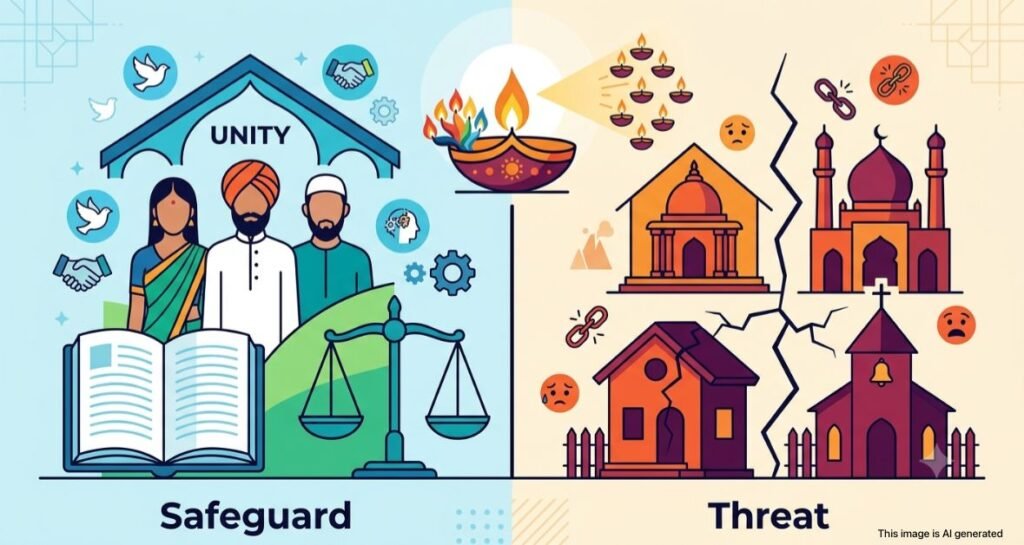
Countries with cultural diversity and multiple religious groups often face the problem of religions having their own laws to govern civil matters. UCC works as a solution to such issues. It refers to a common set of laws governing civil matters like marriage, divorce, adoption, succession, etc. It struck down religious laws existing in the country. While implementing UCC can be a move to strengthen secularism, it has been criticised for supressing religious minorities. Secular democracies like France and Turkey have implemented laws similar to UCC. In India, UCC has been in debate for a very long time, while it is still not implemented in the whole country, many state governments have introduced it in their particular state.
Keywords- UCC, Secularism, religious minorities, democracies, cultural diversity.
Constitutional Provisions
The uniform civil code was thoroughly debated in the constituent assembly. Leaders like Dr BR Ambedkar, KM Munshi, and Alladi Krishnaswamy Ayyar advocated in its favour and put forth that it would improve justice, equality, and secularism in the country, as well as decrease discrimination against women. There were some members like Nazirrundin Ahmad and Mohammad Ismail Khan who argued against it, calling it a threat that can create social unrest and take away the religious autonomy of the citizens. Due to such opposite opinions regarding UCC, it was placed under Article 44 of the Indian Constitution as a DPSP.
Article 44 of the Indian Constitution, which provides DPSP, states that “The State shall endeavour to secure for the citizens a uniform civil code throughout the territory of India.” Unlike fundamental rights, directive principles are merely advisory, thus not making them binding on the state to follow. Due to the advisory nature of directive principles, UCC cannot be demanded before a court of law as well.
Law Commission’s Views on UCC
- 21st Law Commission – The 21st Law Commission, headed by Justice Balbir Singh Chauhan, submitted its report in 2018. In its report, the commission rejected the need for a uniform civil code for the whole country. It suggested for reforms in all religious laws to improve equality and eliminate discrimination based on religious laws. Thus, the commission focused on equality and justice instead of uniformity of law.
- 22nd Law Commission – The 22nd Law Commission, headed by Justice Rituraj Awasthi, invited fresh public views and suggestions on the implementation of a Uniform Civil Code in 2023. As of now, the Commission has not submitted a final report on the subject. The consultation process seeks inputs from various stakeholders before making recommendations to the Government.
Supreme Court’s Stance on UCC
Although being a directive principle under Article 44, the Uniform civil code cannot be demanded in a court of law but that does not prevent the Supreme Court from giving its view on the matter. In various judgments, the apex court has passed its opinion on the need for a uniform law to govern civil matters. Some of those landmark judgments are –
- Mohd. Ahmed Khan Vs. Shah Bano – In this case, the Supreme Court allowed Muslim women to receive maintenance beyond the iddat period, contradicting Muslim personal laws. The Court observed that a Uniform Civil Code would help promote national integration and reduce conflicts arising from diverse personal laws, though these observations were not binding directions.
- Shayara Bano Vs. Union of India – In the landmark judgment of this case, the Supreme Court declared triple talaq as unconstitutional as it harms the fundamental right of a woman and abolished it as well. The Court declared instant triple talaq unconstitutional. Although the judgment strengthened gender justice under personal laws, it did not issue any direction regarding the implementation of a Uniform Civil Code.
- Indian Young Lawyer Association Vs. State of Kerala – In this case, the Supreme Court addressed the issue of menstruating women being banned to enter in Sabarimala temple. The judgment emphasised constitutional morality, equality and non-discrimination over exclusionary religious practices. It did not advocate or direct the implementation of a Uniform Civil Code.
Arguments in Favor of UCC
- Promotes Secularism – The UCC will promote the idea of a secular state. It will strengthen the constitutional spirit of secularism by governing all religious communities under one common law.
- Women Empowerment – Implementation of UCC will abolish all the gender discriminatory laws. The Majority of religious laws are unfair to women, and some of them also abridge their fundamental rights.
- Ease in Legal Administration – If all the religions are governed by one common law, it will take off some pressure from legal administration to juggle between different personal laws to look after civil matters properly. It will also reduce confusion in case of an inter-religious marriage or an issue involving different religions.
- Promotion of Progressiveness – All the religious laws were made centuries ago, thus they are not consistent with current practices of society. Therefore, the implementation of UCC will be looked at as a progressive step towards a modern society.
Arguments against UCC
- Religious Autonomy – Although UCC can promote secularism, it can also abridge the fundamental right, right to freedom of religion under Article 25 of the Constitution of India. It can be a threat to the religious autonomy of the citizens.
- Majoritarianism – The UCC can also pose a threat to minority religions. It is very much possible that the uniform code is similar to the laws of the majority community religion, undermining the minorities.
- Threat to Cultural Diversity – During independence, Pt. Nehru, while delivering his famous speech, Tryst with Destiny, highlighted how India’s cultural diversity makes it unique. Implementation of UCC may take away that uniqueness from it.
- Communal Unrest – Implementation of UCC might lead to severe communal unrest in the country. It can make minorities feel insecure, leading to riots and communal tensions throughout the country. Lack of consensus on UCC makes it obvious that it is a subject of unrest.
Recent Developments
The debate surrounding the implementation of the Uniform Civil Code has gained momentum in recent years. Uttarakhand became the first State after Independence to enact and implement the Uniform Civil Code through the Uttarakhand Uniform Civil Code Act, 2024. Goa continues to follow the Portuguese Civil Code, often cited as an example of a uniform civil law regime. Several States, including Gujarat, Assam, Uttar Pradesh and Madhya Pradesh, have constituted committees or expressed their intention to examine the feasibility of implementing a Uniform Civil Code. However, as of now, Uttarakhand remains the only State to have enacted a comprehensive UCC after Independence.
Way Forward
The implementation of UCC must be gradually done without offending any of the minorities. Its implementation must be an inclusive as well as transparent process, which makes every community heard and represented. It should be taken care that the majority community does not dominate. The Indian Uniform Civil Code must be drafted with utmost respect and sincerity towards the values of all the religions existing in the country. The process must include public awareness, consultation, and regular monitoring so that no one feels left behind and no one feels unjust. A haste and forceful process to implement UCC must be avoided, as it can lead to communal tensions; peace and the wellbeing of all must be prioritized.
Conclusion
All in all, UCC can be a significant step to promote secularism, equality, and women empowerment. But it can also pose a threat to cultural diversity, fundamental rights and social peace. However, if implemented with utmost care, and responsibility without making any community feel excluded, it can be seen as a progressive step towards a modern society. India, being an extremely diversified country, must gradually implement UCC guided by constitutional principles and public consensus. A thorough balance must be maintained between different groups, preventing social unrest.
Frequently Asked Questions
1. What is UCC?
Uniform Civil Code [UCC] refers to a common set of laws to deal with all the civil matters like marriage, divorce, adoption, and succession.
2. Has India adopted UCC?
No, India has not yet adopted UCC.
3. Which Constitutional Provisions include UCC?
Article 44 of the Indian Constitution includes UCC.
4. Which Indian states have adopted UCC?
As of now, Uttarakhand is the only State after Independence to enact and implement a comprehensive Uniform Civil Code. Goa continues to follow the Portuguese Civil Code, while some other States have only constituted committees or announced their intention to examine a UCC.
5. Which uniform code does Goa follow?
Goa has followed the Portuguese civil code of 1867 since its inclusion in India.
REFRENCES –
https://www.sciencedirect.com/science/article/pii/S2590291126000239
https://indiankanoon.org/doc/823221
https://archive.pib.gov.in/documents/rlink/2018/aug/p201883101.pdf