This article is written by Bhoomi Chaturvedi, Atal Bihari Vajpayee School of Legal Studies, CSJMU Kanpur. This article traces the journey of this litigation through its three rounds before the Supreme Court, examines the reasoning of the final majority judgment, and considers what the verdict means for the future of arbitration practice in India.
Arbitration has emerged as India’s preferred alternative dispute resolution mechanism because of its flexibility, efficiency, and party autonomy. This question, “What happens to an arbitration clause when the contract with it is not properly stamped under the Indian Stamp Act 1899?” has been a persistent procedural complaint for more than ten years in the life of the arbitration process, and it threatens to undermine the very promise that arbitration is a proper alternative to litigation. Can a lack of sufficient or proper stamp on the underlying agreement be the sole basis for defeating arbitration? Indian courts have sounded an entirely different tone in a series of decisions in each round, of which the Supreme Court has examined, confusing for businesses and counsel. The law was finally resolved on 13 December 2023 when the Supreme Court, in the seven-judge Constitution Bench headed by Justice Senthilkumar V, gave a definitive answer in In Re: Interplay Between Arbitration Agreements and the Indian Stamp Act 1899 (popularly known as N.N. Global III).
Case Laws
The Background
The litigation arose from a commercial dispute between N.N. Global Mercantile Pvt Ltd and Indo Unique Flame Ltd. Indo Unique invoked a bank guarantee furnished under a work order, prompting N.N. Global to resist the invocation. When Indo Unique sought reference to arbitration under Section 8 of the Arbitration and Conciliation Act 1996, the question arose whether the arbitration clause survived even though the underlying work order itself had not been stamped.
N.N. Global I (2021)
Under the doctrine of separability, a three-judge bench presided by Justice Indu Malhotra said that an arbitration agreement is a distinct document from the underlying commercial agreement, and thus would not be extinguished if the commercial agreement were not in itself stamped. That was not, however, consistent with the previous two-judge bench rulings of SMS Tea Estates v Chandmari Tea Co and Garware Wall Ropes v Coastal Marine Constructions & Engineering, which held that an unstamped instrument containing an arbitration clause was incapable of being enforced. Seeing this as a conflict, the three-judge bench asked a five-judge Constitution Bench to answer the question.
N.N. Global II (25 April 2023)
The Constitution Bench, by a majority of 3:2, reversed N.N. Global I. Most of the Justices, led by Justice K.M. Joseph, found that the instrument in question, which was chargeable for stamp duty but not stamped, cannot be considered as a “contract” under Section 2(h) of the Indian Contract Act 1872, and, therefore, the same cannot be said to be an ‘arbitration clause’ enforceable in law. Most of them reiterated the SMS Tea Estates and Garware, pointing out that before a court can consider an application under Section 11 of the Companies Act, 1950, the court has to impound an unstamped instrument under Section 33 of the Stamp Act. Justices Ajay Rastogi and Hrishikesh Roy, however, dissented, saying that this would make the arbitration process unnecessarily cumbersome and create a situation where judicial intervention at the very first stage will be inevitable, which would defeat the spirit of the 2015 amendment in Section 11(6A) of the Act.
Reference to a Seven-Judge Bench
The 3:2 decision was not going to end the controversy. A five-judge bench noted the sweeping commercial implications of the case of N.N. Global II and remanded the narrow issue of what the effect of non-stamping relates to arbitration agreements would be to a seven-judge bench, while a curative petition in Bhaskar Raju and Brothers v Dharmaratnakara Rai Bahadur Arcot Narainswamy Mudaliar Chattram & Other Charities was pending.
N.N. Global III (13 December 2023)
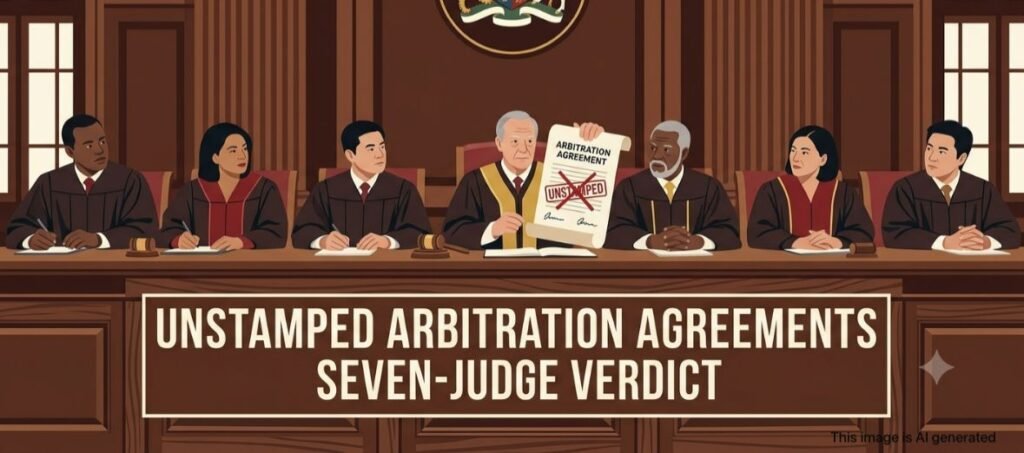
Writing for the majority, Chief Justice D.Y. Chandrachud, along with Justice Sanjiv Khanna, who gave a concurring opinion, unanimously dismissed N.N. Global II. The seven-judge bench said that non-stamping or improper stamping of an instrument makes it inadmissible in evidence but not makes it void or non-existent. The defect can be corrected by paying the duty and the penalty and an arbitration clause which forms part of such an instrument may be invoked in spite of any defect. The Court also ruled that, following the principle of minimal judicial interference in the arbitration process, and the doctrine of kompetenz-kompetenz, the courts at the first stage of the referral under Section 8, 9 and 11 of the Arbitration Act need not consider the objection to stamping.
Doctrine of Separability Reinforced
The doctrine of the separability of an arbitration clause, which holds that the clause is an independent contract which will stand alone from the contract from which it arises, is clearly reaffirmed. The Court restricted the scope of judicial review at the referral stage to what was essential, and deferred the review of objections concerning the stamping, validity and enforceability of the arbitration agreement to the stage of enforcement of the award before the arbitral tribunal, or, if relevant, a court.
Significance for Commercial Practice
The decision is significant for at least three reasons. First, it restores predictability for parties seeking interim relief or appointment of an arbitrator, since courts can no longer be drawn into prolonged disputes over stamp duty at the threshold stage. Second, it reaffirms India’s pro-arbitration posture, aligning domestic jurisprudence with the minimal-interference philosophy that the 2015 and 2019 amendments to the Arbitration Act sought to introduce. Third, by treating the stamping objection as curable rather than fatal, the Court ensured that genuine commercial disputes are not defeated on a technicality unrelated to the merits of the underlying claim.
Conclusion
Five years ago, the Supreme Court was asked a question which went through three rounds of review in just two years before N.N. Global III delivered welcome finality. The seven-judge panel found that the stamp duty was not a contractual matter, but merely a question of who has to pay it, helping to eliminate a major procedural obstacle that had prevented an arbitrator from moving forward on arbitration proceedings despite an unwilling party. The decision also marks a clear message to the legislature: The stamping regime under a colonial-era law needs to be updated to meet the needs of modern commercial dispute resolution. In my view the safest approach for the practitioners should be to ensure that contracts and, where possible, the arbitration provisions in contracts are properly stamped when executed, as the curative option, although now available, is still time and cost consuming. However, the Supreme Court’s decisions to limit the role of threshold stamping objections to the arbitral tribunals, instead of the courts, represent a significant step towards ensuring that arbitration becomes more streamlined and independent in India and moves in line with best practices around the world.
Frequently Asked Questions
1. What did the Supreme Court decide in N.N. Global III?
The seven-judge bench held that an unstamped or insufficiently stamped arbitration agreement is not void; it is merely inadmissible in evidence until the stamp duty is paid, and the defect is curable.
2. Does this mean parties can ignore stamp duty altogether?
No. Stamp duty remains payable, and the document may still be impounded under the Stamp Act. The ruling only clarifies that non-payment does not destroy the arbitration agreement itself or bar reference to arbitration at the threshold stage.
3. Which earlier decision was overruled?
The judgment overruled N.N. Global II, (2023) 7 SCC 1, and departed from the reasoning in SMS Tea Estates and Garware Wall Ropes to the extent they treated an unstamped arbitration clause as non-existent.
4. Who decides the stamping objection now?
The arbitral tribunal, not the referral court, decides issues relating to stamping, consistent with the doctrine of kompetenz-kompetenz and the principle of minimal judicial interference under Section 5 of the Arbitration and Conciliation Act 1996.
5. What is the practical takeaway for drafters of commercial contracts?
Parties should ensure that contracts, and any standalone arbitration agreements, are duly stamped at the time of execution, since curing the defect later still involves delay, impounding procedures, and additional cost.