This article is written by Abha Bajpai, Atal Bihari Vajpayee School of Legal Studies, CSJMU Kanpur.
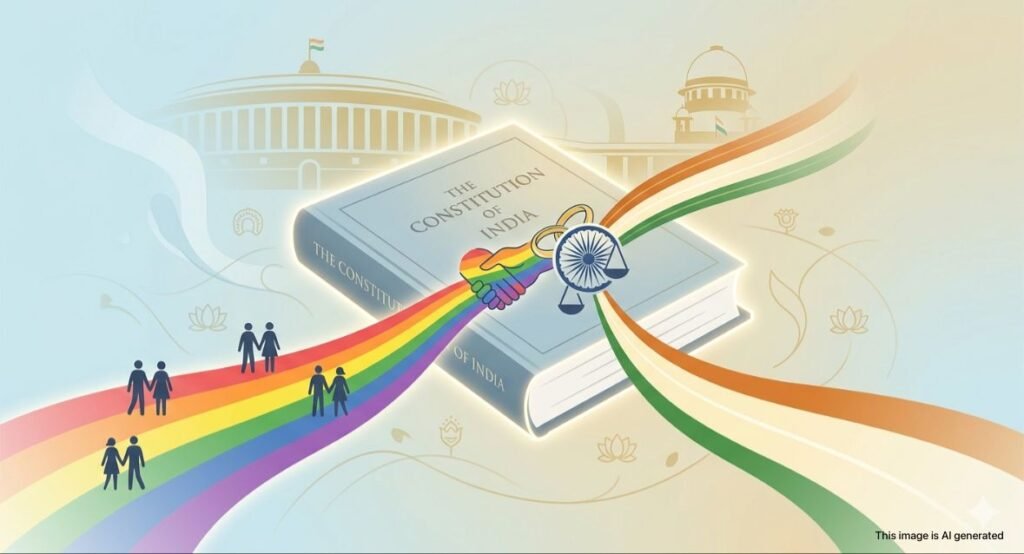
Who has the authority to redefine a foundational social institution in a constitutional democracy? This question was central to Supriyo @ Supriya Chakraborty & Anr. v. Union of India, W.P. (Civil) No. 1011 of 2022, decided on 17 October 2023. A five-judge Constitution Bench comprising Chief Justice D.Y. Chandrachud and Justices Sanjay Kishan Kaul, S. Ravindra Bhat, Hima Kohli, and P.S. Narasimha delivered four separate opinions, reflecting the complexity of the constitutional issues involved.
The petitioners, primarily LGBTQIA+ couples and activists, sought recognition of same-sex marriages under the Special Marriage Act, 1954, arguing that exclusion violated Articles 14, 15, 19, and 21 of the Constitution. Their claims relied on Navtej Singh Johar v. Union of India (2018) and Justice K.S. Puttaswamy v. Union of India (2017), which recognized sexual autonomy and privacy as protected constitutional rights.
By a 3:2 majority, the Court refused to recognize a fundamental right to marry or extend the SMA to same-sex couples. The majority held that such institutional reform falls within Parliament’s domain under the separation of powers. Nevertheless, the judgment significantly contributed to debates on constitutional morality, judicial restraint, and LGBTQIA+ rights in India.
Case Laws and Legal Analysis
- Constitutional Foundations and Precedent
The petitioners’ case rested on a developing chain of precedents. In National Legal Services Authority v. Union of India, (2014) 5 SCC 438, the Supreme Court recognised that transgender persons have the right to self-identify their gender and that dignity under the Constitution is not confined to binary gender categories. Then in Justice K.S. Puttaswamy (Retd.) v. Union of India, (2017) 10 SCC 1, a nine-judge Bench unanimously held that privacy is a fundamental right under Article 21, expressly covering decisional autonomy in intimate matters, including sexual orientation.
This line of reasoning culminated in Navtej Singh Johar v. Union of India, (2018) 10 SCC 1, where a five-judge Bench read down Section 377 of the IPC, decriminalising consensual same-sex conduct. The Court in Navtej held that sexual orientation is innate and that the LGBTQIA+ community enjoys the full sweep of constitutional protections. Building on this, the petitioners in Supriyo argued that if the State could no longer penalise same-sex intimacy, it was obligated to provide equal access to marriage, which carries with it over 150 statutory entitlements spanning inheritance, adoption, taxation, and medical decision-making.
- The Majority: Institutional Restraint and Legislative Primacy
Justice S. Ravindra Bhat, writing for the majority, distinguished between enforcing existing constitutional rights and creating new legal entitlements. The Court held that marriage is not a fundamental right under the Constitution but a statutory institution regulated through laws such as the Hindu Marriage Act, 1955 and the Special Marriage Act, 1954.
Regarding the interpretation of the SMA, the majority held that Section 4, which refers to marriage between a “male” and a “female,” could not be replaced with gender-neutral terms by judicial intervention. Such a change would amount to judicial legislation and exceed the Court’s constitutional role. The Bench also noted that recognizing same-sex marriage would require broader amendments affecting adoption, taxation, and succession laws, matters requiring legislative consideration.
- The Minority: Marriage as a Fundamental Right
Chief Justice D.Y. Chandrachud, with Justice Sanjay Kishan Kaul largely in agreement, took a broader view of the Constitution. In the Chief Justice’s reading, the right to marry a person of one’s choice flows naturally from Articles 19(1)(a), 21, and 14 read together. If Puttaswamy protects decisional autonomy in intimate matters, the right to formalise that intimacy through marriage is constitutionally implied. Denying marriage rights to same-sex couples, he argued, is not legislative neutrality but outright discriminatory exclusion, one that sustains the same stigma Navtej sought to dismantle.
Chief Justice Chandrachud also directed the Central Government to set up a high-powered committee to look into extending rights and entitlements to queer couples. The majority did not endorse this direction, but it nonetheless carries persuasive weight as a clear signal to the executive.
- Constitutional Morality and Precedential Significance
Doctrinally, Supriyo develops the idea of constitutional morality, reaffirming that constitutional values of equality and dignity must prevail over majoritarian views, as recognized in Navtej. While the Court declined to create a new framework for same-sex marriage, all five judges unanimously affirmed that LGBTQIA+ persons enjoy the full protection of fundamental rights. The disagreement was not about the legitimacy of queer rights but about the appropriate institutional mechanism for securing them. The judgment therefore leaves open future challenges concerning whether prolonged legislative inaction on equality issues may itself amount to an unconstitutional omission.
Conclusion
Supriyo v. Union of India occupies a unique position in Indian constitutional law: while the Court denied immediate relief, it preserved the broader constitutional claims of LGBTQIA+ equality. The majority’s reliance on separation of powers reflects the view that reforms to a fundamental institution like marriage should emerge through legislative action. However, the unanimous recognition of queer constitutional dignity, the minority’s view of marriage as a fundamental right, and the resulting pressure on lawmakers represent important developments in equality jurisprudence.
The judgment leaves several issues unresolved, including legislative inaction, adoption rights, and State obligations toward non-heterosexual unions. Thus, Supriyo is not an endpoint but an ongoing constitutional dialogue on equality, dignity, and the transformative vision of the Constitution.
Frequently Asked Questions
1. What was the primary legal question in Supriyo v. Union of India?
The Court was asked to determine whether LGBTQIA+ couples hold a constitutionally protected right to marry, and whether the Special Marriage Act, 1954 could be judicially reinterpreted to include same-sex unions. The right to joint adoption by queer couples was also examined.
2. Did the Supreme Court hold that LGBTQIA+ persons lack fundamental rights?
No. All five judges unanimously affirmed that every member of the LGBTQIA+ community is entitled to the full range of constitutional rights, including equality, dignity, privacy, and non-discrimination. The disagreement was confined to whether those rights extend to a judicially recognized right to same-sex marriage.
3. What is the significance of the 3:2 split verdict?
The split reflects a genuine tension between judicial activism, which favours expanding rights through creative interpretation, and institutional restraint, which insists that complex social reforms be left to elected legislatures. The minority’s recognition of marriage as a fundamental right constitutes significant judicial reasoning that could anchor constitutional challenges down the line.
4. What is the practical effect of the judgment on the LGBTQIA+ community?
Immediately, same-sex couples still lack access to statutory marriage and its associated rights, including spousal inheritance, joint adoption, and medical proxy authority. That said, the judgment places considerable pressure on Parliament and the executive to address these gaps. Chief Justice Chandrachud’s direction for a governmental committee suggests that at least some relief may be achievable through administrative action, even without formal legislative reform.
5. How does Supriyo connect to earlier judgments such as Navtej and Puttaswamy?
Supriyo is best understood as the third part of a constitutional trilogy. Puttaswamy (2017) established that privacy and sexual autonomy are fundamental rights. Navtej (2018) relied on that to decriminalise same-sex conduct. Supriyo (2023) then asked whether those rights collectively compel the State to recognise same-sex marriages. The majority said no, at least not through judicial action at this stage, but the minority’s reasoning keeps the constitutional argument for marriage equality alive and well for future proceedings.