
This article is written by Priyam Pratik, Faculty of Law, University of Allahabad. This article traces the background of the dispute, the earlier judgments that shaped the debate, the reasoning of the 2024 verdict, and what it means for the future of mineral taxation in India.
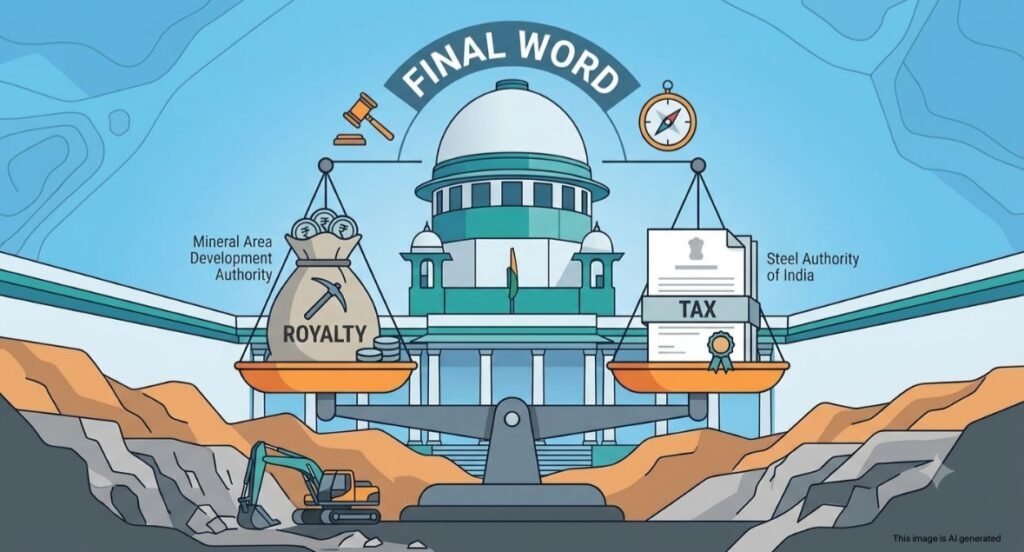
Royalty or Tax? The Supreme Court’s Final Word on Mineral Rights in Mineral Area Development Authority v. Steel Authority of India
For close to three and a half decades, mining firms and state administrations in India remained locked in an unsettled struggle over a question that appeared straightforward but carried massive financial stakes. Is royalty paid by a mining lease holder a tax, or is it a contractual payment for the right to extract minerals from the land? States have long argued they possess the constitutional power to tax mineral rights independently of any royalty fixed by the Centre, while mining companies and the Union have insisted that the Mines and Minerals (Development and Regulation) Act, 1957, leaves no room for any additional state levy.
This long-pending controversy finally reached its conclusion in July 2024, when a nine-judge Constitution Bench of the Supreme Court delivered its verdict in Mineral Area Development Authority and Another v. Steel Authority of India and Others. The ruling overturned a precedent that had governed the field for over three decades and reshaped the fiscal relationship between states and the mining industry.
Keywords: Mineral royalty, Mines and Minerals (Development and Regulation) Act 1957, State legislative power, Constitution Bench, Mineral taxation
Case Laws
The Constitutional Background
The dispute stems from the division of powers under the Seventh Schedule. Entry 54 of the Union List lets Parliament regulate mines and mineral development where it considers this expedient in the public interest. Entry 23 of the State List lets states regulate mines, subject to Entry 54. Entry 50 of the State List separately allows states to tax mineral rights, but subject to any limitations Parliament imposes through a law on mineral development.
Parliament used its Entry 54 power to enact the Mines and Minerals (Development and Regulation) Act, 1957, the MMDR Act. Section 9 authorises the Centre to fix and revise royalty payable by mining lease holders. Courts struggled for decades over whether this central law stripped states of power under Entry 50 to impose any further tax connected to mineral rights, since royalty itself was sometimes treated as a species of tax.
India Cement Ltd. v. State of Tamil Nadu (1989)
A seven-judge bench in India Cement Ltd. v. State of Tamil Nadu first ruled on this issue. Tamil Nadu had imposed a cess as a percentage of royalty, layering a state levy on top of royalty already fixed under the MMDR Act. The Court held that royalty is itself a tax, and since Section 9 already occupies the field, any further levy on royalty amounts to an impermissible tax on mineral rights under Entry 50. This view stood as settled law for over thirty years.
State of West Bengal v. Kesoram Industries Ltd. (2004)
A five-judge bench in State of West Bengal v. Kesoram Industries Ltd. took a different view, suggesting royalty and tax are conceptually distinct, and that a cess on mineral bearing land could validly be levied as a tax on land under Entry 49 rather than under Entry 50. It also suggested India Cement may have erred in equating royalty with tax. Since a five-judge bench cannot overrule a seven-judge bench, the position remained muddled, with courts following inconsistent approaches.
Reference to the Nine Judge Bench
Given this conflict, a three-judge bench in 2011, in Mineral Area Development Authority v. Steel Authority of India, referred the matter to a larger bench, asking whether royalty is a tax, whether the MMDR Act excludes state taxation under Entry 49, and whether states retain residual power under Entry 50. The matter eventually reached a nine-judge Constitution Bench, which heard the Union, several mineral-rich states, and major mining and steel companies, including Steel Authority of India.
The 2024 Verdict: Mineral Area Development Authority v. Steel Authority of India
On 25 July 2024, the nine-judge bench, by an eight-to-one majority, ruled that royalty under the MMDR Act is not a tax. Royalty arises from a contractual relationship between the lessor, often the state, and the lessee, the mining operator, and is payment for the enjoyment of granted rights rather than a sovereign exaction.
The majority held that Entry 50 is a distinct and independent source of power letting states tax mineral rights. Parliament fixing royalty under Section 9 does not by itself remove this power; Parliament must impose an express restriction, which the MMDR Act currently does not. India Cement, to the extent it equated royalty with tax, was held incorrect and overruled. The majority also clarified that Entry 49 covers general land taxation, while a tax on mineral bearing land assessed by mineral value falls more naturally under Entry 50.
Justice B.V. Nagarathna dissented⁵, aligning with India Cement. Justice Nagarathna’s dissent warned that framing royalty as purely contractual could lead to a patchwork of state levies, eroding the MMDR Act’s goal of a consistent national policy, and could spark mineral-rich states into a competitive cycle of raising cesses, pushing up costs for industries dependent on steel and cement.
The Retrospective Application Order
Weeks later, the same bench ruled that states may recover dues retrospectively from 1 April 2005, staggered over twelve years from 1 April 2026, with no interest or penalty for the period before the judgment. This exposes mining companies to liabilities running into thousands of crores while boosting revenue for states like Odisha, Jharkhand, and Chhattisgarh.
Conclusion
The verdict marks a significant shift in Indian fiscal federalism. By holding royalty is not a tax and that Entry 50 gives states independent taxing power over mineral rights, the Court has opened a substantial new revenue source for mineral rich states, overturning an understanding that companies had relied on for over three decades.
Yet the ruling raises concerns about uniformity in mineral pricing, since varying state cesses could affect raw material costs for steel, cement, and power, creating friction with the Centre. The retrospective application, even staggered, also means companies must reassess provisioning for liabilities once considered closed.
Much now depends on whether Parliament amends the MMDR Act to place express limits on this taxing power, balancing state interests against the need for a predictable national mineral policy.
Frequently Asked Questions
1. What was the core issue in Mineral Area Development Authority v. Steel Authority of India?
Whether royalty under the MMDR Act, 1957 is a tax, and whether states have an independent power under Entry 50 of the State List to tax mineral rights despite this central law.
2. What did the Supreme Court finally decide?
By an eight to one majority, the nine judge bench held that royalty is not a tax but a contractual payment, and that states have an independent power under Entry 50 to tax mineral rights unless Parliament expressly limits it.
3. Which earlier judgment was overruled by this decision?
It overruled the relevant part of India Cement Ltd. v. State of Tamil Nadu (1989), which held that royalty is a tax and that the MMDR Act fully occupies the field, excluding state taxing power under Entry 50.
4. Does the ruling apply to past periods, or only from 2024 onwards?
A subsequent order allowed states to recover dues retrospectively from 1 April 2005, staggered over twelve years from 1 April 2026, with no interest or penalty for the period before the judgment.
5. What is the likely impact on mining companies and mineral rich states?
States such as Odisha, Jharkhand, Chhattisgarh, and West Bengal stand to gain significant revenue, while mining companies and downstream industries like steel and cement may face higher costs and past liabilities.