This article is written by Kashish Yadav, B.A. LL.B. (Hons.) 3rd Year, 5th Semester, CSJM University. This article highlights the legal structure of the POCSO Act, reviews the recent judgment of the Supreme Court as well as the respective High Court orders, and looks at the implications of the trend of judgments given by the courts in the field of child rights in India.
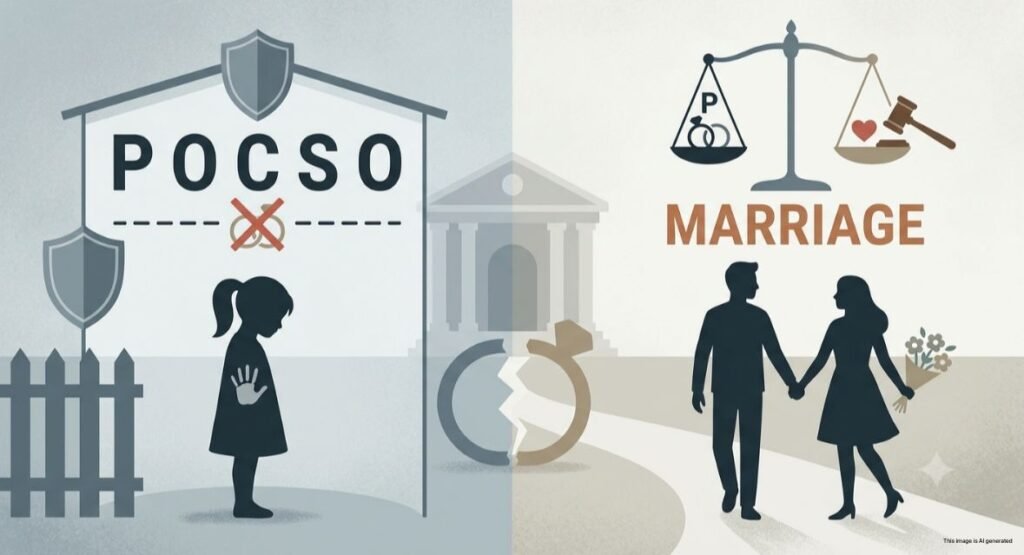
Quashing POCSO Convictions Upon Subsequent Marriage: Judicial Compassion or a Threat to Child Protection?
The Parliament of India enacted the Protection of Children from Sexual Offences Act, 2012 (POCSO Act) with the clear objective of providing strong legal protection to children below eighteen years of age from sexual abuse, exploitation, and harassment. The act is in keeping with India’s commitments to the United Nations Convention on the Rights of the Child (UNCRC), 1989.
In June 2026, the Supreme Court of India, exercising its extraordinary powers under Article 142 of the Constitution, set aside the conviction and ten-year imprisonment of a man convicted in accordance with Section 5(1) of the POCSO Act. The Court observed that the victim had attained the age of majority, married the accused, and they are living together as husband and wife. This judgment has sparked a serious legal and social debate: Does a conviction under the POCSO Act get annulled only if the accused and the victim get married?
Is this the right thing to do to ensure complete justice as guaranteed by the Constitution, or is it a slippery slope that will effectively allow child sexual abuse and encourage child marriage?
LEGAL FRAMEWORK: THE POCSO ACT, 2012
POCSO Act, 2012 is a comprehensive Act which provides a definition and punishment for many sexual offences against children. The Act, which had come in the wake of disturbing statistics of child sexual abuse, contained some major deviations from the previous framework of laws as provided in the Indian Penal Code, 1860 (now replaced by Bharatiya Nyaya Sanhita, 2023).
Key features of the Act include:
- a gender-neutral definition of the victim;
- mandatory reporting under Section 19;
- presumptions under Sections 29 and 30;
- establishment of Special Courts for speedy trials; and
- stringent punishment for aggravated penetrative sexual assault under Sections 5 and 6.
This is reiterated by the Prohibition of Child Marriage Act, 2006, which states that marriage of a person who is under the legal age of marriage is voidable. When considered together, these laws convey a clear legislative message that children are to be safeguarded against all forms of exploitation, even through marriage.
III. CASE LAWS AND JUDICIAL ANALYSIS
A. Supreme Court Judgment (June 2026) — Article 142 and Quashing of POCSO Conviction
In the most widely discussed case of June 2026, a bench of the Supreme Court comprising Justices J.K. Maheshwari and Atul S. Chandurkar invoked Article 142 of the Constitution to set aside the conviction and sentence of the appellant under Section 5(1) of the POCSO Act. The accused had been sentenced to ten years of rigorous imprisonment, and the Madras High Court had declined to interfere with the conviction.
The background of the facts was very strange; the victim and the accused were in a relationship during his class XII. Initially, he refused to marry her, and she filed a complaint and he was convicted. The victim thereafter married again and after her fiancé found out about her other marriage, he left her. After she reached the age of majority, the accused and the victim reconciled and married each other. A compensation of Rs. 10,00,000 was also paid to the victim. The case was brought before the Supreme Court by the victim herself who applied for quashing of the proceedings.
The Supreme Court, noting that “the peculiar facts of the case and the parties’ right to ‘live a peaceful life’ was given a stay of the conviction. Importantly, the Court stated it would “not consider the order a precedent. Although this is important under the law, it has been unsuccessful in debunking the fear that these orders give to society.
B. Ayyub Malik v. State of Uttarakhand, 2026 SCC OnLine SC 637
In this earlier judgment by the Supreme Court, the Court examined the impact of re-marriage of accused and birth of a child by both the parties on the continuation of the POCSO proceedings. That when such is the case, the continuance of the criminal trial would be an unnecessary interruption of life of the parties. After the prosecutrix (aged 15 at the time of alleged offence) married the accused and was seven months pregnant, the Bombay High Court in May 2026, relied upon this precedent, cancelled the POCSO proceedings. Bombay HC said there was “not a single whisper of force” in the prosecutrix’s case and that both sides had reached a compromise.
C. Ishwar Chand Sharma & Others v. State — Weaponisation of POCSO in Matrimonial Disputes
In a separate judgment delivered in June 2026, Justices B.V. Nagarathna and Ujjal Bhuyan quashed more than ten criminal proceedings, including those under the POCSO Act, in a case rooted in a bitter matrimonial dispute. The Court expressed deep concern about the growing tendency to weaponise the POCSO Act as an instrument of personal vendetta in matrimonial conflicts. It observed that while child protection laws are indispensable, their deliberate misuse for ulterior motives gravely undermines both justice and the credibility of the legal system.
D. Delhi High Court — A Humanitarian Perspective on Adolescent Relationships
The Delhi High Court, in a matter involving a 19-year-old man and a 17-year-old girl who had married voluntarily and had a newborn child, closed the POCSO proceedings on humanitarian grounds. Justice Anish Dayal observed that if the proceedings were not quashed, the lives of three individuals, the couple and their infant, would be irreparably damaged. The Court’s reasoning reflected a pragmatic assessment of the best interests of the child (the newborn) against strict enforcement of the POCSO provisions in adolescent consensual relationships.
CRITICAL ANALYSIS: BALANCING CHILD PROTECTION AND COMPLETE JUSTICE
The judicial trend reflected in the above cases raises profound questions about the tension between child protection law and the court’s equitable jurisdiction. On one hand, Article 142 grants the Supreme Court expansive powers to do “complete justice” in any cause before it. This power, by its nature, transcends ordinary statutory limitations and allows the Court to mould relief according to the demands of conscience and equity in a given case.
On the other hand, critics rightfully argue that allowing marriage itself, often a product of coercion, social pressure, or community compulsion on the victim to serve as a basis for negating a lawfully awarded conviction, creates a dangerous incentive structure. It potentially encourages accused persons or their families to pressure or coerce a marriage with the victim to engineer the quashing of POCSO proceedings. This concern is further magnified by the fact that child marriages are themselves illegal and that young girls in such situations may not be exercising genuine free will.
The Supreme Court’s own caveat that its June 2026 order is not a precedent underscores the legal tension inherent in such decisions. A judgment that cannot be cited as precedent is formally confined to its own facts. Yet the very act of quashing a POCSO conviction because of a subsequent marriage communicates to society consciously or otherwise that such a route is at least available to the accused, if not encouraged.
CONCLUSION
The POCSO Act was enacted as a zero-tolerance instrument against child sexual abuse. The series of judicial decisions in 2026, most prominently the Supreme Court’s invocation of Article 142 to quash a POCSO conviction following the victim’s marriage to the accused, reflects the judiciary’s attempt to reconcile strict legislative mandates with the lived realities of parties before it. While the impulse towards compassion and family stability is understandable, courts must be cautious not to create a legal loophole that undermines the very foundation of child protection law in India.
A more structured approach is desirable: the legislature and the Supreme Court could consider framing comprehensive guidelines on when, if ever, it is constitutionally permissible to quash POCSO proceedings in view of a subsequent marriage. Such guidelines must ensure that these decisions do not function as a backdoor mechanism for legalising child marriage or incentivising coercive settlements. Until then, each such case must be decided with utmost caution, keeping the best interests of the child as mandated by the UNCRC and the Indian Constitution at the very centre of judicial reasoning.
In sum, justice for the child must not be sacrificed at the altar of convenience. The law must evolve in a manner that protects, rather than abandons, the most vulnerable members of society.
FREQUENTLY ASKED QUESTIONS
1. What is the POCSO Act and who does it protect?
The Protection of Children from Sexual Offences (POCSO) Act, 2012 is a special legislation protecting children below eighteen years from sexual abuse, harassment, and exploitation. It applies to all children regardless of gender, and renders the consent of a minor legally irrelevant.
2. Can a POCSO case be quashed if the accused and the victim get married?
Ordinarily, courts do not quash POCSO cases on the ground of marriage alone, given the Act’s protective mandate. However, in exceptional cases involving peculiar circumstances such as a consensual relationship, subsequent marriage on attaining majority, and the victim’s own request to quash the Supreme Court has, in rare instances, exercised Article 142 powers to quash proceedings, while expressly clarifying that such orders are not precedents.
3. What is Article 142 of the Constitution of India?
Article 142 empowers the Supreme Court to pass any decree or order necessary for doing “complete justice” in any cause or matter pending before it. It is an extraordinary and plenary power allowing the Court to go beyond the limitations of existing statutes to ensure substantial justice in a particular case.
4. Does marriage to the victim legalise the sexual offence under POCSO?
No. Marriage does not legalise or retrospectively justify a sexual offence committed against a minor. The Supreme Court has consistently clarified that any order quashing POCSO proceedings in such circumstances is based strictly on the unique facts of that case and does not establish a general principle.
5. What safeguards exist to prevent misuse of this judicial trend?
Courts are required to carefully assess the voluntariness of the marriage, absence of coercion on the victim, and whether the victim herself is seeking quashing. The Supreme Court’s consistent clarification that such orders are not precedents is an important safeguard, though legal scholars argue for more comprehensive legislative or judicial guidelines in this developing area.