This article is written by Ayushman Anand, Vivekananda Institute of Professional Studies- Technical Campus.
Keywords: International Commercial Arbitration, Section 29A, Arbitration and Conciliation Act, Time Limits, Supreme Court of India
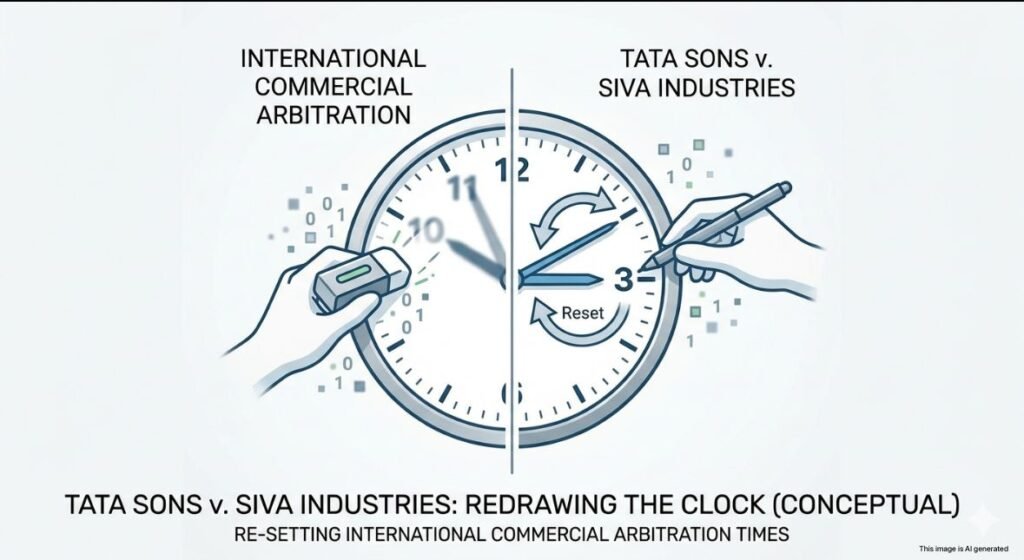
TATA Sons v. Siva Industries: Redrawing The Clock On International Commercial Arbitration
Arbitration sells itself on speed, a way to escape the years a civil suit can take in an overburdened court. But speed and fairness don’t always pull together, and nowhere is that tension sharper than in Section 29A of the Arbitration and Conciliation Act, 1996, the provision putting a clock on how long a tribunal can take to deliver an award.
That clock was tested directly in TATA Sons (P) Ltd. v. Siva Industries and Holdings Ltd., decided by the Supreme Court on 5 January 2023. The case didn’t involve a runaway tribunal or a deliberately delayed award. It involved something messier a respondent pulled into insolvency mid-arbitration, a moratorium freezing everything, and a 2019 amendment that changed the rules for international commercial arbitration specifically.
What the Court decided shapes how Indian courts now read Section 29A for cross-border disputes, and shows how far Indian arbitration law will bend procedural rigidity to avoid punishing parties for delays nobody could control.
The Section 29A Clock
When Section 29A was inserted in 2015, it gave tribunals 12 months from the date of reference to make an award, extendable by 6 months with consent, and beyond that only with court permission on sufficient cause. The provision fixed a real problem arbitrations in India had a reputation for dragging on for years, defeating the point of choosing arbitration over litigation. But the deadline applied uniformly to every arbitration, domestic or international, regardless of complexity.
That changed with the Arbitration and Conciliation (Amendment) Act, 2019, effective 30 August 2019. The amendment carved out a separate rule for international commercial arbitration disputes involving at least one foreign party under Section 2(1)(f), stating the award “may be made as expeditiously as possible” and tribunals should merely “endeavour” to finish within 12 months of completing pleadings. That word, endeavour, turned a mandatory deadline into an aspirational one for cross-border disputes.
Case Laws
TATA Sons (P) Ltd. v. Siva Industries and Holdings Ltd., (2023) 5 SCC 421
The dispute traces to a 2006 share subscription agreement between TATA Sons, Siva Industries, and TATA Teleservices Ltd. When disagreements surfaced, TATA Sons approached the Supreme Court under Section 11, and Justice (Retd.) S.N. Variava was appointed Sole Arbitrator, directed to render an award within a year. In July 2019, the NCLT admitted Siva Industries into insolvency proceedings at a creditor bank’s instance, triggering a moratorium that froze the arbitration. Siva Industries wasn’t released until June 2022, by which point the arbitration had stalled for nearly three years through no fault of either party.
Meanwhile, the 2019 amendment had come into force. TATA Sons argued that, since Siva Industries’ promoter resided outside India, the dispute qualified as an international commercial arbitration, so the amended, non-mandatory Section 29A(1) applied and the tribunal could continue without a formal extension application. The Supreme Court, through Chief Justice D.Y. Chandrachud and Justice P.S. Narasimha, agreed. Reading the shift from a flat 12-month mandate to “endeavour may be made,” the Court held this signalled a deliberate choice to exempt international commercial arbitrations from the strict timeline, leaving 12 months mandatory only for domestic arbitrations going forward.
The harder question was whether this lenient version even applied to an arbitration begun years earlier. The Court answered yes: removing a mandatory deadline doesn’t create a new right or strip an old one; it simply changes how proceedings are conducted. Being remedial, the amendment applied to all arbitrations pending as of its effective date, 30 August 2019, including the TATA Sons-Siva Industries arbitration, clearly still pending then.
Hitendra Vishnu Thakur v. State of Maharashtra, (1994) 4 SCC 602
Not an arbitration case, a criminal law decision the TATA Sons bench relied on for the retrospectivity question. It distinguished substantive from procedural amendments: a person has a vested right in substantive law, but no comparable right in procedure, so procedural amendments can generally apply to pending proceedings unless they create a fresh disability. That distinction did the heavy lifting here. Section 29A(1) only changes the timeline of arbitration, not any substantive right, so it could apply to an arbitration already underway.
BCCI v. Kochi Cricket Pvt. Ltd., (2018) 6 SCC 287
An earlier decision on a similar transitional question over a different part of the 2015 amendment, Section 26, governing whether the amended Act applied to proceedings begun before it took effect. A two-judge bench distinguished arbitral proceedings from court proceedings “in relation to” arbitration, holding the amendment prospective but reaching into ongoing court proceedings tied to older arbitrations. The case shows the Supreme Court has repeatedly had to draw fine lines around how far arbitration-amendment provisions reach backwards, just as TATA Sons later did for Section 29A.
Rohan Builders (India) Pvt. Ltd. v. Berger Paints India Ltd., 2024 INSC 686
Decided over a year after TATA Sons, this case pushed the same philosophy further for domestic arbitration. Several High Courts held that a Section 29A(4) extension application had to be filed before the deadline expired; once the clock ran out, the tribunal’s mandate was simply over. The Supreme Court, through Justice Sanjiv Khanna, disagreed, holding such applications maintainable even after the period lapses, since an absolute cut-off would produce the technical, unworkable outcomes Section 29A was never meant to create. Courts must apply a “sufficient cause” standard, and may reduce a tribunal’s fees for delay attributable to it. The message, read alongside TATA Sons, is consistent: the clock serves the arbitration, not the other way around.
What This Means For Arbitration Practice
For practitioners handling cross-border disputes seated in India, TATA Sons removed a real source of anxiety. Before this ruling, an international arbitration nearing its 12-month mark technically needed a formal extension application even if both parties were happy to let the tribunal keep working, a procedural hurdle adding cost and delay. After TATA Sons, that hurdle is gone for genuinely international disputes; the tribunal can proceed, guided by reasonable diligence rather than a fixed deadline.
The flip side is that this flexibility doesn’t extend to domestic arbitrations, where the 12-month period still governs strictly. Rohan Builders softened the procedural edges there too, by allowing late-filed extension applications, but didn’t touch the substantive requirement. Practitioners need to know which regime they’re in before assuming either case offers a shortcut.
Conclusion
TATA Sons v. Siva Industries answered a narrow technical question: Does the relaxed Section 29A timeline reach back to cover arbitrations already in progress, but the answer reflects something larger about how the Supreme Court treats procedural deadlines in arbitration. A deadline exists to discourage delay, not to punish parties for delay caused by circumstances outside their control, like an insolvency moratorium nobody asked for. Read with Rohan Builders two years later, the trend is clear: Indian courts increasingly treat Section 29A’s timelines as tools serving justice, not technical traps.
That doesn’t mean the deadline is meaningless. Domestic arbitrations remain bound by a strict 12-month period, and courts still insist on sufficient cause before granting any extension. What has changed is the presumption that courts no longer let a missed date derail an arbitration both parties still want resolved on its merits. For India’s ambition to become a serious seat for international arbitration, that shift in posture may matter more than the case’s narrow holding ever suggested.
Frequently Asked Questions
What is Section 29A of the Arbitration and Conciliation Act, 1996?
Section 29A requires a tribunal to make its award within 12 months of the date of reference, extendable by 6 months with consent and beyond that only by court order on sufficient cause. It was introduced in 2015 to curb open-ended arbitration timelines.
Does the 12-month deadline apply to international commercial arbitrations?
Not as a mandatory requirement. Following TATA Sons v. Siva Industries (2023), the Supreme Court held the 2019 amendment makes the 12-month period merely directory for such arbitrations, while staying strictly mandatory for domestic ones.
What counts as an “international commercial arbitration” under the Act?
Under Section 2(1)(f), an arbitration qualifies if at least one party is a foreign national, a body corporate incorporated outside India, an entity with central management outside India, or a foreign government, even where the arbitration is seated in India.
Can a party seek an extension after the Section 29A deadline has already expired?
Yes. The Supreme Court in Rohan Builders v. Berger Paints (2024) held that a Section 29A(4) extension application is maintainable even after the period has lapsed, so long as the court is satisfied there is sufficient cause.
Did the relaxed Section 29A timeline in TATA Sons apply retrospectively?
Yes. The Court held that since the 2019 amendment was procedural and remedial, it applied to all arbitral proceedings pending as of its effective date 30 August 2019, including arbitrations, like TATA Sons, that had commenced years earlier.