This article is written by Utkarsh Singh, CMP Degree College, University of Allahabad.
Keywords: Climate Change Litigation, Environmental Justice, Public Interest Litigation (PIL), Climate Rights, Environmental Constitutionalism
Introduction
Climate change is no longer a futuristic scientific prediction but a present-day reality. Higher sea levels, unseasonable rains, floods, and intense heat waves have come to define the Indian subcontinent in such a manner that immediate governmental and judicial intervention is required. It is here that the role of the legal device known as climate change litigation becomes significant, as a way of making the government and corporations responsible for meeting their environmental obligations.
In the light of its vulnerability to climate change and its position among the world’s largest greenhouse gas emitters. India finds itself at an important place in the global dialogue on climate change. The Indian legal system, characterized as it is by its PIL tradition and expansive constitutional interpretation, has had to engage with the complex relationship between climate science and fundamental rights.
The Constitution of India has served as the model for environmental laws because of the incorporation of Article 21, which deals with the right to life and personal liberty. The right to a clean and healthy environment has been included in the right to life through judicial activism. Article 48A, which is a part of the Directive Principles of State Policy, talks about the responsibility of the State to protect and improve the environment. Article 51A(g) talks about the duties of citizens to conserve nature.
From a statutory standpoint, the Environment Protection Act, 1986, the Air (Prevention and Control of Pollution) Act, 1981 and the Water (Prevention and Control of Pollution) Act, 1974 constitute the main statutes. About the adjudication of environmental cases, the National Green Tribunal Act, 2010, was passed, setting up a special tribunal to ensure the timely disposal of environmental disputes. However, the important factor here is that India does not have a separate Climate Change Act.
The Public Interest Litigation process introduced by the Supreme Court of India in S.P. Gupta vs. Union of India (1981) has been the most important means whereby climate complaints have entered the Indian legal system. The liberalisation of the concept of locus standi under PIL allows any individual or group acting in the public interest to make representations to the higher courts in the interests of individuals who cannot seek redressal for themselves.
Case Laws
1. Subhash Kumar v. State of Bihar (1991): The Supreme Court clearly stated that the right to live in an environment free from pollution is a part of the fundamental right under Article 21 of the Constitution. Such a ruling laid the foundation for future climate litigation in India.
2. M.C. Mehta v. Union of India (various petitions): This set of Public Interest Litigations can be regarded as the most important environmental litigation in the history of Indian law. In various petitions, the Supreme Court ordered the replacement of Delhi public transport buses with the use of Compressed Natural Gas (CNG), the cleanup of the Ganga and Yamuna rivers and the transfer of heavy polluting industries. This further strengthened the idea that the State has an affirmative duty under the Constitution to prevent environmental degradation.
3. T.N. Godavarman Thirumulpad v. Union of India (1995): In this case, the Supreme Court exercised broad supervisory jurisdiction in relation to forest management in the entire nation. Directions mandating that prior government approval be sought before non-forest uses of forest land and the creation of compensatory afforestation schemes have important repercussions for carbon sequestration and climate resilience. Years of Supreme Court involvement in this issue serve to demonstrate the potential of PIL to allow perpetual judicial supervision over the execution of environmental policies.
4. Ridhima Pandey v. Union of India (2017): A child petitioner at the age of nine approached the National Green Tribunal seeking orders to operationalise the Paris Agreement, develop a national carbon budget, and evaluate climate risks while approving infrastructural projects. Though the National Green Tribunal chose not to pass any order on the merits of the case and decided it was a policy issue, this is the first instance in India where climate litigation took place.
5. M.K. Ranjitsinh v. Union of India (2024): In this landmark judgment, the Supreme Court acknowledged the right to be immune from the harmful impact of climate change as a fundamental right enshrined under Articles 14 and 21 of the Constitution. It was made clear that the State has an obligation under the Constitution to ensure protection against any environmental threat, climatic extremes, and ecological degradation.
Conclusion
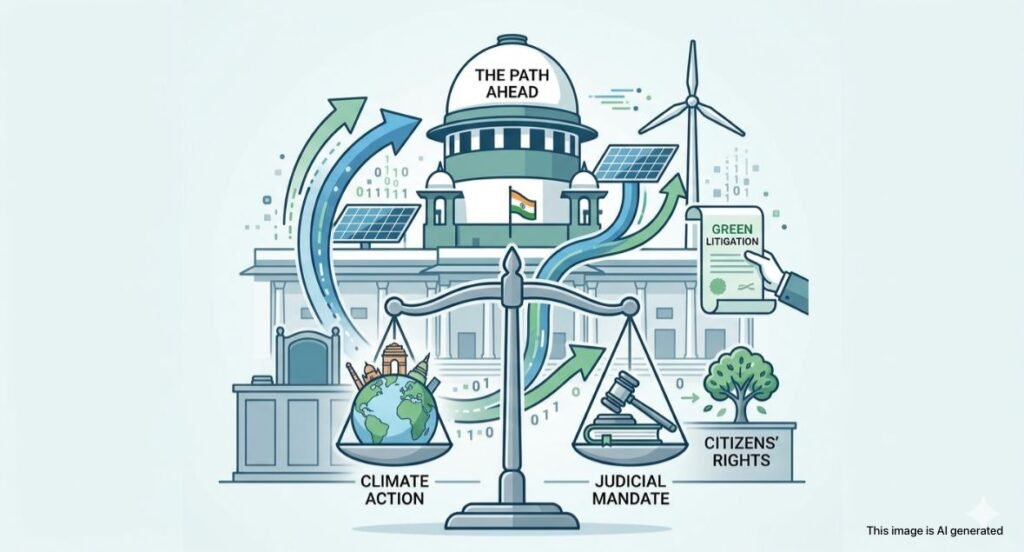
Climate change litigation in India is now truly at an inflection point. The Supreme Court’s recognition of the right to freedom from climate damage as a fundamental right under the constitution, the expanded environmental jurisdiction of the NGT, and increased civic society mobilisation through PIL all point to the formation of a new jurisprudential area.
There are still some structural obstacles, however. First, the “attribution” challenge, that is, connecting an emission source to a policy failure and then linking both to an injury, necessitates complex scientific reasoning, which courts accustomed to tort law principles have difficulty understanding. Second, the “separation of powers” principle acts as another obstacle since it was used to prevent the court in Ridhima Pandey from directing carbon budgeting or NDCs because it was within the executive branch’s policy-making domain. Unlike the UK Climate Change Act 2008, there are no binding legislative targets for climate change mitigation in India. Third, access to justice is a major barrier for those groups that are most vulnerable to climate effects, namely, fisher communities on the coasts, subsistence farmers, and tribals depending on forests.
India is also a part of the UNFCCC, the Kyoto Protocol, and the Paris Agreement, and its latest NDCs, updated in 2022, reflect high targets for the country regarding climate change. As litigation develops further, all these agreements will become a yardstick to which inaction by the government will be compared in courtrooms.
The urgent need of the hour is a Climate Change Act that includes specific targets in different sectors, an empowered NGT with better technical expertise, and standing rules for future generations and threatened ecosystems. The law alone will not save us from the catastrophe of climate change, but the law will help keep the State accountable, protect the rights of the most vulnerable, and make development possible without the price of destroying our ecology forever. As India marches towards sustainable development and decarbonization, the judicial interpretation of the climate justice aspect of our Constitution will shape our destiny in coming generations.
Frequently Asked Questions
1. What is climate change litigation?
Climate change litigation can be defined as litigation brought about by an individual, community or organizations to ensure that government or corporations comply with their responsibilities towards climate action, emissions reduction and protection from climate change impacts. Climate change litigation cases are brought in India via the Public Interest Litigation (PIL) method to the Supreme Court, High Courts or the National Green Tribunal.
2. What constitutional provisions justify climate litigation in India?
The key provisions for justifying climate litigation are Article 21 (which ensures the right to life and personal liberty which was expanded to include the right to a clean environment), Article 48A (which is the Directive Principle directing the State to protect and preserve the environment) and Article 51A(g) (which states that it is the fundamental duty of all citizens to protect and safeguard the natural environment). M.K. Ranjitsinh v. Union of India (2024) Supreme Court case expanded on the right to be protected from climate harm in Articles 14 and 21.
3. Why is the case of M.K. Ranjitsinh v. Union of India (2024) regarded as a landmark case in environmental law?
The judgment is a landmark case in Indian climate jurisprudence. It is the first time that the Indian Supreme Court has held that freedom from the negative impacts of climate change is a fundamental constitutional right. It gives rise to an actionable duty on the part of the State to act in matters related to climate change.
4. Why is there no dedicated law for Climate Change in India?
Till now, India has mainly relied on its environmental laws along with constitutional provisions, along with policy frameworks like the National Action Plan on Climate Change (NAPCC) and State Action Plans on Climate Change (SAPCCs). Various political and economic reasons have prevented the passage of a specific climate law in India.
5. Can international treaties, such as the Paris Agreement on climate change, be enforced through domestic court action in India?
The international treaties cannot be enforced in domestic courts of India unless domestic laws incorporate them. Indian courts have relied upon international treaty obligations in aiding interpretation. With the evolution of climate litigation, India’s NDCs under the Paris Agreement are becoming more frequently used as benchmarks for government inaction despite the absence of their independent enforceability under domestic law.
References
• National Action Plan on Climate Change (NAPCC), Government of India (2008): https://moef.gov.in/wp-content/uploads/2017/11/NAPCC_English.pdf
• India’s Updated Nationally Determined Contribution (NDC), Ministry of Environment, Forest and Climate Change (2022): https://unfccc.int/sites/default/files/NDC/2022-08/India%20Updated%20First%20Nationally%20Determined%20Contrib.pdf
• United Nations Framework Convention on Climate Change (UNFCCC) and Paris Agreement: https://unfccc.int/process-and-meetings/the-paris-agreement