This article is written by Abha Bajpai, Atal Bihari Vajpayee School of Legal Studies, CSJMU, Kanpur
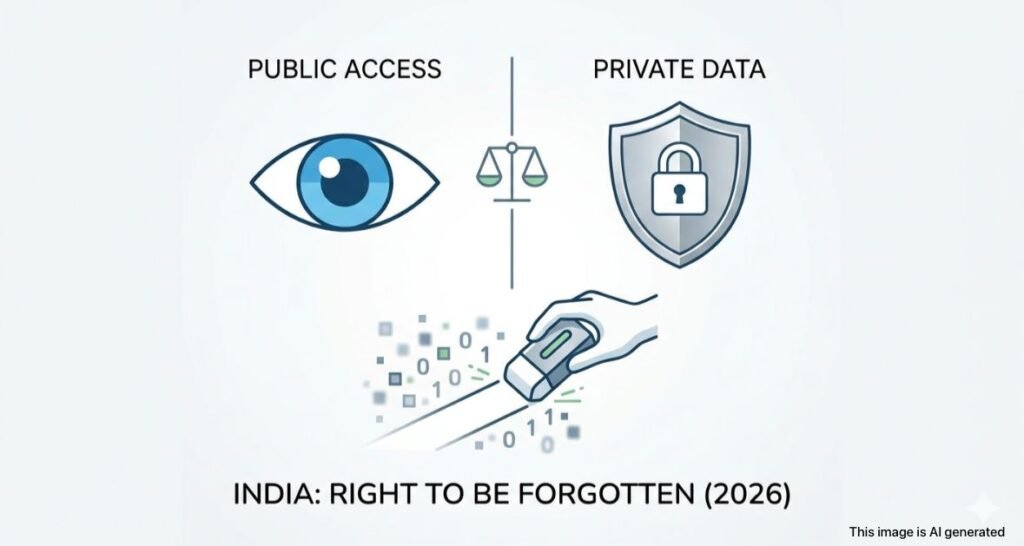
On 29 May 2026, Justice Sachin Datta of the Delhi High Court delivered a landmark 144-page ruling in Laksh Vir Singh Yadav v. Union of India & Connected Matters, formally affirming that the Right to Be Forgotten is an essential component of the fundamental right to privacy under Article 21 of the Constitution of India. The judgment simultaneously established a workable framework for de-indexing, delinking, and masking of personal data from digitised court records and search engine results.
The case consolidated over thirty writ petitions filed by acquitted persons, parties to settled matrimonial disputes, and litigants whose proceedings had attained finality, all of whom continued to suffer reputational and professional harm due to old judicial records surfacing in online name-based searches. With the Digital Personal Data Protection Act, 2023 (DPDPA) still lacking operational rules and no statutory erasure right yet in force, the Court stepped in to constitutionally anchor this right, carefully balancing it against the principle of open justice.
THE CORE LEGAL QUESTIONS ADJUDICATED
The Court addressed two constitutional questions: first, whether the right to be forgotten falls within the fundamental right to privacy under Article 21; and second, whether judicially ordered de-indexing would impermissibly undermine the doctrine of open justice. The Court answered the first affirmatively, grounding the right in human dignity, personal autonomy, and informational self-determination. On the second, it held that de-indexing and masking do not invalidate judicial records; they only restrict indiscriminate name-based retrieval while preserving access through case numbers, citations, and court details. The Court notably observed that the absence of specific legislation “does not preclude Constitutional Courts from recognising and enforcing this right as part of the constitutional guarantee of privacy under Article 21.”
THE JUDICIAL FRAMEWORK: DE-INDEXING, MASKING, AND OPEN JUSTICE
The Court distinguished three forms of relief: de-indexing (removing a name from search engine results), masking (replacing party identifiers in public digital versions of judgments with placeholders like ‘ABC’ or ‘XYZ’ while preserving the original in court repositories), and delinking (severing hyperlinks to third-party media content). A masking order by a competent court constitutes a valid directive under Rule 3(1)(d) of the IT (Intermediary Guidelines) Rules, 2021, obligating operators including Google LLC to de-index and platforms like Indian Kanoon to disable name-based search for affected records. MeitY was directed to ensure compliance and file an affidavit. Crucially, unredacted judgments remain preserved and accessible through non-personal identifiers, so judicial transparency is not compromised.
RELEVANT CASE LAWS
1. Justice K.S. Puttaswamy (Retd.) v. Union of India, (2017) 10 SCC 1
The nine-judge Constitution Bench unanimously held privacy to be a fundamental right under Article 21. Justice D.Y. Chandrachud’s opinion specifically identified ‘informational privacy’ as a distinct dimension, protecting an individual’s control over the collection, storage, and dissemination of personal data. This ruling provided the direct constitutional foundation for the Delhi High Court’s right-to-be-forgotten framework in 2026.
2. Jorawer Singh Mundy v. Union of India, W.P. (C) 3661/2021 (Delhi High Court)
The Delhi High Court extended limited de-indexing relief to an acquitted foreign national whose drug-related trial judgment continued to cause reputational harm online. Though decided on narrow facts, Mundy was a significant precursor to the broader 2026 framework and was expressly acknowledged in the Laksh Vir Singh Yadav judgment as shaping the Court’s approach.
3. Google Spain SL v. AEPD and Mario Costeja González, Case C-131/12 (CJEU, 2014)
The CJEU held that individuals may request search engines to de-list results linking their names to information that is inadequate, irrelevant, or disproportionate given the purposes of its original processing. This decision led to Article 17 of the GDPR codifying the right to erasure. The Delhi High Court drew on its normative foundations while adapting the right to the Indian constitutional context.
4. Vysakh K.V. v. Republic of India, W.P. (C) 20214/2019 (Kerala High Court)
The Kerala High Court held that information no longer serving a genuine public interest purpose may be subjected to access restrictions to protect individual dignity and privacy. This ruling contributed to the developing domestic jurisprudence on the right to be forgotten and was cited in the 2026 judgment as part of the precedential lineage.
5. Shreya Singhal v. Union of India, (2015) 5 SCC 1
While primarily a freedom of expression ruling that struck down Section 66A of the IT Act, Shreya Singhal established that intermediaries incur takedown obligations only upon receiving a court order or government notification. The 2026 ruling built on this by confirming that a judicial masking order qualifies as such an order, providing a clear enforcement mechanism for the right to be forgotten under the IT (Intermediary Guidelines) Rules, 2021.
CONCLUSION
The Delhi High Court’s ruling in Laksh Vir Singh Yadav v. Union of India (2026) is a transformative moment in Indian privacy law. By constitutionally grounding the right to be forgotten under Article 21 and crafting a practical enforcement framework, the Court has provided individuals with a concrete tool to reclaim control over their digital identities from the shadow of concluded legal proceedings. The judgment’s careful distinction between targeted de-indexing and absolute erasure ensures that judicial transparency is preserved while privacy is meaningfully protected. As DPDPA implementation progresses, this ruling will serve as an essential reference point for the right to erasure, and raises larger questions about the scalability of such relief and MeitY’s enforcement capacity in a country of over 1.4 billion people increasingly navigating life online.
FREQUENTLY ASKED QUESTIONS
1. What is the Right to Be Forgotten, and how does it differ from the right to privacy?
The right to be forgotten is a specific dimension of the broader right to privacy, focused on informational persistence in digital spaces. It enables a person to seek removal or restriction of personal data that has become stale or lacks continuing public interest justification. The Delhi High Court located it within ‘informational self-determination’ the individual’s capacity to control what personal data about them remains digitally accessible.
2. Does India have a statutory right to be forgotten?
Not yet. The DPDPA, 2023 contains erasure-related provisions, but implementing rules remain pending. The 2026 ruling fills this gap by recognizing the right under Article 21, giving individuals an enforceable constitutional basis to seek relief through writ jurisdiction.
3. Does this ruling allow anyone to erase their criminal record from the internet?
No. De-indexing is not erasure; unredacted judgments remain in court repositories and are accessible via non-personal identifiers. Relief applies only in defined categories such as acquittals or settled proceedings where continued name-linked visibility causes disproportionate harm with no countervailing public interest. There is no blanket entitlement.