
This article is written by Unnati Dixit, (4th Semester) BA LL.B. (Hons.), Arya Kanya Degree College (affiliated to University of Allahabad). This article examines the Supreme Court (Number of Judges) Amendment Ordinance, 2026, its constitutional basis, the reasons behind the increase in judicial strength, and whether the measure can meaningfully address judicial delays in India.
Keywords: Judicial Pendency, Ordinance Power, Speedy Trial, Bench Strength, Article 123, Collegium System
Expanding the Bench: Analysing the Supreme Court (Number of Judges) Amendment Ordinance, 2026 and Its Implications for Judicial Reforms in India
The Parliament was not in session, but the cases did not stop. As the Supreme Court’s pendency crossed 93,000 cases for the first time in history, the government invoked a constitutional power that many citizens are unfamiliar with: the Presidential Ordinance-making power under Article 123 of the Constitution of India. Through this power, the sanctioned strength of the Supreme Court was expanded.
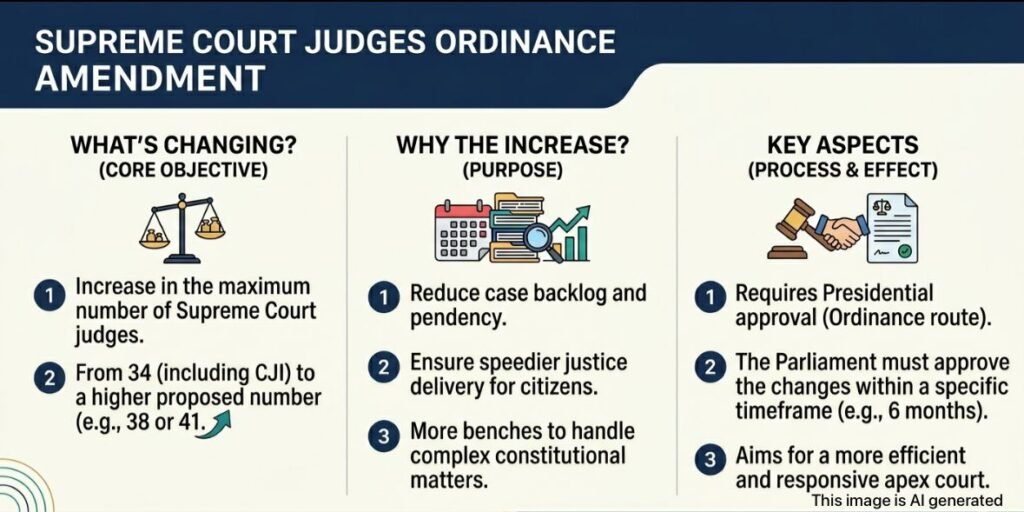
On 16 May 2026, President Droupadi Murmu promulgated the Supreme Court (Number of Judges) Amendment Ordinance, 2026, increasing the number of judges of the Supreme Court from 33 to 37 (excluding the Chief Justice of India). As a result, the total strength of the Court increased from 34 to 38 judges.
At first glance, the amendment appears to be a simple numerical increase. However, the constitutional mechanism used, the reasons behind the decision, and its likely impact on judicial administration raise important questions about the future of judicial reforms in India.
The Supreme Court (Number of Judges) Amendment Ordinance, 2026
India’s Supreme Court was established in 1950 with only eight judges, including the Chief Justice of India. At the time, the volume of litigation was significantly lower, and the role of the Court was still evolving.
As India’s population, economy, and legal awareness expanded, the workload of the Supreme Court increased substantially. To accommodate this growth, Parliament amended the Supreme Court (Number of Judges) Act, 1956 on multiple occasions.
Most recently, in 2019, the sanctioned strength was increased from 30 to 33 judges (excluding the Chief Justice of India), bringing the total strength to 34.
For the next seven years, this number remained unchanged. However, with pendency exceeding 93,000 cases in early 2026 and multiple judicial vacancies expected due to upcoming retirements, the Government considered an increase necessary.
Consequently, on 16 May 2026, the President promulgated the Supreme Court (Number of Judges) Amendment Ordinance, 2026, increasing the sanctioned strength of judges from 33 to 37, excluding the Chief Justice of India.
Ordinance-Making Under Article 123
Most laws in India are enacted through Parliament after debate and approval by both Houses. However, the Constitution provides an alternative mechanism under Article 123.
Article 123 empowers the President to promulgate an Ordinance when Parliament is not in session and circumstances exist that render immediate action necessary. An Ordinance has the same force and effect as an Act of Parliament.
However, an Ordinance is temporary in nature. Once Parliament reassembles, the Ordinance must be laid before both Houses and will cease to operate six weeks after reassembly unless approved by Parliament.
In the present case, Parliament was not in session following the conclusion of the Budget Session. Simultaneously, judicial vacancies and rising pendency created concerns regarding the Court’s ability to effectively manage its workload. The Government therefore invoked Article 123 and recommended promulgation of the Ordinance.
The Union Cabinet approved the proposal on 5 May 2026, and the Ordinance was subsequently notified in the Gazette of India on 16 May 2026.
Why Increase the Strength of the Supreme Court?
The principal justification for the Ordinance was the growing burden of pending cases before the Supreme Court.
With more than 93,000 matters awaiting adjudication and additional retirements anticipated, concerns emerged regarding the Court’s ability to deliver timely justice.
Supporters of the amendment argue that increasing the number of judges is a practical and necessary response to rising litigation. Additional judges may allow the Court to constitute more benches, hear more matters simultaneously, and reduce delays in disposal.
The Government has also stated that the amendment is intended to improve the efficiency of the Supreme Court and facilitate the delivery of speedy justice.
Is Increasing Judicial Strength Enough?
While increasing the number of judges may provide immediate relief, many experts question whether it is sufficient to address the deeper structural issues affecting judicial administration.
The Law Commission of India in its 229th Report (2009) observed that increasing judicial strength alone would not eliminate delays. The Commission recommended the creation of a permanent Constitutional Bench and regional Cassation Benches to reduce the burden on the Supreme Court.
Critics further point out that the Court’s expanding jurisdiction, particularly through Public Interest Litigation (PIL), has significantly increased its workload over time.
Additionally, judicial efficiency depends not only on the number of judges but also on supporting infrastructure, court staff, technology, and procedural reforms. A larger bench strength may have limited impact if these systemic concerns remain unresolved.
Supporters of the Ordinance nevertheless contend that meaningful reform cannot occur unless adequate judicial capacity exists in the first place. According to this view, increasing the number of judges is not a complete solution but an essential first step.
Judicial Appointments and the Collegium System
The creation of four additional judicial positions inevitably raises questions regarding how those positions will be filled.
S.P. Gupta v. Union of India (1981) – First Judges’ Case
In this case, the Supreme Court held that the executive enjoyed primacy in judicial appointments. The Court interpreted the constitutional requirement of “consultation” with the Chief Justice of India as not requiring concurrence.
Supreme Court Advocates-on-Record Association v. Union of India (1993) – Second Judges Case
The Supreme Court subsequently overruled S.P. Gupta and established the Collegium System. The Court held that the Chief Justice of India, acting collectively with senior judges, would have primacy in recommending judicial appointments.
In Re Special Reference No. 1 of 1998 – Third Judges Case
Responding to a Presidential Reference, the Supreme Court clarified and expanded the Collegium System. The Court held that the Collegium would consist of the Chief Justice of India and the four senior-most judges of the Supreme Court.
Consequently, appointments to the newly created positions under the Ordinance will be made through the existing Collegium mechanism.
Judicial Delays and the Right to Speedy Justice
Hussainara Khatoon v. Home Secretary, State of Bihar (1980)
This landmark decision recognized the right to a speedy trial as an integral component of Article 21 of the Constitution.
The case highlighted the plight of undertrial prisoners who remained incarcerated for prolonged periods due to delays in the criminal justice system.
Although the judgment did not specifically address judicial strength, it established the constitutional principle that excessive delays in the administration of justice violate fundamental rights.
The 2026 Ordinance may therefore be viewed as a policy response aimed at strengthening institutional capacity in a manner consistent with the constitutional commitment to timely justice.
Conclusion
The Supreme Court (Number of Judges) Amendment Ordinance, 2026 is a significant institutional reform that increases the sanctioned strength of the Supreme Court from 34 to 38 judges, including the Chief Justice of India.
Whether this measure ultimately succeeds depends on more than numbers alone. The Ordinance addresses one aspect of the problem by increasing judicial capacity, but long-term solutions will also require improvements in infrastructure, technology, court administration, and procedural efficiency.
Increasing the number of judges is therefore best understood as a necessary step rather than a complete solution. The true measure of success will not be the number of sanctioned posts created but whether citizens experience faster and more effective access to justice.