The Same-Sex Marriage Debate and India’s Constitutional Crossroads
This article is written by Sujal Tyagi, B.B.A. LL.B. (Hons.), 6th Semester, Vivekananda Institute of Professional Studies (VIPS), New Delhi.
Keywords: Same-sex marriage, Special Marriage Act 1954, constitutional morality, LGBTQ+ rights, Article 21
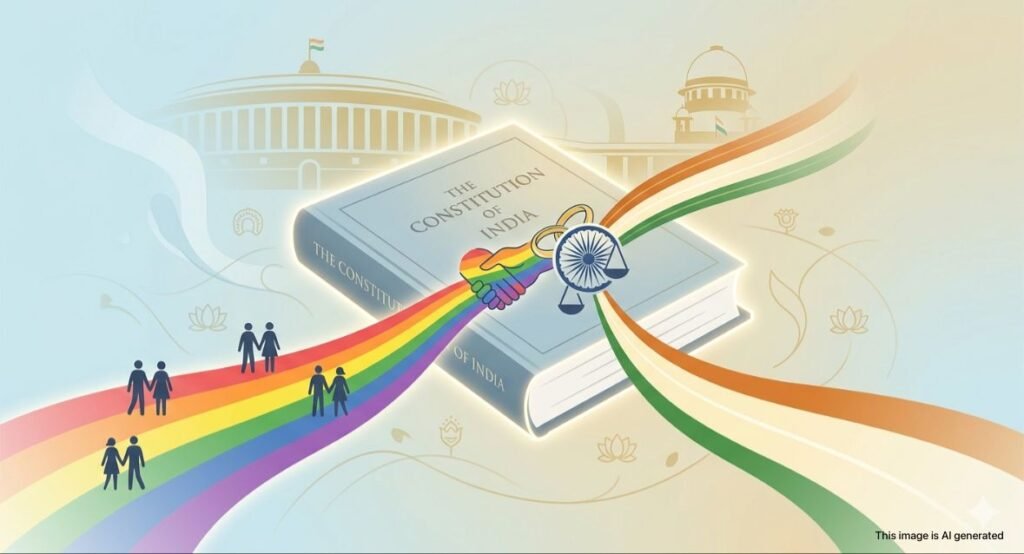
As India’s Supreme Court struggles with the question of whether same-sex couples are entitled to marry in its landmark case Supriyo @ Supriya Chakraborty v. Union of India (2023), it has been a question that has been debated in recent Indian legal history both within and beyond the courtroom. This is in response to the recently decided Navtej Singh Johar v. Union of India (2018) case, which had struck down Section 377 IPC with respect to consensual adult same sex relations. Now that the State has become incapable of punishing who you love, many said, it should also be able to formally acknowledge that love. Marriage is not simply a ceremony; it is a legal entity for adoption, inheritance, insurance, and spousal rights, which cohabitation cannot be. When same-sex couples are excluded from marriage, it is a very real, daily harm, not one that is symbolic.
The backstory of Legal Background: From Naz Foundation To Navtej
In 2009, the Delhi High Court in Naz Foundation v Government of NCT of Delhi read down Section 377 of the IPC, excluding consensual adult acts, thus kick-starting the modern LGBTQ+ rights movement in India. In Suresh Kumar Koushal v. Naz Foundation (2013), the Supreme Court overturned this ruling, re-establishing Section 377 and giving precedence to popular opinion on the constitutional right. The first step was in the case of Justice K.S. Puttaswamy v. Union of India (2017), which was a nine-judge bench decision where privacy was declared as a fundamental right under Article 21, and it was held that sexual orientation is a fundamental part of the protected identity. This was overruled unanimously by the Navtej Singh Johar case (2018), which deleted Section 377 as applied to consenting adults and found that LGBTQ+ people have a right to equal citizenship under Articles 14, 15, 19 and 21. However, the concept of formal recognition of same-sex relationships was completely ignored under decriminalisation, a question that came before the Court in Supriyo.
The Case: Arguments And Issues:
The petitioners (same sex couples, activists and individuals) challenged the Special Marriage Act, 1954 (SMA) which refers to gendered terms like ‘man’, ‘woman’, ‘husband’ and ‘wife’ which inherently exclude same sex couples. They submitted that this omission infringes upon Article 14 (equality), Article 15 (non-discrimination) of the Constitution, Article 19 (speech and expression) and Article 21 (dignity, autonomy and choice of spouses) of the Constitution of India in light of the cases of Navtej Singh, Puttaswamy and Shakti Vahini. The Union government and some States had replied that the concept of marriage is essentially a social institution deeply rooted in the culture and tradition of the people and that if the definition of marriage were changed, there would be a number of laws connected with it to be changed, such as the laws on adoption, succession and guardianship, which are of social policy and belong to the jurisdiction of Parliament and not of the judiciary.
The Judgment: Majority And Minority
The Constitution Bench divided 3:2. Most of the Justices Bhat, Kohli and Narasimha agreed that there is no fundamental right to same-sex marriage. Their argument: the right to cohabit is not the same as the right to marry; marriage is not a fundamental right in Indian law. The majority held that although queer persons possess constitutional rights to dignity, autonomy, and association, extending the Special Marriage Act to same-sex couples would require substantial legislative modification that could not be achieved through judicial interpretation alone, and the implications of the downstream consequences of adopting such a reading, regarding issues of adoption, succession and welfare law, are policy decisions that Parliament alone can make.
The minority opinion, that of then-Chief Justice D.Y. Chandrachud and Justice Sanjay Kishan Kaul, disagreed. The Chief Justice observed that it was clear that the denial of access to SMA on the ground of sexual orientation was an example of direct discrimination under Article 15 of the Constitution and the values of dignity, autonomy and choice of partner that are enshrined in Navtej and Puttaswamy logically require formal recognition by the State of intimate relationships. While stating that the issue of State oppression towards the LGBTQ+ community had been a long-standing issue, Justice Kaul did not agree with the notion that a greater degree of deference to Parliament was constitutional. Both would have read down the SMA’s gendered provisions to allow same sex marriages.
Analysis: Rights Recognised, Equality Denied
The majority’s caution about institutional overreach has some merit; courts are not equipped to craft comprehensive legislative frameworks, and reforms touching religion and culture may hold better if achieved through democratic deliberation. But the reasoning sits uneasily with the Court’s own precedent. Navtej declared that LGBTQ+ persons are entitled to equal citizenship. Puttaswamy held that sexual orientation is a core protected aspect of identity. It is difficult to see how these constitutional commitments are honoured by denying any formal legal recognition to same-sex relationships. The inability to marry is not merely dignitary; it means no joint adoption, no automatic inheritance, no spousal benefits under employment or insurance law.
A workable alternative existed: declare the exclusion unconstitutional and direct Parliament to remedy it within a defined period, the approach taken by the South African Constitutional Court in Minister of Home Affairs v. Fourie (2005), which led to the Civil Union Act, 2006. The U.S. Supreme Court in Obergefell v. Hodges (2015) went further, recognising marriage equality as a constitutional requirement under the Fourteenth Amendment. India’s majority chose neither path, leaving the community waiting on a legislature with no obligation and no deadline to act.
Conclusion
Supriyo v. Union of India is a judgment that offered the LGBTQ+ community recognition without equality. It produced a detailed constitutional record of arguments made and rights asserted, a record that will matter in future litigation and advocacy. But it did not declare the exclusion from marriage unconstitutional, did not direct Parliament to act, and did not translate the dignity it affirmed in principle into the legal equality that flows from it in practice. The dissenting opinions are constitutionally sounder; the rights established in Navtej and Puttaswamy logically extend to formal recognition of same-sex relationships. Until Parliament enacts marriage equality or a civil unions framework, Supriyo will stand both as a marker of progress and as a reminder of how much remains to be done.
Frequently Asked Questions
1. What did the Supreme Court decide in Supriyo?
By a 3:2 majority, the Court held that same-sex couples have no fundamental right to marry and declined to read gender-neutral language into the SMA. It affirmed the right to cohabit and directed a government committee to explore limited benefits such as joint bank accounts and insurance nominations, falling short of marriage. Formal marriage equality was left to Parliament.
2. Why did the minority judges’ dissent?
Chief Justice Chandrachud and Justice Kaul held that excluding same-sex couples from marriage is discrimination under Article 15 and violates Article 21 rights of dignity and autonomy established in Navtej and Puttaswamy. They would have read down the SMA’s gendered provisions directly, arguing the constitutional values already on record demanded that outcome.
3. What rights do same-sex couples have in India after this ruling?
They retain the right to cohabit and live freely without State interference. However, they still cannot jointly adopt, inherit without a will, claim spousal benefits, or access the legal protections marriage provides. The Court-directed committee may recommend some incremental entitlements, but full legal equality is not available through this judgment.
4. Can Parliament legalise same-sex marriage?
Yes. Parliament can amend the SMA to use gender-neutral language or enact a Civil Unions Act granting equivalent rights without using the term ‘marriage’. The judgment explicitly recognises legislative competence in this area. Whether Parliament will act, given the current political climate, remains an open question.
5. How does India’s position compare internationally?
India’s position is among the more restrictive in comparable constitutional democracies. The U.S. (Obergefell, 2015), South Africa (Fourie, 2005 and Civil Union Act, 2006), Canada (Civil Marriage Act, 2005), and the Netherlands (2001) all recognise same-sex marriage. Each was willing to declare the exclusion constitutionally untenable, a step the Indian majority declined to take.