
This article is written by Rafiah Mairaj, Lloyd Law College. This article explores how AI and Legal Tech are changing the way evidence is managed in India and around the world. It also looks at important case laws that show how courts have responded to digital and AI-assisted evidence.
Keywords: Artificial Intelligence, Legal Technology, Evidence Management, Digital Evidence, Chain of Custody
We are living in a world where technology is changing everything around us, and the legal system is no different. Courts and lawyers deal with a huge amount of evidence every day, from documents and photos to videos, emails, and audio recordings. Managing all of this properly is very important because even one small mistake can change the result of a case.
Earlier, evidence was mostly physical, like paper documents, fingerprints, or objects found at a crime scene. Lawyers and police officers would collect, label, and store these items manually. But today, most evidence is digital. A single case can involve thousands of emails, CCTV footage, phone records, and social media posts. Handling all of this without any help from technology is nearly impossible.
This is where Artificial Intelligence (AI) and Legal Technology (Legal Tech) come in. AI refers to computer systems that can perform tasks which normally require human intelligence, such as reading, analyzing, or finding patterns. Legal Tech refers to the use of technology specifically in the field of law to make legal work faster, cheaper, and more accurate.
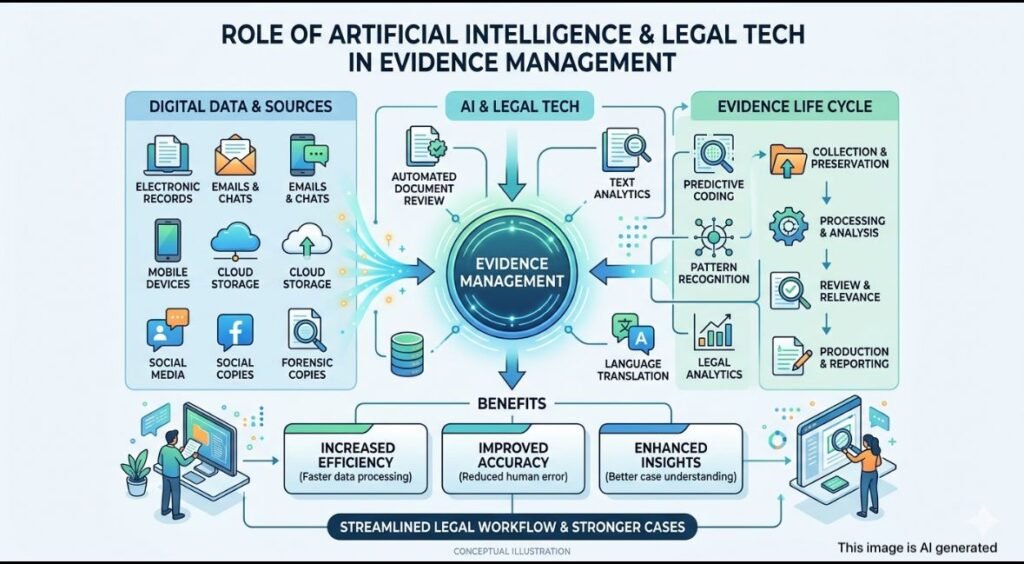
In the context of evidence management, AI and Legal Tech help in collecting evidence, organizing it, verifying it, and presenting it in court. These tools also help ensure that evidence is not tampered with and that the “chain of custody” is maintained at all times. Chain of custody simply means keeping a clear record of who handled the evidence, when, and where, from the time it was collected to the time it is presented in court.
What Is Evidence Management And Why Does It Matter?
Evidence management means the process of collecting, storing, tracking, and presenting evidence in a legal case. In simple words, it is making sure that all the proof in a case is handled properly so that it can be trusted and used in court.
The Bharatiya Sakshya Adhiniyam, 2023 (BSA), which came into force on 1 July 2024, has replaced the Indian Evidence Act, 1872. Electronic records are now expressly recognised as documentary evidence under the new framework and the Information Technology Act, 2000. These laws recognise digital records as valid evidence, but they also require that such evidence must be authentic, reliable, and must not have been tampered with.
When evidence is mishandled, it can lead to wrongful convictions, acquittals of guilty persons, or dismissal of strong cases. This is why proper evidence management is one of the most important parts of the justice system.
How AI Is Being Used In Evidence Management
1. Automated Evidence Collection
AI tools can automatically collect digital evidence from various sources like emails, social media accounts, websites, and cloud storage. For example, if police are investigating a cybercrime, an AI system can scan thousands of emails in a few minutes to find relevant information, something that would take a human investigator days or even weeks.
2. Facial Recognition And Video Analysis
CCTV footage is one of the most common types of evidence today. AI-powered facial recognition software can identify people in video footage quickly and accurately. These systems compare faces with large databases to find matches. Courts in many countries have started accepting such AI-analyzed video evidence.
However, this technology has also been criticized. Facial recognition systems have been found to be less accurate for people with darker skin tones, which raises serious concerns about fairness and discrimination.
3. Document Review And Authentication
AI can review large volumes of documents in a very short time. Tools like predictive coding or technology-assisted review (TAR) help lawyers find relevant documents from thousands of files. AI can also detect if a document has been forged or altered by analyzing its metadata, font patterns, and digital signatures.
4. Maintaining Chain Of Custody Using Blockchain
One of the biggest challenges in evidence management is ensuring that no one tampers with the evidence. Blockchain technology, which is often used alongside AI, creates a permanent and unalterable record of every action taken with a piece of evidence. This digital ledger records who accessed the evidence, when, and what changes (if any) were made. This makes it almost impossible to tamper with evidence without being detected.
5. Predictive Analysis
AI tools can analyze past cases and current evidence to predict outcomes or identify patterns. For example, they can detect patterns in financial fraud cases by comparing thousands of transactions. This helps investigators focus their attention on the most important pieces of evidence.
Legal Tech Tools Used In Evidence Management
Several Legal Tech tools are now being widely used in courts and law firms for evidence management. Some of the most popular ones include:
Relativity is a popular e-discovery platform used by law firms to manage and review digital documents. It uses AI to sort and prioritize documents, making it easier for lawyers to find what they need.
Logikcull is another cloud-based tool that helps legal teams collect, process, and review evidence automatically. It reduces the time and cost of managing large amounts of data in a legal case.
Nuix is widely used by law enforcement agencies to process digital evidence from computers, phones, and other devices. It can extract deleted files, analyze communication records, and identify suspicious patterns.
In India, the National Crime Records Bureau (NCRB) and various state police departments are slowly starting to use digital tools for managing evidence, though full AI adoption is still in its early stages.
Case Laws
1. Anvar P.V. v. P.K. Basheer (2014) – Supreme Court of India
This is one of the most important cases in India when it comes to digital evidence. The Supreme Court held that electronic records like emails, CDs, and pen drives can be used as evidence, but they must be accompanied by a certificate under Section 65B of the Indian Evidence Act (now Section 63 of the Bharatiya Sakshya Adhiniyam, 2023). This certificate is proof that the electronic record is genuine and has not been tampered with. This case shows how Indian courts take authentication of digital evidence very seriously.
2. Shafhi Mohammad v. State of Himachal Pradesh (2018) – Supreme Court of India
In this case, the Supreme Court clarified the rules around the Section 65B certificate. It held that if the person submitting the electronic evidence is not the owner of the device or computer from which the evidence was taken, then the certificate requirement can be relaxed. This was an important step in making digital evidence more accessible, especially for victims and witnesses who may not have direct access to the devices.
However, the position adopted in Shafhi Mohammad was later reconsidered by the Supreme Court in Arjun Panditrao Khotkar v. Kailash Kushanrao Gorantyal (2020), where the Court reaffirmed the mandatory nature of the certificate requirement under Section 65B, subject to limited exceptions.
3. State (NCT of Delhi) v. Navjot Sandhu (2005) – Parliament Attack Case
In this famous case involving the 2001 Parliament attack, the Supreme Court accepted mobile phone call records as electronic evidence. This was one of the early cases in India where digital evidence played a major role in securing a conviction. The court accepted the call records even without a strict compliance of Section 65B, which later became a point of debate in subsequent judgments.
4. Dharambir v. Central Bureau of Investigation (2008) – Delhi High Court
In this case, the Delhi High Court dealt with the issue of electronic evidence and data stored on computers. The court held that all electronic records must be carefully authenticated before being admitted as evidence. This case highlighted the need for proper evidence management protocols when dealing with computer-based data.
5. R v. Reed and Reed (2009) – UK Court of Appeal
This is an international case from the United Kingdom where the court dealt with the use of DNA analysis and forensic science in evidence. The court emphasized that scientific evidence, including AI-assisted analysis, must be explained clearly to the jury so that they can understand and evaluate it properly. This case is often cited to argue that AI-generated evidence should not be accepted blindly and must be subject to scrutiny and explanation.
6. State of Maharashtra v. Dr. Praful B. Desai (2003) – Supreme Court of India
In this case, the Supreme Court allowed the recording of evidence through video conferencing. While not directly related to AI, this case opened the door for the use of technology in court proceedings. It showed that Indian courts are willing to embrace technology when it helps deliver justice more efficiently.
7. Arjun Panditrao Khotkar v. Kailash Kushanrao Gorantyal (2020) 7 SCC 1
The Supreme Court reaffirmed that a Section 65B certificate is ordinarily mandatory for admissibility of secondary electronic evidence and clarified the law after conflicting interpretations in earlier decisions. The judgment remains one of the leading authorities on electronic evidence in India.
8. Anuradha Bhasin v. Union of India (2020) 3 SCC 637
The Supreme Court emphasized the importance of internet access and digital communication in contemporary society. While not directly an evidence case, it demonstrates judicial recognition of the growing significance of digital technologies in legal and constitutional contexts.
Challenges And Concerns
While AI and Legal Tech offer many benefits, there are also serious challenges that need to be addressed.
The first major concern is privacy. AI systems that collect and analyze large amounts of data can easily invade people’s privacy. There needs to be a clear legal framework to ensure that evidence is collected lawfully and that people’s rights are protected.
The second concern is bias. As mentioned earlier, AI systems are not always accurate. Facial recognition software has shown errors, especially with certain groups of people. If courts rely too heavily on AI evidence, it could lead to unfair outcomes.
The third challenge is the lack of awareness and training. Many lawyers, judges, and police officers in India are still not fully trained to use or evaluate AI-assisted evidence. This can lead to misuse or misunderstanding of the technology.
Finally, there is the issue of cyber security. Digital evidence stored on servers or cloud platforms can be hacked or manipulated. Strong cyber security measures are essential to ensure that evidence remains safe and untampered.
Conclusion
Artificial Intelligence and Legal Technology are already changing the way evidence is managed in legal cases, and this change is only going to grow in the coming years. From collecting digital evidence to verifying its authenticity and maintaining chain of custody, AI tools are making the process faster, more accurate, and more reliable.
However, technology alone cannot deliver justice. It must be used carefully, with proper laws and guidelines in place. Indian courts have already started recognizing digital evidence, as seen in landmark cases like Anvar P.V. v. P.K. Basheer. But there is still a long way to go in terms of training legal professionals, creating clear rules for AI evidence, and addressing concerns about privacy and bias.
As India moves towards a more digital future with initiatives like Digital India and the new Bharatiya Nyaya Sanhita, it is important that the legal system keeps pace with technology. AI and Legal Tech, when used responsibly and ethically, have the potential to make the Indian justice system faster, fairer, and more transparent.
Frequently Asked Questions
1. What is evidence management in law?
Evidence management refers to the process of collecting, storing, tracking, and presenting evidence in a legal case. It ensures that evidence is authentic, properly handled, and admissible in court.
2. Is digital evidence valid in Indian courts?
Yes, digital evidence is valid in Indian courts. Under the Bharatiya Sakshya Adhiniyam, 2023 (earlier the Indian Evidence Act, 1872), electronic records are admissible as evidence, provided they are accompanied by a proper certificate of authenticity under Section 63.
3. How does AI help in managing evidence?
AI helps in evidence management by automating the collection and review of digital data, analyzing video footage through facial recognition, detecting forged documents, maintaining chain of custody through blockchain, and finding patterns in complex data sets.
4. What is a chain of custody and why is it important?
Chain of custody is a complete record of who handled the evidence, when, and in what condition, from the time it was collected to when it is presented in court. It is important because it proves that the evidence has not been tampered with and can be trusted.
5. What are the risks of using AI in evidence management?
The main risks include invasion of privacy, AI bias (especially in facial recognition), lack of proper training among legal professionals, and vulnerability to hacking or data manipulation. These risks can be managed through proper laws, regulations, and training.
References
National Crime Records Bureau, Ministry of Home Affairs, Government of India. https://ncrb.gov.in
Ministry of Law and Justice, Government of India. https://doj.gov.in
Relativity Legal Tech Platform. https://www.relativity.com