
This article is written by Aditya Shankar Rawani, Radha Govind University.
This article basically revolves around and explores the social behaviour of individuals in society towards live-in relationships in the era of development. The article gives clarity on what a live-in relationship actually is. This article gives in detail analysis of how live-in relationships are performed in our country, India. Along with one legal insight on live–in relationships of our Indian Judiciary.
The article also reviews the pros and cons of these relations and whether the societal attitudes are keeping up with the laws. Overall, it informs us of the further development of cohabiting relationships on the legal front of acceptance by society
Introduction
What is a live-in relationship
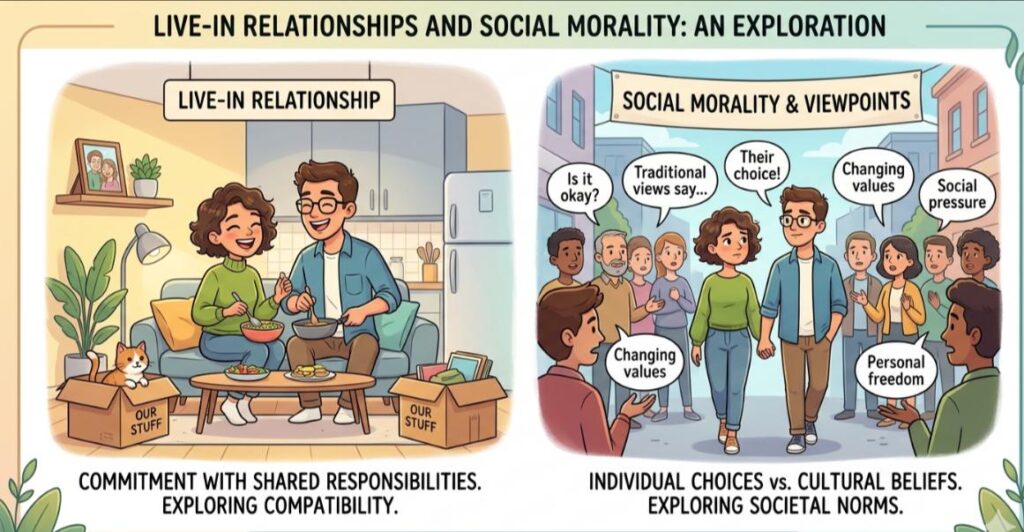
A live-in relationship is a type of relationship between two individuals who are unmarried, but they mutually agree and decide to live with and maintain a domestic life without the common and official legal and religious bonds. They have natural love and affection towards each other.
It covers the type of their relationship and duties. Indicatively, you could tell that they share everyday household chores, emotional support, and they even discuss and decide on their future, which builds a partnership of trust and collaboration. This gives a better idea of the nature of such a relationship with each other.
Key Characteristics of a Live-in Relationships:
The most significant key features in live-in relationships are emotional intimacy, residing in a specific place, and financial partnering. The cohabiting couples tend to share the daily chores, home chores and personal space as they accommodate the personal development of each other. The ones that keep this relationship functioning and strong during the period of living together are open communication and emotional intimacy in couples.
Reasons behind the preference of live-in Relationships by people?
Live-in relationships attract people due to different reasons. Others want to have a compatibility test before they make the commitment to marriage and others value individual freedom and would not want to see the issues surrounding the marriage that are legal binding. Such contemporary set up helps partners to know more about one another before making life altering choices.
The differences between Live-in Relationship and Marriage:
Live-in relationships and marriages have many differences though both partners engage in emotional commitments to one another. Marriage is a solemn union and this is normally marked by cultural and religious rituals whereas live-in company focuses on individual freedom with no legal commitment. These arrangements are not always met with myths and prejudice but often marriage is a more accepted way of living.
Advantages of a Live-in Relationships:
1. Matchmaking Check: To couples’ compatibility is the process of being together to see how they like each other and to make assessments about their compatibility over time.
2. Flexibility: Live-in relationships can be adjusted accordingly to meet the real interests of the two spouses to liberate themselves from the social norms.
3. Smoother Separation: With an unlucky relationship, breaking up a live-in relationship is cheaper in terms of prisoners and legal hassles than breaking up a marriage.
4. Trial Before Marriage: The live-in relationship is a kind of trial period before committing to the legally and socially binding institution of marriage. The ability to live together means that couples can have a life together because, unlike in traditional courtship, where partners get to meet now and then, they get to live together and see what it means to be in a day-to-day life together.
With this setup, spouses will be able to see how the other participants live, their habits, life, temper, and emotional reaction in a real life like managing finances, house work, stress, and
Further, it minimizes the chance of contracting an unsuitable marriage hence the likelihood of marriage quarrels, split or divorce could be brought to a bare minimum. In this respect, a live-in relationship is a preventative measure that enables people to make a better and more mature decision on marriage.
Example
This is in a case where two people are in a relationship but have not cohabited. Once into a joint living meaning, they can encounter divergences in their monetary ways- one is a saver and one is a spendthrift. The presence of such differences and their failure to be addressed during the time of marriage might cause severe problems. Early detecting them assists the couple to either adapt or reconsider the relationship.
Disadvantages in Live-in Relationships:
1. Legal Uncertainty: The absence of the legal rights may cause difficulties in separation.
2. Social Stigma: There may still be the stigma of a live-in relationship in societies and cultures.
3. . Emotional Insecurity: When there is no legal obligation, certain partners might have no long- term confidence.
4. Unpredictability: Live-in relationships do not have the same level of commitment as marriage and therefore some couples might not be as certain of the future. This may create confusion as to the duration of the relationship and in times of conflicts any of the partners may find it easy to abandon the relationship.
Legal Status of Live-in Relationships in India
In India, cohabiting relations are actually legalised. Major legislation that is provided is the Protection of Women against Domestic Violence Act, 2005. This act offers protection to people living in a cohabiting relationship against domestic abuse, just as married couples are accorded. That is to say, the law presents people in such relationships with a lawful security cover.
Societal Perspective in India
1. Traditional Taboo: Indian society considers marriage a sacrament. Hence, getting down before getting married is normally regarded as either wicked or a societal disgrace or a lack of cultural values being passed by the western world.
2. Generation Gap: The younger generations are much more open to live-in relationships, as they have a common idea that it is mainly a convenient option of testing the integrity and locution before choosing to get married.
3. Social Issues: Finding houses to rent out, pressure on the state of marriage, family, and moralism are the major social challenges that can be faced by couples in live-in setups.
Live in relationship between social morality in India
A live–in relationship has the power to influence social morality in India, not because of the process it
Just because of some people mindset who lives in Indian society basically
Consenting adults in India are legally allowed to live in relationships but this is against the traditional social morality that emphasized on marriage as enshrined in Article 21. Although judicial protections can protect against domestic violence and entitlement to maintenance is guaranteed, such relationships are stigmatized, especially where there is conservative society, which is the conflict between individual freedom and culture.
Judicial overview on live-in relationship.
The Supreme Court has in the recent past, addressed the issue of whether such a provision as Section 498A (cruelty) can be applied to a live-in partner. The Allahabad High Court said that although live-in is not a crime, it lacks legal validity when one of the partners is married. Also, the courts observed that marriage is usually the basis of legal rights and privileges, even in cases where the couple had lived long before marriage.
Case law-
Indra Sarma v. V.K.V. Sarma, 2013
Facts of case
Indra Sarma and V.K.V. Sarma spent a feasible 18 years together in Bengaluru. Their relationship started in the late 1980s, and in the course of this relationship, Indra quitted work and became economically dependent on V.K.V. Sarma. The relationship was performed and at the time of its end, she sought legal aid and protection.
The verdict: The Supreme Court acknowledged that not every live-in relationship qualifies for such protection. However, the Court held that if a live-in relationship resembles a marriage, in duration, shared responsibilities, and public recognition, then the woman can be granted protection under the Act.
Ratio decidendi: The Court established that relationships “in the nature of marriage”; those where the couple cohabits with long-term commitment, joint responsibilities, and a shared life, are eligible for protection, even without formal marriage.
Conclusion
In conclusion, in India, live-in relationship is a very absent yet meaningful shift in the attitude to commitment and the choice of a person. Although strides have been made in these relationships like the Protection of Women in Domestic Violence act, they are still unable to confront the socio traditional norms. But the bottom line of it all is that a live-in relationship is the choice made by two loving adults. It does not need to be interfered with, the same way that any couple needs to be left to make their own decisions. This openness would soon become such a natural part of our evolving society over time.
Frequently Asked Questions
What is a live-in relationship?
A live-in relationship is a type of relationship where two unmarried individuals cohabit as a couple without being married.
What is the reason why people prefer live-in relationships?
They are usually taken by people to check their compatibility or to evade legal intricacies of marriage.
Is it legal to live in a live-in relationship in India?
Yes, cohabitation is legal and is safeguarded by domestic violence laws.
What’s the key difference between live-in and marriage?
Marriage is a formal legal union, while live-in focuses on personal freedom without legal ties.
What’s a disadvantage of live-in relationships?
They are able to experience social stigmatization and unclear separations in the law.
References