This article is written by Reeba Banday
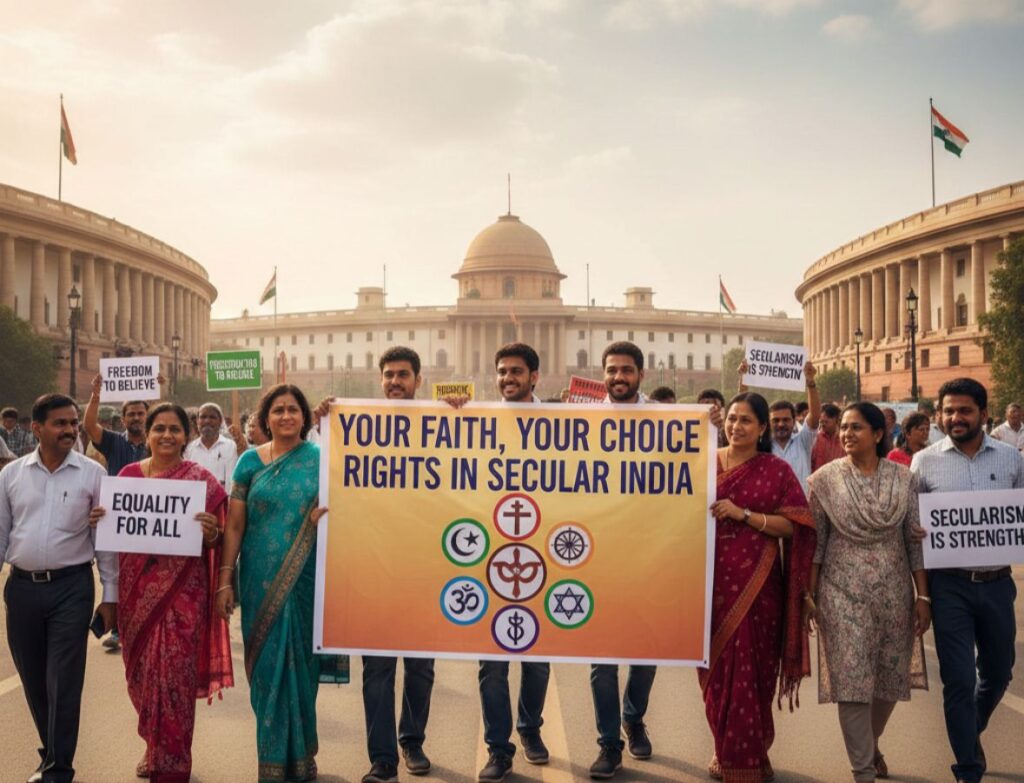
India is one of the most diverse countries in the world, and secularism here isn’t just a word in the Constitution. It is a promise, a promise that every belief and every faith get respect. It is also referred to as Sarva Dharma Sambhav, which simply means every religion deserves equal respect, and all religions should be honored equally. No religion is larger or smaller than others, and no one must be afraid of practicing his or her beliefs. Secularism isn’t just about tolerance; it’s about creating a society where differences are accepted, not used to create hatred, and where everyone can live according to their faith.
Take the hijab, for example. For many Muslim women, it’s not just a piece of cloth; it’s a sign of faith, modesty, and identity. Yet, it has always been the center of debates and controversies. Why? Because it’s visible, because it challenges some ideas about how women should look or behave, and sometimes, sadly because of misunderstandings and prejudice. It is our right and our responsibility as citizens to not only raise questions but also demand answers. We should try to understand why these issues exist and how we can protect everyone’s freedom. Supporting someone’s choice of clothing, whether it’s a hijab or something else, isn’t just about religion. It’s about defending equality, dignity, and the basic idea that everyone should be able to be themself. In the end, a country is stronger when people are free to be who they are.
Meaning of Secularism
Secularism was meant to ensure that the state is fair to every single faith. It is all about not
punishing or favoring anyone because of what they believe in. In simple words, you live your
life, I live mine, and the state respects both of us. But when some forms of religious expression are accepted and others are suddenly labelled as “problematic,” we are missing the real meaning of secularism. Being neutral doesn’t mean ignoring differences; it means treating all differences with equal respect.
Constitutional Framework
Our Constitution makes some important promises for every citizens:
- Article 14 says everyone is equal under the law.
- Article 19(1)(a) ensures freedom of expression.
- Article 25 guarantees freedom of religion and belief.
These articles are not just words; they are the foundations that allow us to live freely without
fear.
The Bihar Incident
A few days ago, there was a video on social media of the Chief Minister of Bihar pulled down the hijab off a Muslim woman doctor at a governmental event. It was shocking not just because it happened, but because it was done by someone in power. When a public figure messes woman’s religious attire without her consent, it’s not just a mistake; it’s a serious abuse of power. Amnesty International India condemned such an act and termed it as an assault on the dignity of the woman, autonomy, and identity. They indicated that such actions by those in high positions give a harmful signal: that it is alright to police the faith of a woman. No individual, no government, no organization, and certainly not the state has permission to behave in such a manner.
Why is it always a hijab? Something so personal, so deeply connected to a woman’s faith, is always targeting to become a tool for public debate or controversy. It is part of her identity, her devotion, and her choice, and yet, time and again, it is treated as if it is a problem. This event made us stop and ask, why are women’s personal religious choices constantly put under the spotlight and judged?
The Karnataka Hijab Case 2022
In 2022, a big problem started in Karnataka when Muslim girls were told they could not enter their colleges because they wore the hijab. Many of these girls had been going to the same schools for years without any trouble. Suddenly, they stopped at the gates just to practice their faith. The case went to court, but it only made things more difficult. The Karnataka High Court supported the ban, saying the hijab is not a “must-have” part of Islam. Later, the Supreme Court looked at the case but couldn’t agree on a final answer. This left the situation stuck, with no clear rules for the students.
While the courts were busy talking and debating, the girls were the ones who were suffering. Some had to sit outside their classrooms, and others stopped going to school entirely. They were forced to make a choice that no one should ever have to make: their faith or their career.
The Hijab: A Choice of Faith and Identity
Freedom isn’t something you can force on someone. The hijab isn’t just a piece of cloth; it has
meaning. If it were just fabric, it wouldn’t spark such strong reactions or even become a topic of
bans and public arguments.
For many Muslim women, wearing the hijab is a source of pride. It’s how they express their faith
and who they are. Most importantly, it’s a choice made from deep belief. When someone’s hijab
is pulled off them against their will, it’s not just an act of disrespect; it feels like an attack on
their dignity.
Redefining “Liberation”
There are people who say banning the hijab “frees women.” But to me, that doesn’t make sense;
freedom is not being forced to take something off when you want to keep it on.
Real freedom means:
- Trusting women to make decisions about their own bodies and beliefs.
- Respecting their autonomy, even if it’s different from what other people expect.
- Listening to their voices instead of trying to change them.
Conclusion
The debate over the hijab is really about respect and equality. Every woman should have the
right to wear what she chooses without being judged or forced to explain herself. Faith is part of
a person’s identity and should never be treated as a barrier. Using religion to create barriers
between people divides us instead of bringing us together. True freedom means protecting everyone’s dignity, not policing it. Dignity and choice are rights, not privileges. If we want equality to be real, “Unity in Diversity” must be more than words; it
must be how every woman is treated every day.
Frequently Asked Questions
- What does “Secularism” mean in the Indian context?
Unlike the Western concept of secularism, which often implies a strict separation between
church and state, Indian secularism is defined by Sarva Dharma Sambhav. This means the state
maintains an equal distance from all religions while respecting and protecting the right of every
citizen to practice their faith freely. - What was the core of the 2022 Karnataka Hijab controversy?
The controversy began when several governments run colleges in Karnataka denied entry to
Muslim female students wearing hijabs, citing a violation of uniform policies. The issue sparked
a national debate over whether school dress codes can override the fundamental right to religious
practice and education. - What is the actual impact on Muslim women when these controversies happen?
It isn’t just a legal debate; it is an educational and economic barrier. Realistically, many girls are
forced to choose between their education and their identity.This leads to higher dropout rates
among Muslim women, pushing a vulnerable community further away from financial
independence and public life.