
This article is written by Shreyansh Tripathi, B.B.A L.L.B., Symbiosis Law School, Noida
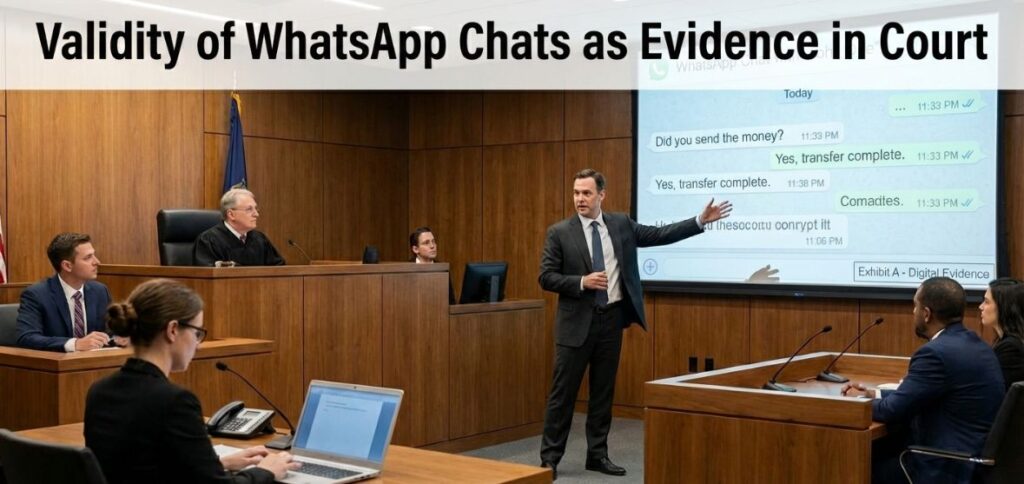
Evidence is one of the keys in the success or failure of a case in contemporary litigation. Historically, judges were using paper documents and testimony to reach a verdict. In the modern world, the digital evidence which also captures WhatsApp messaging, emails, CCTV footage, telephone logs, and social media posts is highly significant in both civil and criminal proceedings.
WhatsApp messages are often relied upon to establish contracts, threats, admissions, conspiracy, defamation and financial transactions. Nevertheless, the courts have to make sure that such chats are genuine, unaltered and admissible in a court of law. The problem of growing volume of digital evidence and the fact that India has more than 4.5 crore cases pending has necessitated the need to verify properly.
The Bharatiya Sakshya Adhiniyam, 2023 (BSA) reinforces the legal position of electronic evidence, the continuation of the need for authenticity by certification and chain of custody. This paper discusses the admissibility of WhatsApp messages as evidence, the legal framework of the case, law of landmark cases, its advantages, disadvantages, and prospects.
Regulatory Laws of WhatsApp Chats used as Evidence
WhatsApp chats are classified as electronic records after orderly meeting the legal guidelines, and can be used as evidence in a court of law according to the Indian law. The Bharatiya Sakshya Adhiniyam, 2023 (formerly Section 65B of the Indian Evidence Act, 1872) provides that only under the conditions of a valid certificate certifying the equipment that generated the chat, the authenticity and integrity of the data, the identity of the person who created the record and the extraction method, electronic records can be used. The chats in WhatsApp can be denied in the court despite appearing genuine, without this certificate. Where a case of cyber tampering or fabrication of chats is concerned, Information Technology Act, 2000 is applicable. The Digital Personal Data Protection Act, 2023 also safeguards privacy in situations when the sensitive personal information is part of the chats.
Difficulties with Using WhatsApp Chats as Evidence
- Possible Risks of Fraud and Forgery
Chats may be edited, deleted or forged by using a screenshot or third-party programs. The courts are therefore demanding good evidence of authenticity.
- Issues With Evidence Integrity and Continuity
The courts are forced to follow the manner in which the chats were gathered, archived and manufactured. Any manipulation can cast the doubt of a break.
- Lack of the appropriate certification
A lot of cases are lost due to the failure of parties to provide the necessary electronic certificate.
- Volume and Checking of Verification
Thousands of records on computers have to be reviewed by courts and lawyers and this adds to delays.
Applicability of Technology and AI in WhatsApp Evidence Verification
AI and legal technology have now helped in managing digital evidence by:
- Identifying modified or counterfeit chat screen shots.
- This is the extraction of metadata (timestamps, the device ID, information about the sender).
- Marking trading activities as pseudo marketing.
- Ensuring chat logs by means of hash computation.
- Digital evidence management with the help of Digital Evidence Management System (DEMS) developed by C-DAC.
Through such technologies, integrity, speed, and reliability are enhanced, even though the courts are supposed to be monitored by man.
WhatsApp Chats and Electronic Evidence Landmark Case Laws
Anvar P.V. v. P.K. Basheer (2014)
According to the decision of the Supreme Court, electronic records cannot be used without an appropriate certificate. This ruling incorporated stringent compliance measures on WhatsApp chat and the likes of digital evidence.
Arjun Panditrao Khotkar v. Kailash Kushanrao (2020)
The Court made it clear that even though the certificate is obligatory, it may be provided later in case it was not possible to do that in the past. This has struck a balance between strict legal specifications and realities.
Ambalal Sarabhai Enterprise Ltd. v. K.S. Infraspace LLP (2020).
The Supreme Court recognized the evidentiary nature of WhatsApp messages but once again stated that they needed to satisfy statutory authentication requirements.
Jaswinder Singh v. State of Punjab (2023)
The acceptance of digital data was prompted by the fact that a chain of custody was clear, and it was significant that tamper-proof evidence trails are important.
Advantages of Admission of WhatsApp Chats as Evidence
The acceptance of WhatsApp chats as admissible evidence can enhance contemporary justice because it represents the digital communication reality. Such chats will give time-stamped, first-hand, and contemporaneous records that limit the reliance of insecure oral evidence when authenticated under the Bharatiya Sakshya Adhiniyam, 2023. WhatsApp messages may be strong evidence in the matters of contracts, fraud, threats, harassment, domestic violence, defamation, and criminal conspiracy. The factual character of their nature assists courts to evaluate intent, confessions, and behaviour enhancing the accuracy of facts. Chats kept electronically are also affordable, simpler to maintain, and faster to analyse and this will help in faster decision of cases- an essential consideration in a country like India where the judicial system faces a big backlog. They also enable the victims and other vulnerable parties whose hands otherwise might not be able to substantiate malpractices. WhatsApp chats can raise the level of reliability of evidence with the help of digital forensics, metadata validation, and safe evidence systems, which is conductive to fair and efficient trials according to Articles 21 and 39A of the Constitution
Ethical and Legal Concerns
The threat to privacy is that the personal information that is exchanged on WhatsApp chats may be sensitive and therefore privacy is one of the most critical provisions in the Digital Personal Data Protection (DPDP) Act. Bias and misinterpretation are also a possibility, since messages can be out of context, misconstrued or presented selectively in order to support a certain story. The technological difference is another problem, as not all judges and lawyers have obtained sufficient training on the analysis of digital evidence or AI-verified evidence, which can influence proper assessment. There is also no particular evidence control of AI; despite the acceptance of digital records as part of the Bharatiya Sakshya Adhiniyam (BSA), AI generated or AI confirmed chat evidence does not yet have specific rules of laws that regulate its admissibility and evaluation.
Future Directions
India needs to take a proactive legal and technological position in order to enhance the admissibility and credibility of WhatsApp evidence. The necessity to establish AI-related evidentiary standards to control the application of automated tools in the context of verifying digital evidence increases. The audit trails and metadata checks should be required by the courts to maintain authenticity, traceability and prevent tampering. Introduction of a secure digital evidence management system like C-DAC’s DEMS in the entire country would enhance the storage, integrity and accessibility of evidence considerably. Moreover, judges and lawyers have to be provided with formal education about digital forensics and AI-assisted evidence assessment to improve judicial decision-making. Bharatiya Sakshya Adhiniyam, 2023 also needs to be revised to introduce bias audits, explainability and reliability tests of AI-assisted digital evidence. Lastly, there is a need to make legal technology affordable to both the public prosecutors and the legal aid lawyers to facilitate that technology does not bring disparity in access to justice.
Conclusion
WhatsApp messages have emerged as a potent and a common kind of evidence in Indian courts. They can effectively determine the course of justice when verified regarding Bharatiya Sakshya Adhiniyam, 2023.
Courts have ruled in cases like Anvar P.V., Arjun Panditrao and Ambalal Sarabhai in favor of authenticity, certification, chain of custody and reliability. Although technologies and AI can improve verification and efficiency, issues of privacy, bias, cost, and transparency still exist.
The WhatsApp evidence of the future is finding a balance between technology and the legal protections in a way that digital evidence can be used to reinforce justice and not undermine it.
Frequently Asked Questions
Is the use of WhatsApp chats admissible in Indian courts?
Yes. WhatsApp messages also can be used as electronic evidence when presented in the form of a valid certificate under BSA 2023 that demonstrates authenticity.
Is it possible to use the screenshots of WhatsApp chats as evidence?
Screenshots cannot be considered enough without a proper electronic certificate and metadata checks.
What would happen when WhatsApp messages are altered or counterfeited?
Courts may reject them. Criminal liability may also be drawn by tampering in the IT Act, 2000.
Is it possible to recover deleted WhatsApp messages and use them?
Yes, provided they are retrieved by means of forensic tools and certified accordingly.
Will AI substitute human authentication of WhatsApp evidence?
No. Courts need human controls because technology is not a decision-maker but rather is just a supporting tool.
References
- Anvar P.V. v. P.K. Basheer (2014) – Anvar P.V vs P.K.Basheer & Ors on 18 September, 2014.
- Arjun Panditrao Khotkar v. Kailash Kushanrao (2020) – Arjun Panditrao Khotkar v. Kailash Kushanrao Gorantyal And Others | Supreme Court Of India | Judgment | Law | CaseMine.
- Ambalal Sarabhai Enterprise Ltd. v. K.S. Infraspace LLP (2020) – Ambalal Sarabhai Enterprise Limited v. Ks Infraspace Llp Limited And Another | Supreme Court Of India | Judgment | Law | CaseMine.
- Jaswinder Singh v. State of Punjab (2023) – Jaswinder Singh vs State Of Punjab on 25 September, 2023.
- Bharatiya Sakshya Adhiniyam, 2023 (BSA): Replaces Evidence Act; mandates certification for electronic records like WhatsApp chats. Official PDF: http://certification.manupatra.in/assets/pdf/BharatiyaSakshyaAdhiniyam2023.pdf or https://www.mha.gov.in/sites/default/files/2024-04/250882_english_01042024_0.pdf.
- Digital Personal Data Protection Act, 2023: Privacy safeguards for sensitive chat data. Official: https://www.dpdpact2023.com or https://prsindia.org/billtrack/digital-personal-data-protection-bill-2023dpdpact2023+1.