
This article is written by Ankit Mohanty of Soa National Institute of Law
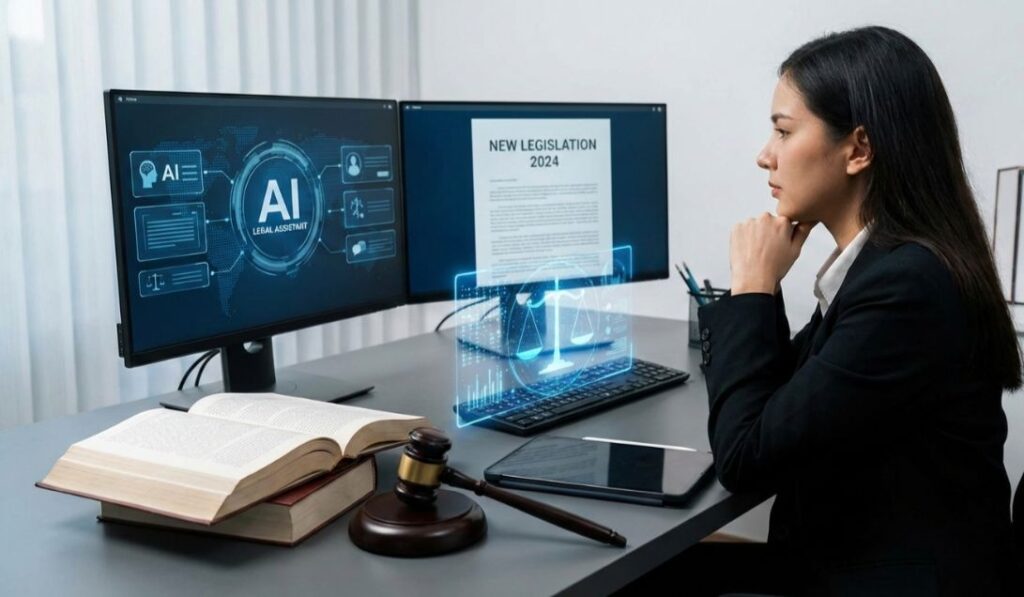
In legal research, artificial intelligence (AI) refers to machine learning methods, natural language processing (NLP), and generative models that convert static databases into dynamic research partners by parsing, summarizing, and analyzing large legal corpora. The quickly developing “new laws” such as India’s Bharatiya Nyaya Sanhita (BNS), 2023, which superseded the colonial Indian Penal Code, 1860, coupled with Bharatiya Nagarik Suraksha Sanhita and Bharatiya Sakshya Adhiniyam, make this technology extremely relevant. The specific codification of “terrorist acts” in BNS’s Section 113 is an example of how new legislation necessitates quick understanding of new sections, cross-references, and judicial interpretations. Thesis: AI requires strong ethical safeguards against delusions, bias, and over-reliance that could undermine legal thinking, even while it speeds up access to such embryonic statutes through automated scanning and predictive analytics. This article explores the development of artificial intelligence (AI) in legal research, its revolutionary applications on new legislation, Indian case studies, benefits, difficulties, ethical frameworks, and recommendations for the future. The goal is to help law students navigate the dual promise of technology.
The Evolution of Legal Research in the Digital Age
The Global leaders include Westlaw Edge (23% faster research with judicial analytics and KeyCite Overruling Risk) and LexisNexis AI (Lexis+ with conversational search saving attorneys 8.2 hours weekly). In India, Supreme Court Vidhik Anuvaad Software (SUVAS) uses machine-assisted translation for multilingual access to rulings, while Manupatra AI improves search accuracy and case forecasts. The impact of AI is confirmed by statistical snapshots: According to Thomson Reuters Users of Westlaw Edge finish assignments 23% faster; larger studies show 40–75% time savings on research, allowing for strategy redirection in the face of skyrocketing caseloads. Although it democratizes access, this digital progress requires verification against original sources.
How AI Transforms Research on New Laws
By automating cognitive burdens previously carried by academics, artificial intelligence (AI) radically changes legal research on new laws, allowing for quick understanding of emerging statutes like India’s Bharatiya Nyaya Sanhita (BNS), 2023.
Natural language processing is used by Automated Scanning and Summarization to parse unstructured data from legislation, amendments, and gazettes. The Digital Personal Data Protection Act, 2023 (DPDP Act) is ingested by tools in a matter of seconds, extracting important clauses such as permission requirements (Section 6) and data fiduciary obligations (Section 8), and producing executive summaries with clause-wise hierarchies that avoid tedious line-by-line examination. Predictive Analytics for Legislative Trends forecasts court interpretations by using machine learning on case precedents. As demonstrated by Harvey AI’s docket predictions, platforms evaluate BNS Section 113’s “terrorist act” in conjunction with UAPA rulings to forecast sedition overlaps or mens rea thresholds with 82% accuracy.
Semantic matching is used in cross-jurisdictional comparisons to map Indian reforms to their worldwide counterparts. AI finds GDPR analogies in the DPDP Act’s right to erasure (Article 17 GDPR vs. Section 12 DPDP) and purpose limitation (Article 5 GDPR vs. Section 5 DPDP), revealing comparative jurisprudence from EU case law that contextualizes India’s adequacy findings.
Challenges and Limitations
While examining new legislation such as Bharatiya Nyaya Sanhita, 2023, the integration of AI into legal research presents substantial problems that is necessary for cautious deployment. Acute dangers include hallucinations and bias, as early GPT models perpetuated training data biases favoring metropolitan, high-profile precedents over rural tribunals and fabricated cases (e.g., referencing nonexistent Vishwasrao v. State in briefs). In the absence of broad datasets, Section 113’s “terrorist act” analysis may produce skewed threat evaluations. As AI systems process sensitive case files, the risks to data privacy under the IT Act, 2000 (Section 43A) and the Digital Personal Data Protection Act, 2023 (Section 8) increase. Under DPDP’s fiduciary duties, querying BNS rules may result in the unapproved retention of customer data on US servers, necessitating cross-border compliance. Law students who rely too much on AI summaries avoid verifying primary sources, which undermines critical thinking. In terms of pedagogy, this compromises the doctrinal analysis required by the Bar Council, resulting in interns who are skilled at quick engineering but lack statutory interpretation. In order to ensure that technology enhances rather than replaces jurisprudential rigor, mitigation necessitates hybrid workflows with AI acting as the first filter and humans acting as the last gatekeepers.
Ethical and Regulatory Frameworks
The Indian Guidelines lack comprehensive AI-specific laws, despite the Bar Council of India (BCI) Rules on Professional Standards (Chapter II, Part VI) requiring competence in developing technologies while ensuring client confidentiality. The proposed Digital India Act, which anticipates AI ethics requirements, may reflect the IT Rules 2021’s intermediate due diligence for platforms like Manupatra AI. BCI disciplinary bodies are responsible for enforcement in the absence of statutory mandates. Global Benchmarks provide strict guidelines: legal AI is categorized as “high-risk” (Annex III) by the EU AI Act (2024), which mandates human oversight, bias audits, and transparency for tools that forecast BNS interpretations. AI usage is allowed under US ABA Formal Opinion 512, subject to confidentiality and competency requirements. From a student’s point of view, law students must strike a balance between the efficiency of AI and Article 21’s requirements of a fair trial. Inaccurate AI-cited precedents run the possibility of a miscarriage of justice, since the disclosure of exculpatory information is undermined by fake authority.
Prospects for the Future and Suggestions Educational Integration
As NLSIU Bengaluru demonstrates, National Law Universities (NLUs) ought to require AI literacy courses that combine prompt engineering with legislative interpretation. Hybrid research skills could be tested in bar exams. Policy Recommendations: Require original source footnotes and human-AI verification certificates for court submissions (Rule 14, BCI Rules). Create AI regulatory sandboxes for legal tech validation in accordance with the proposed Digital India Act.
Emerging Technologies: Blockchain checks citation validity against gazette databases, while generative AI such as Harvey 2.0 creates research notes on pending bills; Waqf (Amendment) Bill study in 90 seconds.
Conclusion
Through automated scanning, predictive analytics, and cross-jurisdictional mapping, artificial intelligence transforms legal study on emerging laws, such as India’s Bharatiya Nyaya Sanhita (BNS), 2023. While international benchmarks like the EU AI Act mandate high-risk oversight, AI platforms like Manupatra, LexisNexis, and Harvey provide 40–75% time savings, democratizing access for Tier-2 law students, from parsing BNSS timeframes and Biological Diversity amendments to droughting Waqf Bill notes. However, there are risks associated with this efficiency: pedagogical degradation of doctrinal rigor, DPDP-infringing data flows, and hallucinations creating precedents necessitate hybrid vigilance, AI as accelerator, not oracle. Innovation must be restrained by BCI competency requirements and the proposed Digital India Act ethics, guaranteeing that Article 21 fair trial safeguards take precedence over unbridled automation. NLUs must be at the forefront of blockchain-authenticated citations, mandated verification procedures, and AI-statutory fusion curriculum for legal education. Law students are at the cutting edge of technology as generative models develop, utilizing BNS research velocity without compromising jurisprudential sovereignty. This well-balanced adoption upholds the constitutional ethos in the face of digital innovation and strengthens India’s justice delivery against legislative flux.
Frequently Asked Questions
What are AI’s primary advantages for Indian law students?
For jobs like tracking Biological Diversity Act modifications or mapping BNSS deadlines (such as Section 193’s 45-day judgements), AI platforms like SUVAS, Lexis India, and Westlaw Edge can save 40–75% of the time. In the face of growing caseloads, they democratize access to multilingual rulings and predictive insights and facilitate cross-jurisdictional comparisons (e.g., DPDP Act vs. GDPR).
What difficulties does AI present for legal research?
Hallucinations (making up instances like nonexistent precedents), biases favoring urban cases, data privacy violations under DPDP Act Section 8, and over-reliance undermining critical thinking are some of the main hazards. Bar Council requirements require doctrinal analysis, which could be undermined if students neglect to verify primary sources.
How are AI practices in Indian law governed by ethical frameworks?
BCI Rules (Chapter II, Part VI) strongly emphasis IT competency and secrecy, while IT Rules 2021 and the proposed Digital India Act advocate due diligence. The EU AI Act classifies legal AI as “high-risk,” necessitating oversight and bias audits, while the US ABA Opinion 512 allows use with competency testing to protect fair trials under Article 21.
What suggestions does the article make for law students going forward?
NLUs like NLSIU should include AI literacy courses on prompt engineering and hybrid processes. Policy options include mandatory human-AI verification in submissions, blockchain for citation authenticity, and regulatory sandboxes. Use AI as a “first filter” in conjunction with human gatekeeping to achieve a balance between efficiency and legal rigor.
References
https://prsindia.org/billtrack/the-bharatiya-nyaya-sanhita-2023
https://legal.thomsonreuters.com/blog/how-ai-is-transforming-the-legal-profession
https://indiankanoon.org/doc/1217384
https://prsindia.org/billtrack/the-bharatiya-nyaya-sanhita-2023