
This Article is written by Jeyashri R, B.Sc. LL.B., student at the Government Law College, Madurai, Tamil Nadu. This article examines the history of income tax and DPDP Act, DPDP Act principles, tax and its evasion, computer system & virtual digital space, the contradiction between income tax & DPDP Act, and case laws.
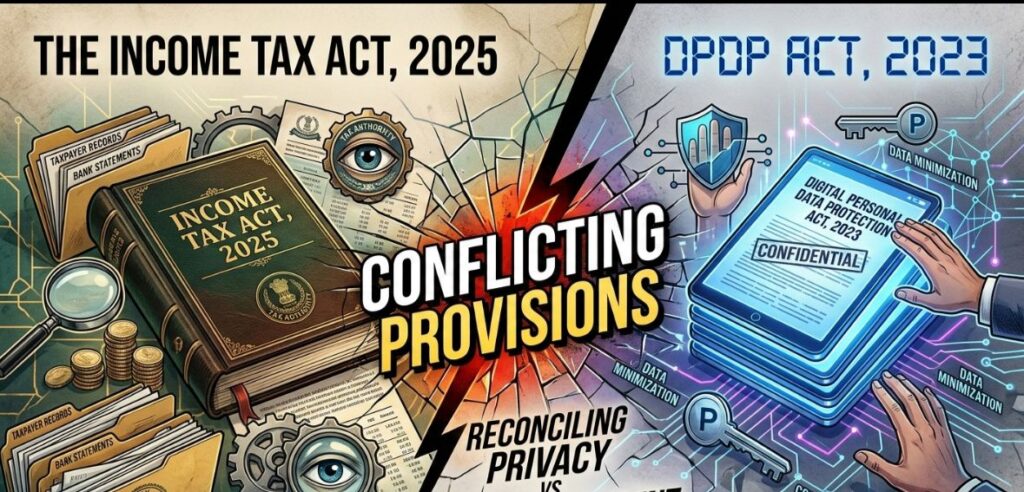
In this epoch, worldwide Information Technology usage is prevalent. Therefore, crime related to Information Technology is alarming, such as cybercrime and data theft. Internationally, many conventions have been established to protect the right to privacy, including the United Nations Convention against Cybercrime (2024), Budapest Convention on Cybercrime (2001). In India, the Information Technology Act, 2000 and the Digital Personal Data Protection (DPDP) Act, 2023, were in force. On the other hand, the white-collar crime rate is also significantly increasing. Therefore, the parliament introduced provisions in the new Income Tax Act, 2025, that challenge the Digital Personal Data Protection Act, 2023.
HISTORY
DPDP Act
Internationally, “Convention 108” was established to safeguard the right to privacy. In fact, it is the world’s first legally binding treaty in the field of data protection. India is not a party.
In India, the Information Technology (IT) Act was enacted in 2000. It deals with cybercrime. However, the area of ‘protection of data’ is unregulated. Later, in 2017, the Union government constituted a committee to examine the protection of data. Based on the committee recommendations, a draft Bill was introduced in the Lower House of the parliament. Later, the Digital Personal Data Protection Act, 2023, was enacted.
The Income Tax Act
In 1922, the history of income tax began with an enactment. This 1922 Act was replaced by the Income Tax Act, 1961. Recently, in 2025, the Indian parliament enacted the Income Tax Act. This Act raises concerns regarding Data protection.
DPDP ACT PRINCIPLES
The DPDP Act, 2023, is based on the following seven principles:
- The principle of consented use of personal data;
- The principle of purpose limitation.
- The principle of data minimisation.
- The principle of data accuracy.
- The principle of storage limitation.
- The principle of reasonable security for safeguards; and
- The principle of accountability.
TAX AND TAX EVASION
According to Prof. Taylor, Taxes are compulsory payments to governments. The taxpayer should pay without expectations for direct return or benefit to the taxpayer”. It may be either a direct or indirect tax.
In particular, Income Tax is a kind of tax levied by the Government of India on the income of every person based on a slab rate. Therefore, the taxpayer has the responsibility to report all or some of their income earned through legal or illegal means. Failure to report their income is illegal, which is known as tax evasion. It thereby increases the rate of white-collar crimes.
COMPUTER SYSTEM AND VIRTUAL DIGITAL SPACE
The term “computer system” was defined in the Income Tax Act, 2025, under Section 261(e) which defines “computer system” as computers, computer networks, computer resources, communication devices, digital or electronic data storage devices. It includes a remote server or cloud server, or a virtual digital space.
In particular, the term ‘virtual digital space’ was defined in the Income Tax Act, 2025 under Section 261(j) as an environment, area or realm that is constructed and experienced through computer technology. It is not a physical world. Rather, it is a tangible world. It encompasses any digital realm that allows users to interact, communicate and perform activities using computer systems, computer networks, computer resources, communication devices, cyberspace, the internet, web worldwide and emerging technologies. It includes the following:
(i) email servers;
(ii) social media account;
(iii) online investment account, banking account, etc.;
(iv) any website which stores details of ownership of any asset;
(v) remote server or cloud servers;
(vi) digital application platforms; and
(vii) any other space of a similar nature.
This Section raises a concern regarding personal data protection of an individual.
CONTRADICTION BETWEEN INCOME TAX AND DPDP ACT
The major conflict is between Section 247 of the Income Tax, 2025 and Sections 4,5,6 and 8 of the DPDP Act, 2023.
INCOME TAX, 2025
Section 247 of the Income Tax, 2025, empowers the competent authority to seize any such books of account, other documents, computer systems or assets (other than stock-in-trade of the business), found as a result of such search.
The grounds for such seizure are when any person is in possession of any asset or information in relation to any assets, and such asset represents either wholly or partly. Thereby, it enables the authorised officer to inspect such books of account or other documents or such information.
This exclusionary power of the concerned authority tends to affect an individual’s privacy rights. In addition, it encourages warrantless seizure. It leads to arbitrary action.
DPDP ACT
Section 2(n) of this Act defines “digital personal data” as personal data in digital form. Those data are protected under this Act. In addition, Section 2(i) defines a “Data Fiduciary” as a person who processes personal data of a Data Principal. In particular, “Data Principal” is an individual to whom the personal data relates, defined under Section 2(j).
This Act provides obligations of a data fiduciary. They are:
- Section 4: The consent of the Data principal is mandatory, and data must be used for certain legitimate uses.
- Section 5: The Data Fiduciary must give a notice to the Data Principal to access digital personal data.
- Section 6(1): The consent given by the Data Principal must be free, specific, unconditional and unambiguous.
- Section 8(5): A Data Fiduciary must protect personal data of data principal when he has possession or control. He must take reasonable security safeguards to prevent personal data breach.
In addition, this Act provides certain exceptions under Section 17 without affecting Sub-sections (1) and (5) of Section 8. That is, when the processing of personal data is necessary. It can be carried out by any court, tribunal or any other body in India entrusted by law. It will perform any judicial, quasi-judicial, regulatory or supervisory function. Even though this section supports the provisions of the Income Tax Act, 2025. Sometimes it may be enforced arbitrarily.
CASE LAWS
In the case of Malak Singh v. State of Punjab & Haryana 1981 AIR 760, it was held that the surveillance may be intrusive. It may seriously encroach upon the privacy of a citizen. It will infringe the fundamental right to personal liberty guaranteed by Article 21 and the freedom of movement guaranteed by Article 19(1)(d). In the case of Justice K.S.Puttaswamy(Retd) and anr. vs Union of India and ors. (2017) 10 SCC 1, the court gave wide scope to Article 21 by upholdingthe right to privacy as an intrinsic part of the right to life and personal liberty under Article 21.
CONCLUSION
This article examines the contradiction between the Income Tax Act, 2025 and the DPDP Act, 2023. The primary objective was to highlight how the seizure provisions of the Income Tax Act, 2025, will affect the personal data protection of an individual. Additionally, the analysis of this article is from a personal data perspective. It does not fully explore the Income Tax Act, 2025. In conclusion, the power of the income tax authorities must not be exercised arbitrarily. They must protect the data processed. Therefore, seizure must be done after issuing notice.
Frequently Asked Questions
What is the difference between the IT Act, 2000 and the DPDP Act, 2023?
The Information Technology (IT) Act, 2000, deals with cybercrimes and specified penalties. The DPDP Act, 2023, deals with data privacy.
Which rule regulates intermediary liability?
The Information Technology (Intermediary Guidelines & Digital Media Ethics Code) Rules, 2021.
Who is the chairman of the committee that provides a report on the protection of data?
The chairman is Justice B. N. Srikrishna.
What is personal data?
Personal data is any personal information of an individual. For example, names, email addresses, location, etc.
On what principles is the Indian Taxation system based?
It is based on the writings, such as Manu Smriti and the Arthasastra.
REFERENCES:
- https://www.indiabudget.gov.in/budget2022-23/doc/Finance_Bill.pdf
- https://mib.gov.in/sites/default/files/2024-02/IT%28Intermediary%20Guidelines%20and%20Digital%20Media%20Ethics%20Code%29%20Rules%2C%202021%20English.pdf
- https://www.coe.int/en/web/data-protection/convention108/parties
- https://www.meity.gov.in/static/uploads/2024/02/Information-Technology-Intermediary-Guidelines-and-Digital-Media-Ethics-Code-Rules-2021-updated-06.04.2023-1-2.pdf