
This article is written by Ishika Jangir, 1st year LL.M. student at Amity University, Kolkata. The article focuses on the evidentiary value of Whatsapp chats in Indian Courts.
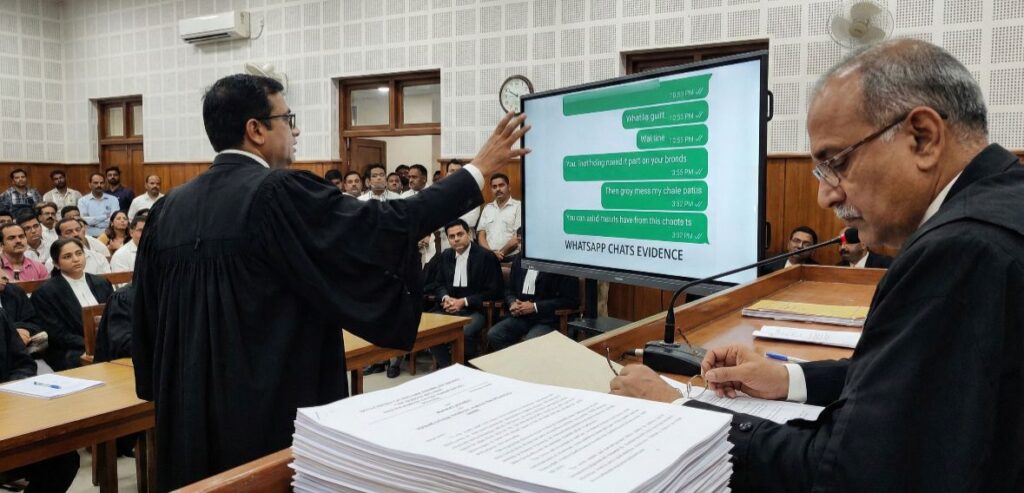
In a world where the use of digital means of communication continues to increase, Communication Platforms such as WhatsApp are becoming one of the main forms of Personal and Commercial communication. As a result, the admissibility and weight of WhatsApp chats as evidence in courts of law has become a major issue facing Indian law. Although it has been established that WhatsApp chats are electronic records and therefore form an admissible type of evidence in courts, their admissibility will be determined by a specific legislative framework that forms the basis of their legal recognition. Courts in India have established a number of judicial precedents that continue to evolve and guide the courts as they determine the legitimacy of WhatsApp chats as legal records.
This article explores the legal standing of WhatsApp chats as evidence, primarily under the Indian Evidence Act, 1872 (IEA) and the Information Technology Act, 2000 (IT Act), examining the stringent procedural requirements and landmark judicial pronouncements that shape their use in trials.
The Legal Framework for Electronic Evidence
The foundation for admitting digital communication lies in the statutory recognition of “electronic records” as a form of “documentary evidence”.
1. The Information Technology Act, 2000
Under the Information Technology Act, 2000 (as amended), section 2(1)(t) of the Information Technology Act defines an ‘Electronic Record’ as ‘a record created, received or stored in an electronic form’. Therefore, chat messages on WhatsApp are covered by this definition.
2. The Indian Evidence Act, 1872: Sections 65A and 65B
The legal basis for admitting electronic evidence is contained in Sections 65A and 65B of the Indian Evidence Act (IEA).
- As per Section 65A, a party may use the provisions of Section 65B when establishing what the contents of electronic records were.
- Section 65B constitutes a “complete code” in itself to establish whether or not an electronic record can be admitted as evidence, and in the case of documents regarded as ‘deemed documents’ under the IEA, will permit admission if certain technical and procedural requirements have been satisfied.
Therefore, if the electronic record is one that has been recorded, saved, printed, copied, or otherwise maintained on paper; in other words, it is available in a form other than its original (a screenshot/print out of a WhatsApp chat) and satisfies all of the technical and procedural prerequisites as set out in Section 65B of the IEA, that print-out or screenshot would have the same evidentiary value as if it had been created at the time.
3. The Mandate of the Section 65B Certificate
To be admissible as evidence, WhatsApp chat records usually need to come with a certificate issued under section 65(b)(4) of the Indian Evidence Act. The purpose of the certificate is to provide assurance regarding the credibility of these records, because they can easily be created or altered by anyone with digital access to a message.
The certificate must be from someone with official authority regarding operations of the device where the message was created and requires the following:
- The identified electronic record where the statement appears, and how this record was produced.
- Information about the device (mobile phone/computer) that produced this record.
- Confirmation that this electronic record was produced on the device while the device was normally used for storing and processing information, and that this information was typically inputted into the device in the regular course of activities.
- A statement that at the time of creation of the electronic record the device was fully functional, and that the information in the electronic record can be duplicated from the information that was entered into the device.
Failure to produce the mandatory Section 65B certificate renders the electronic record inadmissible as secondary evidence.
Landmark Judicial Precedents
The interpretation of Section 65B and the specific status of WhatsApp chats have been clarified through several landmark Supreme Court judgments, often resolving conflicting views.
1. The Mandatory Certification: Anvar P.V. v. P.K. Basheer (2014)
The three-judges bench ruling is the basis for electronic evidence. It has mandated that “Sections 65A” and “65B” are an entirely distinct and comprehensive framework for the admissibility of electronic evidence, which will supersede the provisions in “Section 63” and “Section 65” concerning the general admissibility of documentary evidence.
The Bench further held that secondary electronic evidence (including a print-out of a WhatsApp chat) is inadmissible unless accompanied by the certificate of authentication as discussed in both “Sections 65A and 65B”.
2. The Clarification on Certificate Requirement: Arjun Panditrao Khotkar v. Kailash Khushanrao Gorantyal (2020)
Judgement from the Supreme Court helped resolve inconsistencies within the lower courts related to the need for a section 65B certificate for claimants without possession of the original evidence from the 2018 case of Shafhi Mohammad v. State of Himachal Pradesh (SHP), allowing for a temporary circumvention of the certificate.
Clarification: “the Supreme Court re-affirms and restates the requirement for Section 65B certificate to establish secondary electronic records” as follows:
- A section 65B (4) certificate is inherently required to establish any type of secondary electronic record.
- Only in instances of original electronic record is there no requirement for a section 65B certificate as long as the owner/operator of the record is present in the witness stand to produce evidence in support of the original electronic record.
- If a claimant wants to use an electronic record and does not have immediate access to the original device, the claimant may request that the Court directs the custodian of the electronic record to provide a certificate or the person in possession of the electronic record provide the owner/operator in the witness stand, with evidence supporting the electronic record.
3. Evidentiary Value of WhatsApp Chats: Ambalal Sarabhai Enterprise Ltd. v. KS Infraspace LLP Limited (2020)
This case dealt specifically with the evidential value of virtual communications. The Supreme Court noted that WhatsApp messages, as forms of virtual verbal communication, are merely types of evidence regarding both the meaning of the content contained within them and the message contained within them, and they can only be introduced into evidence at trial by way of witness testimony (primary evidence) as well as through cross-examination.
Importantly, Courts have also consistently stated that even if WhatsApp chats may be admissible (if they are authentic and meet the requirements set forth in Section 65B), being admissible does not mean that they can be automatically relied upon to prove something. The extent to which a chat will be given probative value, and how much weight the chat will hold in the process of proving something, will depend on support from other evidence and also on the ease with which the chat can be altered.
Challenges and Evidentiary Requirements for WhatsApp Chats
Despite the clear legal framework, presenting WhatsApp chats as evidence remains fraught with challenges, primarily related to authenticity, attribution, and the inherent nature of the platform.
A. The Challenge of Authenticity and Tampering
Manipulation potential is the biggest problem. An image that shows a screenshot can easily be changed through software tools. The Section 65B certificate will confirm that the method of extracting data from the device was appropriate and the extracted data is reliable. The best way to gather evidence is to use these techniques to gather evidence from the system involved in the case using best practices:
- Create forensically extracted copies using a cyber forensics expert that is certified to produce forensics reports. Cyber forensics experts should also issue a Section 65B certificate to support the metadata about when the message was received and sent, both by whom the message was sent to and was sent by.
- Preserve the device containing the chat history for examination.
- Provide the total context of the entire conversation or chat history; otherwise, the ruling of the court may not consider the importance of each individual message.
B. Attribution and Authorship
In order to utilize WhatsApp chats as evidence against an individual, it is imperative that your WhatsApp chats be properly attributed back to whom you are trying to provide evidence against through that chat. Even though chat message status can indicate whether a message was delivered and read (i.e., the presence of the blue tick), this type of status alone cannot confirm the identity of the individual who typed the wording in question. It is essential to have corroboration of the person who wrote these messages through multiple forms of proof or evidence demonstrating that the phone number used by that person to write that message and the individual to whom it was sent are consistent. Corroboration of the ownership of the number used to send the WhatsApp messages can be accomplished by obtaining documents showing the ownership of that phone number or through testimony from the person that used the phone number to send the WhatsApp message.
C. Privacy Concerns
There may be overlaps when considering the right to confidentiality (K.S Puttaswamy v Union of India) alongside the necessity to achieve justice. Courts must weigh the competing interests of privacy rights, as well as those of public order and morality. The Supreme Court held that there is nothing prohibiting the admission of illegally obtained evidence; however, while the Court has determined that relevant evidence may still be admissible even if illegally obtained, the manner of obtaining it can have an effect on its probative value and lead to additional legal proceedings against those who engaged in such an act (e.g., hacking) under the IT Act.
Conclusion: A Conditional Admissibility
In Indian court, WhatsApp messages are somewhat valid because they can be used for some purposes in court, but they cannot just be used outright because they must meet certain rules to be admissible. WhatsApp chats do not get an automatic pass for being admitted into court; instead, they have the same status under the law as electronic records and they are considered as secondary evidence which are governed by the very stringent rules of Section 65B of the Indian Evidence Act of 1872.
The main way to demonstrate that a WhatsApp chat is admissible is through compliance with the Section 65B (4) Certificate (known as “the Certificate”). Even if a WhatsApp chat is found to be admissible, its probative value is usually regarded as much less than that of a paper document because of the possibility of it being created or altered, and also because it is difficult to determine to whom the chat belongs.
Therefore, in conjunction with it being relevant to a case, a party wanting to use a WhatsApp chat in support of their position must meet the procedural requirements of the above sections, and also be able to prove the authenticity of the content of the chat. As new technology emerges, it is expected that courts will attempt to adapt to such changing technologies through interpreting and applying the same standards of admissibility to digital records as they do for traditional forms of evidence.
FAQs
- Are screenshots of WhatsApp chats admissible in court?
Ans: Yes, but not alone. A screenshot is considered secondary electronic evidence. It is admissible only if it is accompanied by a mandatory certificate under Section 65B(4) of the Indian Evidence Act, 1872, certifying its authenticity and the process of its production.
- What is the Section 65B certificate?
Ans: It is a signed written statement by a person in charge of the device/system, confirming that the electronic record (WhatsApp chat) was produced from a regularly-used, functioning device and that the data has not been altered or tampered with.
- Is the blue-tick a valid proof that the recipient read the message?
Ans: Courts have acknowledged the blue tick as an indicator that the message was received and read by the recipient’s device. However, this alone is not conclusive proof of the message’s content or the identity of the person who read it, and it still requires compliance with Section 65B.
References:
- How Indian Courts Treat WhatsApp Chats as Evidence (How Indian Courts Treat WhatsApp Chats as Evidence)
- What is the Probative Value of WhatsApp Messages in trials in Indian Courts? (What is the probative value of WhatsApp Messages in trials in Indian Courts? – Nyaaya)
- Are WhatsApp Messages Admissible in Court of Law? (WhatsApp Messages as Evidence in Indian Courts: A Legal Analysis of Admissibility under the Indian Evidence Act, 1872 – Bhatt & Joshi Associates)
- An In-depth Analysis of the Judicial Interpretation of Electronic Evidence under Section 65B of the Evidence Act (WhatsApp Chats as Evidence in Indian Courts: Legal Framework and Judicial Interpretation – Bhatt & Joshi Associates)
- Validity for WhatsApp Messages as Evidence (Validity For Whatsapp Messages As Evidence)
- Are WhatsApp Chats Admissible as Court Evidence? (Are Whatsapp Chats Admissible As Court Evidence?)