
This Article is written by Ritika Priyadarshini of Soa National Institute of Law.
The shift in paradigm based on the old Indian Penal Code of 1860 is represented by the concept of the Bharatiya Nyaya Sanhita of 2023, in which “terrorist act” is defined by Section 113 to forbid any sort of threat based on the use of explosives, guns, or hazardous materials that threaten to create terror and affect vital services. Especially in the aftermath of the 26/11 attacks in Mumbai, this provision reflects the need for the changing counterterrorism regime in India regarding provisions for sedition and waging wars as provided by the IPC. The Unlawful Activities (Prevention) Act, 1967 is closely aligned with BNS, which was enacted as part of the triumvirate that replaced colonial-era laws along with Bharatiya Nagarik Suraksha Sanhita and Bharatiya Sakshya Adhiniyam. The Parliament’s commitment this integration to national security amid rising of radicalization threats.
Definition of Terrorist Act
Section 113 (1) states that a terrorist act as using dynamite, bombs, poison, dynamite or any other lethal means to intimidate the government, public, or foreign figures to cause death or any serious injury. The clause is similar to UAPA Section 15, but it broadens the definition to include sending a “message of fear,” which might increase the scope of prosecution. International alignment is ensured by reference to UAPA’s Second Schedule accords.
Core Offences and Penalties
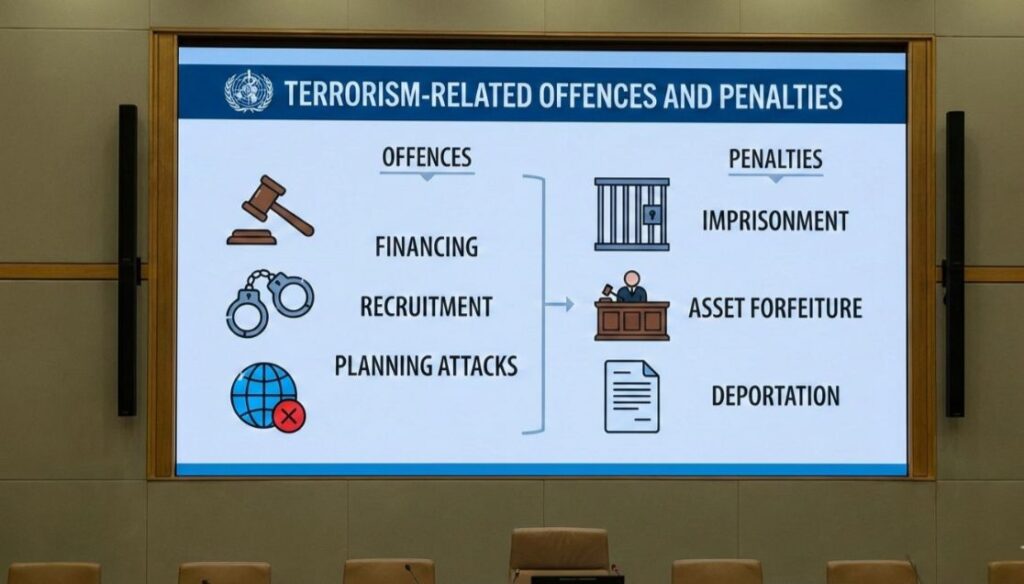
To ensure effective deterrence, a robust system for imposing punishments for terrorist activities is provided under the Bharatiya Nyaya Sanhita Act, 2023, under Section 113. The system is arranged on a severity chart. Besides imposing a life sentence and/or a life term in prison without a possibility for early release, a grave felony involving the commission of a terrorist act leading to loss of life is fined by a minimum amount of ₹10 lakh to account for the damage to life and the fabric of society. Terrorists engaging in non-fatal offenses, like detonating bombs to scare people and/or Governments at large, will face a fine calculated at a minimum ₹5 lakh and a jail sentence to ensure adequate punishment.
This law targets persistent loyalty that supports terror networks. With mandated minimum sentences limiting court discretion and high fines imposing financial consequences on offenders and supporters, these graduated penalties highlight a deterrence-centric approach.
Comparison with UAPA
India’s dual-track counterterrorism strategy has both strengths and weaknesses as compared to UAPA. In order to maintain conceptual coherence, Bharatiya Nyaya Sanhita (BNS), 2023’s Section 113 reproduces the fundamental UAPA definitions of “terrorist act” from Section 15, which include the use of explosives or lethal weapons to harm unity, integrity, security, or public order. But BNS leaves out UAPA’s procedural protections, including as Section 45’s requirement for prior government approval before prosecution, allowing for direct invocation in Sessions Courts for speedy trials without executive screening. With specialized tools like Designated Courts, professional investigators, and property seizure procedures under Sections 17–20, UAPA continues to be the legislation of choice for complex global matters. By classifying terrorism as a general criminal offence, BNS enables quicker prosecutions in common situations and permits the use of UAPA in cases of complexity involving overseas connections or registered organizations. Courts may prioritize UAPA’s rigor for seriousness, relegating BNS to supplemental roles in abetment or isolated acts, based on cases such as National Investigation Agency v. Zahoor Ahmad Shah. Although this division simplifies the administration of justice, it increases the possibility of abuse in the absence of sanction thresholds, which could put Article 21 rights at danger. Although prosecutorial flexibility is encouraged by legislative intent, judicial review is nevertheless essential to preventing overreach.
Constitutional and Critical Analysis
Section 113 of BNS provisions states to balance national security imperatives with fundamental rights to balance under Articles 14, 19, and 21 of Constitution of India, imposing penalties on terrorist acts while preserving equality, free speech, and personal liberty. The punishment is from five years to death proportionately addresses threats to sovereignty, such ambiguity risks violating Article 14’s arbitrariness doctrine, as articulated in Navtej Singh Johar v. Union of India, by enabling discriminatory enforcement against minorities or activists. In Arup Bhuyan v. State of Assam ((2011) 3 SCC 377), the Supreme Court rejected the punishment of mere membership or passive association and instead required genuine mens rea and overt acts for conviction under similar UAPA provisions, demonstrating the continued strength of judicial scrutiny. In the face of extraordinary rendition concerns, this “guilty association” rejection which was upheld in Shri Indra Das v. State of Assam requires specific proof of intent to protect Article 21’s due process safeguards.
Conclusion
Bharatiya Nyaya Sanhita (BNS), 2023, is a major revision of India’s counter-terrorism laws, distancing itself from colonial era laws while strengthening national security through the addition of terrorism offenses to an enhanced and modernized “general” penal code. The extensive codification under section 113 establishes a system of graduated deterrence to tackle the entire terror spectrum, from actual terrorism leading to loss of life (attracting a sentence of either death or life without parole), to ancillary offenses like haven-providing, terrorism finance, and membership. This is more in line with addressing terrorism offenses rather than the fragmented manner adopted under the Indian Penal Code. As a reaction to 26/11 lobby pressures for greater “operational ease” to combat nuclear terrorism in an era of rising levels of terrorism-fueled levels of-radicalization, BNS enables prompt justice delivery in Sessions Courts through verbatim adoption of UAPA definitions and expedites prosecution without previous convictions. Through the lenses of Articles 14, 19, and 21, such a two-pronged synergic interaction between UAPA is best viewed as a compromise between the special apparatus designed to combat external menaces, on the one hand, and BNS’ regular usage, on the other. Procedural loopholes can also induce an increased risk for misuse. In-built mens rea defenses, as dictated by various judicial judgments like that in the case of Arup Bhuyan, ensuring that “guilt by association” is punished only upon the establishment of evidence, yet ambiguous wording necessitates its precise usage to prevent the negating effect on free speech is necessary, yet the apparatus conferred upon security forces is robust to counter hybrid menaces, provided democratic ideals are ensured to prevail in the face of existential concerns.
Frequently Asked Questions
Define Terrorist Act under Section 113 of BNS?
According to Section 113(1) terrorist act states about its use of poison, firearms, bombs, explosives to intimidate the public, government which cause death or any serious injury. It is broadened from UAPA section 15 by including acts that send a message regarding fear.
State about the important penalties under BNS Section 113 for terrorist acts?
Any act that causes death carry a death penalty or life imprisonment or fine of minimum rupees 10 lakh. Any non- fatal acts, facilitation, conspiracy or membership in terrorist group, life imprisonment up to 5 years and rupee 5 lakh fine minimum with penalties for deterrence.
How does BNS Section 113 address similar acts such as sponsoring or harboring terrorists?
Targeting enablers and in compliance with UN Resolution 1373, there is a minimum fine of ₹5 lakh, three years to life in prison, and asset confiscation for harboring terrorists (Section 113(5)) or financing or holding terror earnings (Section 113(6)).
In terms of counterterrorism, how is BNS Section 113 different from UAPA?
In order to facilitate quicker Sessions Court proceedings, BNS replicates UAPA’s definitions but leaves out procedural protections like Section 45’s prior government sanction. A dual-track system is created by BNS handling basic matters and UAPA suing complex ones with specialized courts.
What are the constitutional concerns arising under BNS Section 113?
Words like “intimidate the public” run the possibility of being used too broadly, which might be against Articles 14, 19, and 21. In order to prevent abuse, judicial precedents such as Arup Bhuyan demand proof of intent rather than simple association and call for reforms like preliminary investigations.
References
https://lawrato.com/bharatiya-nyaya-sanhita/bns-section-113
https://prsindia.org/billtrack/the-bharatiya-nyaya-sanhita-2023
https://m.thewire.in/article/government/duplication-or-duplicity.