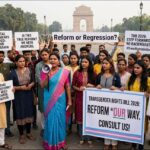
This article is written by Kashish Varshney. It breaks down a recent Supreme Court ruling on maternity leave for adoptive mothers. The focus is on what changed, why it matters in practice, and what still remains unclear.

Hamsaanandini Nanduri v. Union of India (2026)
On 17 March 2026, the Supreme Court delivered a judgment that, at first glance, deals with a very narrow issue in maternity law. But when seen in practice, the impact is much wider.
The case came from a challenge to Section 60 of the Code on Social Security, 2020. The specific problem was a condition that most people don’t even notice while reading the law. Maternity leave for adoptive mothers was available only if the child adopted was below three months of age.
That sounds like a technical detail. In reality, it decided who gets the benefit and who doesn’t.
Where the Problem Actually Was
Under the existing framework, a biological mother is entitled to 26 weeks of maternity leave. An adoptive mother gets 12 weeks, but only when the adopted child is under three months old.
The issue becomes clearer when you look at how adoption works in India.
It takes time. There are procedures, verification, and waiting periods. By the time authorities finalize the adoption, the child is often older than three months. As a result, even though the law covers adoptive mothers, many of them still fail to qualify.
The case brought attention to this gap.
The Constitutional Challenge
The petitioner challenged this restriction under Article 14 of the Constitution.
The argument was not that adoptive mothers must be treated identically in every respect. The focus was narrower.
If maternity leave exists to support early childcare and adjustment, then why should it depend on whether the child is two months old or four months old at the time of adoption?
That distinction does not really change the situation of the mother. But it completely changes her legal entitlement.
Supreme Court Analysis
The Court did not spend much time defending the structure of the provision. Instead, it focused on the purpose behind maternity leave.
The court recognized that maternity leave extends beyond mere physical recovery after childbirth. It also enables a mother to adjust to a new routine, care for the child, and build an early bond.
This understanding is not new. In Municipal Corporation of Delhi v. Female Workers (Muster Roll), 2000, the Supreme Court had already taken a broader view of maternity benefits. The Court held that such benefit is part of social justice and should not be denied even to women working on a casual basis.
That reasoning becomes relevant here. Once maternity benefits are seen as a form of social protection rather than a narrow biological requirement, the distinction in the present case becomes difficult to justify.
Why the 3-Month Condition Failed
The Court applied the test of reasonable classification under Article 14.
For a classification to be valid, it must:
- be based on an intelligible differentia, and
- have a rational connection with the objective of the law
In this case, the classification was based on the age of the child. The objective of the provision was to support motherhood and childcare.
The court found no real connection between the two.
A mother adopting a child older than three months still requires time to adjust and provide care. The responsibilities do not reduce after a specific age threshold. Because of this, the classification appeared artificial.
The reasoning aligns with earlier decisions such as Air India v. Nergesh Meerza (1981), where the Court struck down service conditions that created arbitrary distinctions affecting women employees.
Key Holding of the Court
The Supreme Court:
- Struck down the 3-month age restriction for adoptive mothers under Section 60.
- Affirmed that adoptive mothers cannot be denied maternity leave based on the age of the child.
This effectively means:
The law now grants adoptive mothers maternity leave without tying it to the child’s age.
What the Court did not do is equally important. It did not change the duration of leave. The law still provides 12 weeks for adoptive mothers.
So, the judgment removes an exclusion, but it does not fully bridge the gap between biological and adoptive mothers.
Approach Towards Equality in Parenthood
One part of the judgment that stands out is how the Court looks at motherhood.
It does not get stuck on biology. Instead, it looks at what actually happens when a child comes into a family: someone has to step in, take responsibility, adjust their routine, and provide care from day one.
From that point of view, the distinction between biological and adoptive mothers starts to feel less convincing. The nature of responsibility does not really change. An adoptive mother is still doing the same work, often without the kind of preparation time that biological mothers may have.
What the Court seems to be doing here is shifting the focus slightly. Instead of asking how motherhood begins, it looks at what motherhood involves.
That small shift makes the reasoning more practical and closer to how things actually work outside the statute.
Paternity Leave Point: A Related Concern
The Court also made a brief observation on paternity leave.
It notes that childcare is not solely the responsibility of the mother and that there is a need to consider policies that recognize shared parenting roles.
Although no binding directions were issued, the observation highlights a gap in the current legal framework.
Impact of the Judgment
This judgment has both legal and practicable implications.
1. Strengthening Equality
The decision reinforces the principle that laws cannot create arbitrary distinctions between different categories of mother.
2. Recognition of Adoptive Parenthood
It acknowledges that adoptive parents require equal support, especially during the early stages of parenting.
3. Policy Implications
The ruling may push lawmakers to revisit:
- Maternity benefit frameworks
- Gender-neutral parenting policies
- Workplace regulations
4. Workplace Impact
Employers may need to update their leave policies to align with the judgment.
Why This Judgment Matters
One thing that stands out in the judgment is the way the court frames the idea of motherhood.
It does not reduce it to biology. Instead, it looks at the role itself: care, responsibility, and adjustment.
This is not a dramatic shift, but it is noticeable.
Courts are slowly moving towards recognizing that parenting is not defined only by birth. Adoption is not an exception to the rule. It is another way in which families are formed.
Limited Scope of the Ruling
The judgment corrects a clear flaw in the law, but it stops at that.
The court removed the age restriction, yet it did not address the difference in duration of maternity leave. Biological mothers continue to receive 26 weeks, while adoptive mothers remain limited to 12 weeks.
If maternity leave is meant to support caregiving and adjustment, the basis for this difference is not entirely clear. The responsibilities that follow adoption do not significantly reduce in a way that justifies a shorter period.
The Court appears to have confined itself to the issue before it. As a result, the ruling improves access but does not fully resolve the broader imbalance.
Conclusion
The decision in Hamsaanandini Nanduri v. Union of India addresses a specific but important issue within the maternity benefit framework.
By removing the three-month restriction, the Supreme Court has ensured that adoptive mothers are not excluded from maternity leave on an arbitrary basis. The ruling reflects a more practical understanding of parenting and the needs associated with it.
At the same time, the judgment stops short of a complete reform, leaving certain questions for future consideration.
Author’s Note
What this case shows is how a single condition can affect the real value of a legal provision.
The law recognized adoptive mothers, but the age restriction limited access in a way that was not immediately obvious. That gap has now been addressed.
At the same time, the judgment feels intentionally restrained. It fixes what was clearly indefensible but avoids stepping into the larger question of whether different durations of leave can still be justified.
That question has not gone away. It has only been postponed.