This article is written by Nidhi Singh, student at Fairfield Institute of Management and Technology affiliated with Guru Gobind Singh Indraprastha University.
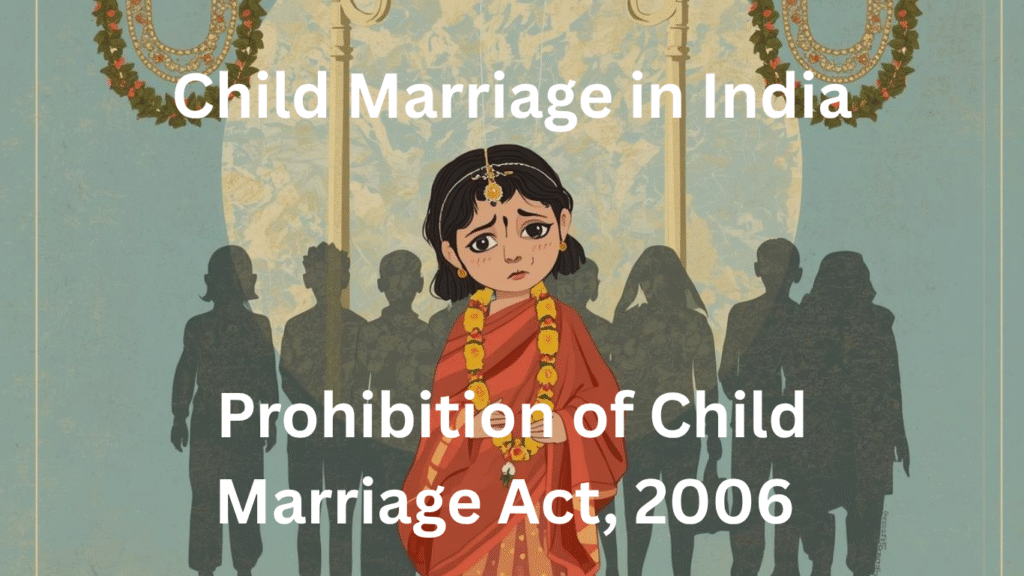
Strengthening the Fight Against Child Marriage in India: An Analysis of the Prohibition of Child Marriage Act, 2006 and Recent State-Level Amendments
Child marriage remains one of India’s most critical social challenges as well, in violation of children’s rights and undermining national goals in respect of education, health and gender equality. The Prohibition of Child Marriage Act, 2006 (PCMA) was enacted to prohibit and prevent the marriage where one of the parties is below the legal age — 18 for women and 21 for men. It criminalises persons who carry out, promote or allow such marriages and provides for protection and rehabilitation of minors.
Despite the existence of the PCMA India has witnessed a country that still registers thousands of child marriages every year, especially in rural areas. Deep rooted traditions, poverty, gender bias and poor education are still major factors. Enforcement challenges and social acceptance have also had negative impacts on how the Act has functioned. Recognising these barriers, a number of states have recently made changes or exceptions to their legislation, seeking to enhance the mechanisms against child marriage, as well as ensuring better communication between the authorities and the communities.
Legal Framework and Key Proposals
The PCMA, 2006 superseded the earlier Child Marriage Restraint Act, 1929 in order to introduce stringent punishments and means of prevention. It defines child as a male under the age of 21 years or a female under the age of 18 years and makes such marriages voidable at the discretion of the child who was a minor at the time of marriage.
The Act also:
- Penalises any person who performs or abets child marriage with imprisonment extending up to two years or fine up to [?]1 lakh.
- Appoints Child Marriage Prohibition Officers to prevent such marriages, take evidence and make some advices to the community.
- Provides for maintenance and residence and custody of children born of such unions.
However, the Act only makes certain child marriages automatically void, for instance those in which the child is trafficked, forced or tricked. The difference between void and voidable marriages makes a lot of people confused, and many illegal unions exist without anyone trying to put an end to them.
Judicial Developments
Independent Thought v. Union of India (2017)
In a historic judgement, the Supreme Court of India read down Exception 2 to the Section 375 IPC and held that sexual intercourse with a wife under the age of 18 years is rape. This judgment brought uniformity between criminal and PCMA and the Protection of Children from Sexual Offences (POCSO) Act, 2012 with regard to marriage which cannot legitimise sexual exploitation of minors. The right of the child to bodily integrity, dignity and autonomy was emphasized by the Court.
Lajja Devi v. State (2012)
In this case, Delhi High Court emphasised that the PCMA overrides all the personal laws and social customs. The court concluded that a marriage between children cannot be confirmed just because it is conformed to custom or religious practice, which the welfare and the statutory protection of a child must overcome any accommodation of social practice.
The decision re-enforces the primacy of the statutory protection granted to children and the need for the public officials to be proactive in their response rather than to be passive.
Recent Level of State Level Amendments and Policy Shifts
Rajasthan: Amendments should be introduced in Compulsory Registration of Marriages
Rajasthan amended its law passed in 2009 to make registering every marriage, including the ones in which either of the party is below legal age, compulsory. Supporters in the argument claimed the importance of registration in formulating early detection and intervention and critics claimed the possible legitimisation of illegitimate marriages. The State clarified that there is no legal recognition involved in registration and it is only used as a monitoring tool.
This debate highlights the fine line between which actions should be taken by administrative instruments and which actions should be avoided in order not to endorse a social process of the legalization of child marriage.
Haryana: Prohibition on Child Marriage (Haryana Amendment) Act, 2022
Haryana improved enforcement by giving officials the powers to intervene pre-emptively, expand the reporting obligations and increase the penalties against repeated offenders. The amendment is part of a trend towards decentralising enforcement and making it accountable at local levels.
It also gives an inter-departmental cooperation between police, child welfare committee and district administration, thus emphasizing the proactive approach of the state to meet compliance and awareness.
National Reform: The Prohibition of Child Marriage (Amendment) Bill, 2021
At the national level, the proposed amendment to the PCMA is an effort to increase the age at which women can marry from 18 to 21 years, to bring it in tune with men. The Bill also focuses on overriding incompatible personal laws and bringing uniformity. It was referred to a parliamentary committee for review amidst the debates on its impact on personal freedom, religion and cultural practices.
If passed, this change could considerably alter the face of marriage laws in India, as well as strongly indicate greater gender equality commitments.
Difficulties in Implementation
In spite of the progress achieved by legislation, there are still difficulties: This is.
1. Social Acceptance: Child marriage is an age-old custom in various societies which is linked to the notions of honour, dowry, or economic burden.
2. Enforcement Gaps: There are still enforcement gaps from a lack of trained officers, poor inter-agency coordination, and underreporting which limits the effective implementation of the law.
3. Legal Complexity: The distinctions between void and voidable marriages and different provisions of laws in different states are a source of confusion.
4. Protection and Rehabilitation: The retrieved minors often become victims of stigmatization, homelessness and, as a result, experience constraints in accessing education or livelihoods.
These challenges reveal the need for reforms in legal concerns to be coupled with larger socio-economic undertakings such as alleviation of poverty, education of girls and awareness campaigns.
Way Forward
A broad approach should be an integration of:
- Uniform legal standards throughout states in order to avoid confusion.
- Community mobilisation through NGOs, schools and local leaders in order to change social attitudes.
- Technology and registering systems for real-time monitoring as well as reporting.
- Rehabilitation programmes that include education, vocational training and counselling of victims.
- Court sensitivity and fast-track for child marriage annulment and child protection.
Such steps can help to ensure that the PCMA is not functioning as a punitive statute, but as a holistic social reform tool.
Conclusion
The foundation for combating child marriage in India was laid by the Prohibition of Child Marriage Act, 2006, which was supplemented by judicial interpretation and the work of states to fight child marriage. However, in order to make actual progress, there needs to be a shift from reactive enforcement to proactive prevention.
The relentless monitoring of amendments effected in Rajasthan and Haryana and the national bill proposed to increase age of marriage for women are significant steps in the right direction. Yet, without change in society and proper administrative capacity, laws alone cannot eliminate the practice.
Ending child marriage requires a concerted effort from government agencies, judiciary, civil society and communities – which can ensure that every child can enjoy the right to education, health and a future without early and forced marriage.
FAQs
What is the minimum age of being married in India?
Under the PCMA, 2006 – 18 years for women and 21 years for men.
Is marriage for a child automatically void?
Not always. It is voidable at the option of the minor except where there is trafficking and coercion and deceit in which case it is void.
Can lightning be prosecuted for sex relations with his under-18 wife?
Yes. After the Independent Thought (2017) ruling, such intercourse would amount to rape.
What can be done by states to reduce child marriage?
States can order compulsory registration, enhance local surveillance and give child protection officers the power to intervene at the earliest stage.
Why is this proposed 2021 Amendment Important?
It aims to establish gender parity and also delay the age of marriage for women up to 21; improve women’s educational and health outcomes.
References
- The Prohibition of Child Marriage Act, 2006 – Government of India.
https://www.indiacode.nic.in/bitstream/123456789/6843/1/child_marriage_prohibition_act.pdf - Prohibition of Child Marriage (Haryana Amendment) Act, 2022.
https://prsindia.org/files/bills_acts/acts_states/haryana/2022/ActNo-23of2022-Haryana.pdf - Rajasthan Compulsory Registration of Marriages (Amendment) Bill, 2021.
https://prsindia.org/files/bills_acts/bills_states/rajasthan/2021/Bill%204%20of%202021%20RJ.pdf - Prohibition of Child Marriage (Amendment) Bill, 2021 – Press Information Bureau.
https://pib.gov.in/PressReleaseIframePage.aspx?PRID=1947773