
This article is written by Kashish Varshney. This article examines how standard form contracts in India are reshaping bargaining power, why courts are increasingly skeptical of unfair terms, and what legal professionals, founders, and future lawyers must understand before treating “boilerplate” as harmless.
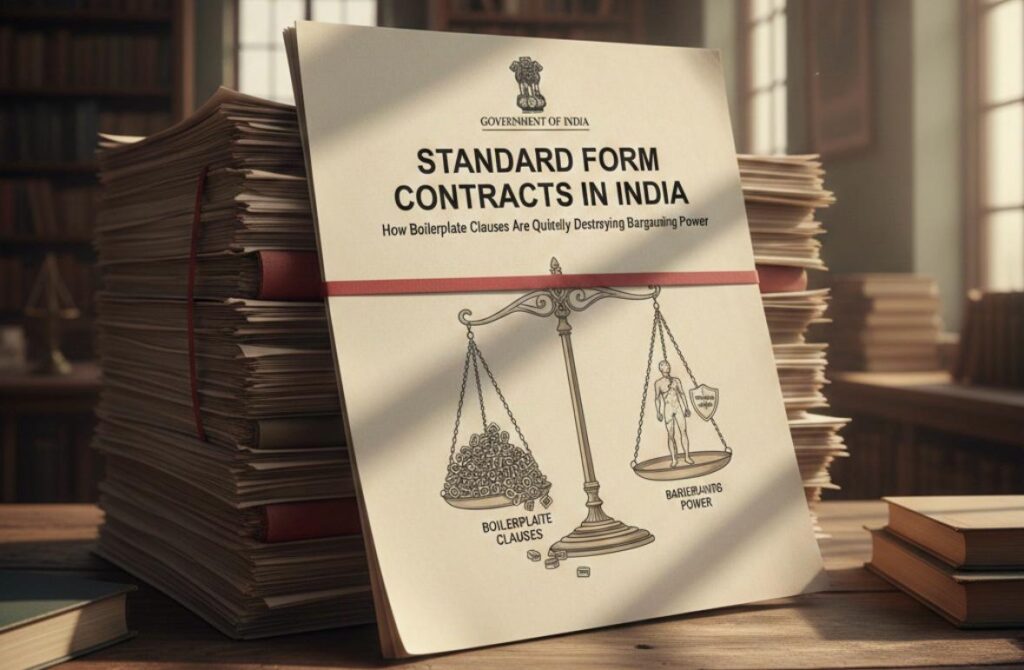
Every day, individuals and businesses in India sign contracts they never truly negotiate. From SaaS onboarding forms and employment agreements to bank loan documents and platform terms, most modern transactions rely on standard form contracts.
These agreements promise efficiency. In reality, they often hide one-sided clauses that quietly transfer risk to the weaker party. What looks like a routine document often decides who controls exit, liability, data, and dispute resolution long before a problem ever arises.
Over time, one uncomfortable truth becomes clear:
The danger is not that people fail to read these contracts. The danger is that the stronger party never wrote the contract for them in the first place.
Understanding Standard Form Contracts
A standard form contract is a pre-drafted agreement prepared by one party for repeated use. The other party does not help shape the terms. They can either accept the contract as it is or walk away from the deal.
In theory, this saves time. In reality, it removes choice.
These contracts are everywhere. We sign them when we open a bank account, accept a job, subscribe to software, shop online, or join a platform. Because they look ordinary, we rarely stop to question what they actually allow the other party to do.
The problem is not that these contracts exist. The problem is that they decide important things without discussion.
How Power Shifts Without Anyone Noticing When one party controls the entire contract, it also controls the risks. It decides who can leave, who must pay, and who is responsible when something goes wrong.
The other party may not realize this at the time of signing. The imbalance only becomes visible when a dispute arises.
This one-sided structure is why people call these agreements “take it or leave it” contracts.
The Illusion of Consent
Indian contract law recognizes free consent as its foundation under Section 14 of the Indian Contract Act, 1872. However, when one party controls the entire contract, consent becomes procedural rather than meaningful.
The Supreme Court addressed this issue in Central Inland Water Transport Corporation v. Brojo Nath Ganguly (1986). In that case, an employer could terminate workers at any time using a single clause. The court held that such a clause was unfair because the employees had no real bargaining power.
This case remains the backbone of judicial resistance to oppressive boilerplate clauses. It makes one point clear: a contract should not be enforced just because it is signed, especially when one side never had a real option.
What These Clauses Look Like in Real Life
Many people only discover the impact of a standard contract when something goes wrong.
For example, a startup may sign a software agreement that allows the provider to cancel access without notice. When that happens, the business loses data and time, but the contract limits any compensation.
Neither party commits fraud nor makes a mistake; the contract simply operates exactly as the stronger party drafted it.
Common Predatory Clauses Hidden in Boilerplate
Standard form contracts often contain clauses that look neutral but operate harshly.
- Termination for Convenience
Allows one party to exit without cause, while the other remains locked in.
- Unilateral Amendment Clauses
Permit one side to change the terms at any time without fresh consent.
- Jurisdiction and Arbitration Traps
Force the weaker party to litigate in distant cities or expensive forums.
- Overbroad Indemnity Clauses
Shift unlimited financial risk to one side, even for events beyond their control.
- Confidentiality Clauses Without Limits
Prevent employees or vendors from even speaking about unfair practices.
Parties rarely discuss these clauses before signing, yet these terms decide the outcome of disputes later.
Are Standard Form Contracts Enforceable in India?
Indian laws do not ban standard contracts. However, courts now examine whether such agreements are fair.
Section 16 and section 23 of the Indian Contract Act allow courts to reject contracts that result from unfair influence or go against public policy.
In Pioneer Urban Land v. Govindan Raghavan (2019), the Supreme Court held that one-sided clauses imposed by builders on flat buyers were unfair and not binding. The court recognized that buyers had no real choice but to accept the terms.
This shows that courts are no longer willing to treat signatures as proof of fairness.
Consumer Law and the Rise of “Unfair Terms”
The Consumer Protection Act, 2019, empowers courts to strike down unfair contract terms. It defines an unfair contract as one that places too much power in the hands of one party.
Section 2(46) defines “unfair contracts” as those that cause significant imbalance in rights and obligations.
This applies directly to online platforms, service providers, and digital agreements. What was once seen as normal practice can now be challenged.
Digital Contracts and Data Concerns
Most online platforms use click-based agreements. These often allow wide use of personal data while limiting accountability.
The Digital Personal Data Protection Act, 2023, now requires clearer consent and lawful data use. This means vague or blanket permissions may no longer be acceptable.
Standard contracts must now respect data rights, not just business convenience.
Why Boilerplate Should Never Be Ignored
Boilerplate clauses are not neutral. They quietly decide who holds power.
When legal professionals treat them as routine, they stop protecting people. Every clause carries a real consequence. Because contracts are not just paperwork. They shape relationships.
Conclusion
Standard form contracts have quietly become the backbone of modern businesses in India. They move fast and scale easily, but they also allow one side to control the language, the risks, and the outcome before the other party even enters the agreement.
The real concern is not that standard contracts exist, but that balance is missing from them. Most people and small businesses only realize what they have agreed to when a dispute arises. By then, the contract has already decided who holds power.
Courts and new laws are beginning to question this imbalance, but real change cannot come from legislation alone. It must also come from those who draft and rely on these agreements. If contracts are meant to reflect trust, they must not function as silent weapons.
Frequently Asked Questions
Are standard form contracts legal in India?
Yes, Indian law allows standard form contracts. However, courts can refuse to enforce clauses that are unfair, one-sided, or opposed to public policy.
Can courts remove or ignore unfair clauses?
Yes, courts can strike down or ignore clauses that create serious imbalance or take unfair advantage of one party. They look at how the contract was formed and whether real choice existed.
Are clickwrap and online agreements legally binding?
Yes, they are valid if users receive proper notice and clearly agree to the terms. However, vague consent and hidden conditions may weaken their enforceability.
How does the Consumer Protection Act help against unfair contracts?
The Act allows consumers to challenge terms that place excessive power on one side. Courts can cancel or modify such clauses when they harm the weaker party.
Why should founders and startups review standard contracts carefully?
Because these contracts decide liability, exit rights, and dispute rules. A single clause can expose a business to financial and legal risks that are hard to reverse later.