This article is written by Shreyansh Tripathi, B.B.A L.L.B., Symbiosis Law School, Noida.
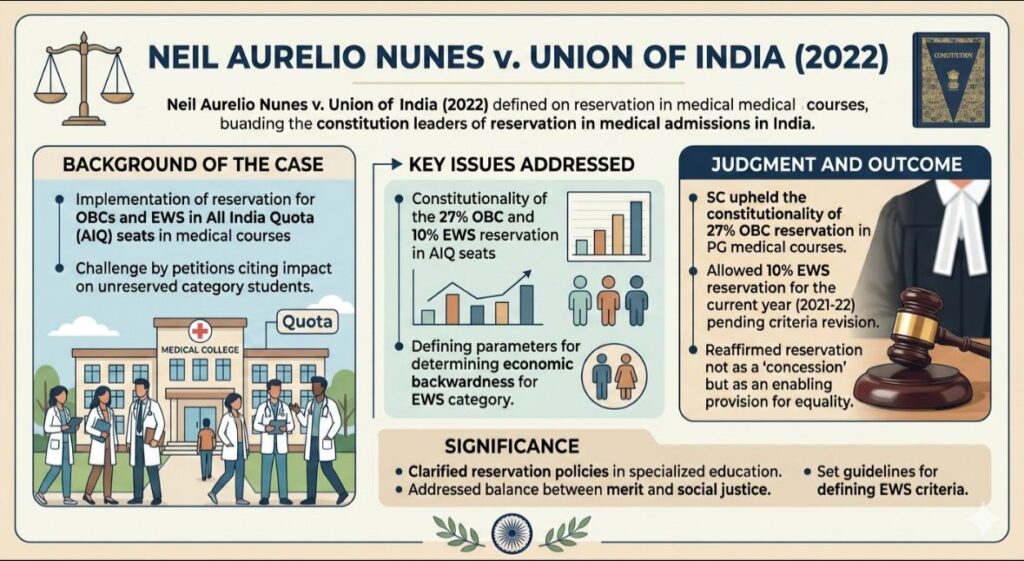
The ruling of the Supreme Court in Neil Aurelio Nunes v. Union of India (2022) is a landmark in regard to extension of Other Backward Classes (OBCs) 27% quota and the Economically Weaker Sections (EWS) 10% quota in the All-India Quota (AIQ) seats in medical admissions under NEET.
The case discussed the constitutionality of a July 2021 notification of the Union Government installing such reservations in undergraduate (MBBS) and postgraduate medical programs. The case is important due to its elaborate remarks on substantive equality, affirmative action and judicial decision on policy matters with regard to Articles 14 and 15 of the Constitution of India.
Involved laws and Constitutional Provisions
Article 14 – Ensures the equality before the law and the equal protection of the law. The petitioners utilized it to appeal to the so-called arbitrariness of the ₹8 lakh income criterion.
Article 15(4)- gives the State the power to prepare special provisions to socially and educationally backward classes (SEBCs), SCs and STs.
Article 15(5)- Allows reservation in schools, such as private unaided schools (except minority schools).
Article 15(6) – Added under the 103rd Constitutional Amendment Act, 2019, that allowed up to 10% reservation to the EWS alongside the current reservation.
103rd Constitutional Amendment Act, 2019 – Proposed Articles 15(6) and 16(6), which were constitutionally acknowledging economic criteria as a foundation of affirmative action.
NEET (National Eligibility cum Entrance Test) system and the centrally based system of All-India Quota.
Background and facts of the Case
Background
All-India Quota (AIQ) in medical admissions was established in the light of the decision made by the Supreme Court in the case of Pradeep Jain v. Union of India. This was aimed at eliminating the imbalances within regions through filling medical seats by a proportion of percentages on an all-India merit basis.
Reservations were gradually introduced in AIQ seats in the form of Scheduled Castes (SCs) and the Scheduled Tribes (STs). Reservation to AIQ seats was however not extended to OBC until several years later despite the reservation having been in place in state quotas and central educational institutions.
Facts
On July 20, 2021, the Union Government has made a notification to grant:
- Reservation of OBCs (according to the Central OBC list) is 27%.
- 10% reservation for EWS
in Medical MBBS and postgraduate AIQ.
A number of petitions were made with regard to challenging this notification. As claimed by the petitioners, the Central OBC list and the requirement of ₹8 lakh of annual income to qualify as an EWS was unconstitutional and arbitrary.
The case has been presented to a two-judge Bench of the Supreme Court which gave an interim yet detailed verdict in support of the validity of both reservations.
Arguments from both sides
The Petitioners made the following arguments:
Unacceptable Usage of Central OBC List
The petitioners argued that AIQ seats were cut off the state quotas. Thus, the application of the Central OBC list, at the expense of the state-specific backward class lists, was a breach of the federal principles and a disadvantage to some communities.
₹8 Lakh Income Criterion Arbitrariness
OBC and the eligibility of EWS were determined using the same lakh annual income limit which was ₹8 lakh. The petitioners claimed that this was tantamount to social proliferation of OBCs (who had not been covered by the creamy layer) to the disadvantaged parts of the general category which was not economically strong.
Violation of Article 14
It was held that the criterion of income did not have an empirical basis and was not presented with sufficient data, thus contravening the test of reasonable classification of Article 14.
Lack of compliance with Indra Sawhney Principles
Indra Sawhney v. was the case on which petitioners were basing their claims. Union of India which claimed that reservation should be made mainly on social and educational backwardness as well as on economic criteria, should not be made to be the sole basis unless well organized.
Respondents (Union of India) Arguments:
Constitutional Support in the Articles 15(4), 15(5) and 15(6).
Union claimed that reservation in AIQ by OBC is constitutionally acceptable because AIQ seats are centrally allocated. Article 15 (4), and 15 (5) expressly permit such measures.
Adjustment of Past Aberrations
OBC reservation was said to be an anomaly in AIQ. As SC/ST reservation was already present in AIQ, it was not constitutional to exclude OBCs.
Validity of EWS Reservation
The 103rd Constitutional Amendment explicitly allows economic standards as a condition of reservation. EWS reservation is, therefore, constitutional.
Domestic Policy and Judicial restraint
The ₹8 lakh income ceiling decision was justified as an administrative decision grounded on administrative practicability and current economic norms. The Court ought not to interfere in case it can be demonstrated that there is manifest arbitrariness.
Legal Reasoning and Judgment
OBC Reservation in AIQ 27% is valid
The Court maintained the reservation of 27% OBC in AIQ seats. It believed that AIQ is an intermediate pool of seats and thus it is reasonable to make use of the Central OBC list.
The Court placed emphasis on substantive equality – equality should take into consideration historical disadvantage. It noted that formal equality (one treating unequals as equals) would help to keep the injustice going.
Relying on Indra Sawhney v. The Court reiterated that OBC reservation was constitutionally valid, but on the exclusion of creamy layer.
Validity of 10% EWS Reservation
The Court affirmed the EWS reservation of the Article 15(6). It believed that when even the Constitution itself gave economic standards, those standards could not be struck down solely on the ground that they were not consistent with the previous jurisprudence that paid attention to backwardness by caste.
The Court acknowledged that poverty may also become institutionalized like social backwardness and may warrant affirmative action.
Validity of ₹8 Lakh Income Criterion
At the interim stage, the Court dismissed the arbitrariness argument. It held that:
- Economic classification is flexible in nature.
- The ₹8 lakh limit was not new in terms of government standards.
- Courts are to be careful in overseeing socio-economic policy decisions.
In this way, income criterion was not identified as being as such.
Case Laws
Pradeep Jain v. Union of India
This case gave birth to All-India Quota in medical admissions to encourage national integration and limit the imbalance of regions. The Court also ruled that there should be certain level of all-India merit selection and state interests should be weighed. Neil Nunes used this framework to investigate the operations of reservations at AIQ.
Indra Sawhney v. Union of India
It was declared by a nine-judge Bench that OBC reservation of a quarter in public employment was valid and developed the principle of creamy layer. It has explicated that the weapon of substantive equality in Article 16(4) is reservation. The Court used this precedent to justify the OBC reservation and the idea of no advanced sections in Neil Nunes.
Ashoka Kumar Thakur v. Union of India
The Court supported OBC reservation in central educational institutions in Article 15(5). It restated that backwardness had to be social and educational and not merely economic. It was mentioned by the Neil Nunes decision when the authors analysed the extent of reservations in education.
The requirements established in this case were data collection and demonstration of backwardness to reserve in promotions. Although it concerned Article 16(4A), it reaffirmed that affirmative action had to enjoy constitutional discipline. The rationale affected the debate on judicial standards of review in Neil Nunes.
Conclusion
Neil Aurelio Nunes v. Union of India is a landmark case upholding the constitutional viability of the extension of OBC and EWS quota to AIQ medical seats.
The Court supported 27% reservation of OBC because it was necessary to achieve substantive equality in Articles 15(4) and 15(5). It also confirmed 10 percent EWS reservation under article 15(6) in which economic deprivation was accepted as reasonable grounds of affirmative action that was constitutionally permissible.
Notably, the decision was a constitutional balancing of constitutional principles and judicial restraint, where it did not encroach on the socio-economic policy, unless there was an unmistakable arbitrariness. It enhances the role of social justice in India and supports the constitutional boundaries.
Frequently Asked Questions
What was the key problem in Neil Aureilio Nunes v. Union of India?
The sole question raised was whether the OBC (27%) and EWS (10%) reservation in the All-India Quota medical seats was constitutional.
Was the Supreme Court affirmative in reservation of OBC in AIQ seats?
Yes. The Court ruled that 27%OBC reservation in AIQ seats was constitutionally valid in Articles 15(4) and 15(5).
What was the challenge to ₹8 lakh income limit?
The petitioners contended that it was arbitrary to have identical ₹8 lakh income cap among EWS and OBC creamy layer that was in contravention of Article 14.
What was the principle of equality the Court focused upon?
The Court also focused on substantive equality more than formal equality, as it is understood that affirmative action is the way to go to overcome historical disadvantage.
What is the more general effect of this judgment?
The decision reinforces the constitutional provisions of affirmative action and clears up the authority of the State to impose reservations in educational quotas that are centrally administered.
References
OBC & EWS Reservation in Postgraduate Medical Admissions (PG NEET) – OBC & EWS Reservation in Postgraduate Medical Admissions (PG NEET) – Supreme Court Observer