
This Article is written by Tamanna, B.A. LL.B., KCC INSTITUTE OF LEGAL STUDIES AND MANAGEMENT, Gr Noida.
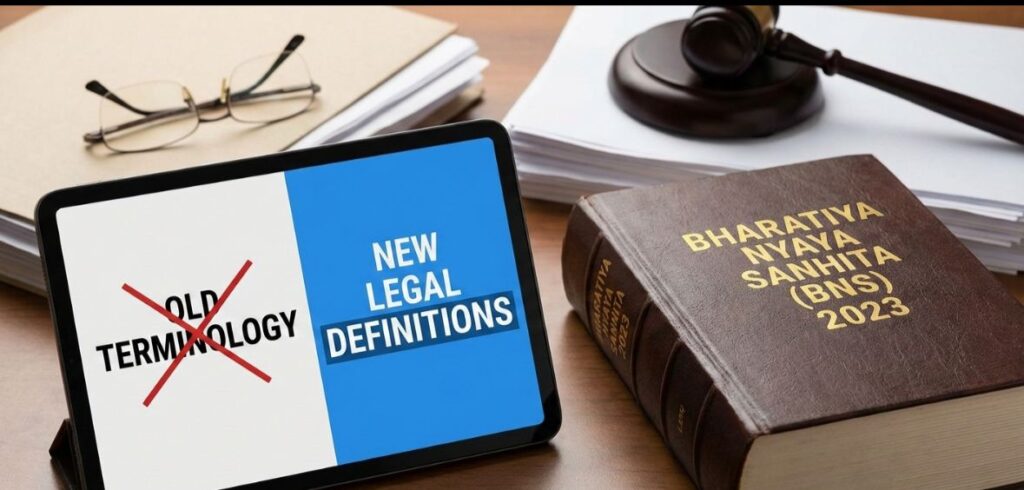
On the 1st of July, 2024, The Indian Criminal Justice system had the biggest overhaul when the Bharatiya Nyaya Sanhita (BNS) 2023 came into force. For almost 164 years, the definition(s) of crime in the Indian Society were organized under the Indian Penal Code (IPC) 1860. The transition to the new BNS fundamentally changes how the law operates – from ‘Dand’ (punishment) to ‘Nyaya’ (justice).
This article will discuss some central changes in definitions and their implications within this new system.
The Consolidation of Definitions (Section 2)
In the old IPC, the main terms were written and explained in Sections 6 to 52A, which meant that any person looking for the explanation had to go back and forth between different chapters.
Firstly, the BNS corrected this by bringing all such significant definitions together in one place (Section 2) arranged alphabetically.
Secondly, the BNS updated the IPC’s term ‘denotes’ with a new precise term ‘means’. This created specific definitions, reduced ambiguity and ensured consistent application across all courts.
The New Offense of “Organized Crime” (Section 111)
The biggest problem in the previous IPC was that there was no explicit provision for ‘Organized Crime’, that is – if a criminal gang had a syndicate, the police could only charge them under specific state laws like MCOCA or general conspiracy charges. This led to a situation where some members of these criminal syndicates were being acquitted because they were not directly involved in the crime.
Section 111 of the BNS corrects this by defining ‘Organized Crime’ as proposed by law: “continuing unlawful activity” undertaken by a syndicate that uses violence, threats, or other illegal means to gain financial advantage.
The definition includes Economic Offenses (Mass marketing fraud), Cyber-crimes, Land Grabbing, Trafficking Weapons, Drugs, Humans etc. If such an offense causes the death of any person, the penalty is quite severe, involving death or a sentence of life imprisonment.
Distinguishing “Petty Organized Crime” (Section 112)
In order to prevent the abuse of law on Organized Crime against minor offenders, the BNS introduced the category of “Petty Organized Crime” under Section 112 of the law.
The definition includes common crimes like theft, Unauthorized betting or gambling, selling public examination papers, card skimming, ATM Theft, etc. It addresses street gang behaviours who interfere with public order but are likely not involved in massive syndicates.
The punishment for petty organized crime ranges from one to seven years of imprisonment ensuring that the pickpocket is not sentenced in the same way as a murderer or serial killer.
“Snatching” as a Separate Offense (Section 304)
Under the previous IPC, “chain snatching” cases fell under an area of “legal vacuum” where the Police had to register these cases under “Theft” which is a bailable offense and has less punishment attached to it. The law enforcement had to prove that the robber “had caused fear of death or hurt” to charge him.
The BNS tackles this by creating a special definition for the term “Snatching” under Section 304 – the act of suddenly, quickly, and/or forcibly seizing movable items from a person.
This new definition is relevant because it does not require proof that the victim was hurt or threatened, but recognizes that the act itself is a violation of the citizen’s sense of safety. It is now considered a separate crime with a harsher penalty.
“Terrorist Act” in General Law (Section 113)
Terrorism in India was earlier defined under special laws such as Unlawful Activities (Prevention) Act (UAPA). In the new BNS, “terrorism” has been defined and included under Section 113 as an act committed with the intent to threaten the unity, integrity, sovereignty or economic security of India, or to strike terror in the public.
The most notable change in the terms used is the description of “economic security” – Example: passing fake currency is legally recognized as an offense under the act.
However, to prevent misuse by local police, the law includes a safeguard. An officer not below the rank of Superintendent of Police must decide whether to register the case under this section of the BNS or under the special UAPA law.
Sexual Offenses: The “Deceitful Means” Doctrine (Section 69)
The most contentious issues argued before Indian courts have been “rape on the false promise of marriage” – Earlier, tackling this was a challenge in courts (whether a broken promise of marriage constitutes rape). The BNS removes this confusion by adding Section 69, which criminalizes “sexual intercourse by employing deceitful means.”
Crucially, however, this is defined separately from Rape (Section 64). The section clearly defines what “deceitful means” are – Making a false promise of employment or promotion, marrying someone by concealing real identity, encouraging marriage without an intention of honoring the promise.
This terminology validates the legal principle – consent obtained through fraud cannot be valid. It also sets this apart from other forms of forced sexual assault. The punishment can include a prison term of up to ten years.
Decolonizing Language: Sovereignty, Gender, and Mental Health
The BNS also focuses on adding modern values and removing colonial traces. It focuses on Transgender Inclusion – including “transgender” in the definition of gender, Mental Illness – Terms like “lunatic” and “unsound mind” are replaced with more respectful and medically accurate terms (“Person with mental illness”), Treason vs. Sedition – Section 124A (Sedition) is replaced by Section 152, which penalizes acts endangering sovereignty, unity, and integrity.
Case Laws and Judicial Precedents
- Tehseen S. Poonawalla v. Union of India (2018): The SC termed mob lynching as “mobocracy” and urged special legislation.
BNS Update: Section 103(2) incorporates this, mandating death or life imprisonment for murder by a group of five or more on grounds of race, caste, or community.
- Navtej Singh Johar v. Union of India (2018): This judgment decriminalized consensual homosexual acts and emphasized gender neutrality.
BNS Update: Section 2(10) explicitly includes “transgender” in the definition of Gender. However, the BNS notably lacks a replacement for Section 377 regarding non-consensual unnatural offenses against men.
- Mithu v. State of Punjab (1983): The SC struck down the mandatory death penalty for life convicts under IPC Section 303 as unconstitutional.
BNS Update: Section 104 revives the provision but cures the defect by offering an alternative of “imprisonment for life” alongside the death penalty, restoring judicial discretion
Conclusion
The Bharatiya Nyaya Sanhita 2023, represents a decisive break from the colonial past. By consolidating all definitions into a single section and introducing modern day terms like “Organized Crime”, “Terrorist Act” and “Community Service”, the statute modernizes the toolkit available for all law professionals and learners, and the police as well.
However, the success of these new definitions depends on how they are interpreted and implemented by the courts. Some terms like “subversive activities” in Section 152 and “deceitful means” in Section 69 are far-reaching, and without vigilant judicial oversight, they could be misused. As the legal society transitions to this new code, the challenge will be to ensure that these modern definitions serve the cause of Nyaya (justice) rather that expanding the power of the state.
Frequently Asked Questions
Does the BNS recognize electronic records as valid documents?
Yes. Section 2(8) of the BNS explicitly includes “electronic and digital records” in the definition of a “Document”.
Has the offense of “Sedition” been retained in the BNS?
No, the specific term “Sedition” (Section 124A IPC) has been removed. It has been replaced by Section 152 – penalized acts endangering the “sovereignty, unity, and integrity of India” through secession or armed rebellion.
What is the difference between “Organized Crime” and “Petty Organized Crime”?
“Organized Crime” (Section 111) refers to serious offenses like economic fraud and contract killing committed by a syndicate. “Petty Organized Crime” (Section 112) covers street-level gang crimes like snatching, theft, and unauthorized betting.
How is “Community Service” defined in the new law?
Section 4(f) introduces Community Service as a punishment for petty offenses like defamation and theft under ₹5,000.
Is a false promise of marriage considered Rape under the BNS?
No. The BNS creates a separate offense under Section 69 – “sexual intercourse by employing deceitful means”. This is punishable by up to 10 years’ imprisonment and is legally distinct from Rape.
References
- Bharatiya Nyaya Sanhita, 2023, No. 45 of 2023 (India).
- Indian Penal Code, 1860, No. 45 of 1860 (repealed 2024) (India).
- National Legal Services Authority V. Union of India, (2014) 5 S.C.C. 438 (India).
- Tehseen S. Poonawalla v. Union of India, (2018) 9 SCC 501.
- Navtej Singh Johar v. Union of India, (2018) 10 SCC 1.
- Mithu v. State of Punjab, (1983) 2 SCC 277.
- Key Changes in the Bharatiya Nyaya Sanhita, 2023 – Drishti Judiciary.
- Decoding the Bharatiya Nagarik Suraksha Sanhita (BNSS), 2023 – Lawctopus.
- Top 10 Changes Made by BNS Vis-a-Vis IPC – Taxmann.