
This article is written by Neeraj Jain, Siksha O Anusandhan National Institute of Law, Bhubaneswar
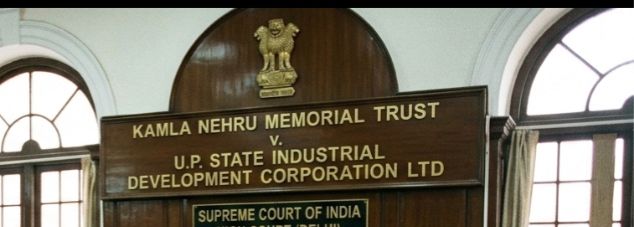
Supreme Court Upholds Cancellation of Industrial Land Allotment in Kamla Nehru Memorial Trust v. U.P. State Industrial Development Corporation Ltd.: Ensuring Fair Contracts and Public Resource Protection
Justices Surya Kant and Nongmeikapam Kotiswar Singh affirmed cancellation of a 125-acre allotment of industrial land in Uttar Pradesh in Kamala Nehru Memorial Trust v. U.P. State Industrial Development Corporation Ltd., 2025 INSC 791 on repeated defaults in paying. The Court also refused to allow a re-allotment in the public trust notion without transparency and thus, strengthened the responsibility in government land transactions (Kamla Nehru Memorial Trust v. U.P. State Industrial Development Corporation Ltd., 2025 INSC 791).
Case Law
Factual Background and Allotment Process
On July 10, 2003, KNMT made an application to UPSIDC under the scheme of 125 acres of Utelwa in Jagdishpur, Sultanpur, giving earnest money of 62,600. It was allotted on September 18, 2003, at ratios of 10 per cent. money on September 18, 2003; and 90 per cent. by eight half- annual instalments in respect of December 1, 2006; and 15 per cent. interest on delay (3 per cent rebate on prompt payment); lease deed; and as is where is basis.
KNMT failed to pay preliminaries and further extensions to November 17, 2003 were made with interest. Late delivery requests were not granted under the policy of a waiver. Notices pursued: December 14 2005 (4,04,850 overdue); November 13 2006 (869.20 overdue 10 days, Clause 15(a)6(b)). Cancellation date January 15, 2007.
KNMT did not allege any form of demarcation, possession or encroachment excuses. UPSIDC argued in its defense: site plan approved, March 3, 2005 (recognized March 11 by KNMT); farmer lands bought/compensated; possession by lease deed. The Court held that the defaults imposed by KNMT were willful and that it could only pay in part without interest in a period not less than half a decade.
High Court Proceedings and Remand
Writ Petition No. 349/2007 (amended) was filed by KNMT after which it obtained an interim stay against fresh allotments. It was reinstated on May 27, 2009, by the lone judge, said to be UPSIDC SLP (C) No. 14680/2009 but the Supreme Court refunded it on appeal on May 29, 2009, on the ground of reasoned merits decision. In the process, M/s Jagdishpur Paper Mills Ltd. was allocated to UPSIDC (challenged in Misc. Bench No. 11055/2013, status quo ordered).
On May 29, 2017 (following SLP (C) No. 7952/2014), the High Court upheld cancellation on the basis of non-payment, non-rescheduling and UPSIDC Manual Clause 3.04(vii) (cancellation after three notices). The Supreme Court has then been approached by KNMT.
Arguments of Parties
Petitioner’s Arguments (KNMT): Delayed demarcation, encroachments, compensation against farmers with UPSIDC not delivering possession (fulfilling contract objectives), and in that respect frustrated the contract and required non-payment and waiver of interest. Processually invalid (no captions/consequences under Manual); applied to be reinstated on grounds of charitable status and part payment.
Respondent’s Arguments (UPSIDC): Cancellation under Clause 3. 04(vii) through three notices by dues/breaches/ forfeiture. There was evidence of demarcation (site plan March 3, 2005), possession (lease deed) and compensation, no frustration or prejudice, there are no waivers to policy with regard to willful defaults.
Supreme Court Analysis: Key Legal Issues
- Issue 1: Was UPSIDC Frustrated in the Contract? Non-possession was one area of reciprocal breach presented by KNMT. The Court did not accept this: demarcation finished, no encroachments (affidavits proved), post-lease possession deed (slowness of KNMT). allotment letter bound- no frustration recovered.
- Issue 2: Was the Procedural Form of Cancellation Valid? Under UPSIDC Manual, three consecutive notices were to be made after default. Notices including December 14, 2004; July 1, 2005 (rescheduling-demand); December 14, 2005; November 13, 2006, were qualified in that they expressed facts, dues, breaches and consequences allowing no prejudice. In Dilip Singh v. State of Haryana (2019) 11 SCC 422: the procedure safeguards. No certain caption was required, content counts.
- Issue 3: Public Trust Doctrine’s Role. Invoking M.C. Mehta v. Kamal Nath (1997) 1 SCC 388 and Natural Resources Allocation, in re (2012) 10 SCC 1, the Court considered industrial land as a government resource. The allocation in 2003 (for two months) without any bids and economic criteria was illegal and did not comply with transparency. Re-allotment during litigation was a breach of policy; annulled. Orders: allotments that are done in the future through competitive bidding, revenue maximization, job creation, and environmental checks.
Legal Precedents Established
This aligns with M.C. Mehta v. Kamal Nath, went further in trusting lands/forests under Article 21 replicated in The Majra Singh v. Indian Oil Corpn. It strengthens the case Centre for Public Interest Litigation v. Union of India (2012) 3 S.C.C 1 about natural resource auctions. Rulings Compares early High Court liberalism (set aside of restoration), of strict compliance with allottee sympathy, in contrast to certain pre-remand cases.
The ruling endorses contractual discipline: governments cannot continue on a perpetual basis condoning defaults on limited public properties that are currently worth crores. It provides systemic UPSIDC reforms to transparent policies that contribute to the responsive growth of the industry.
Implications
It is a decision that supports contractual discipline: governments can never ever continue condoning defaults in hard-to-find public lands worth crores. It requires UPSIDC reforms on transparent and competitive policies to promote responsive growth in the industrial context.
Conclusion
Kamala Nehru Memorial Trust case can be viewed as an example of judicial control over managing public assets. It is strongly in support of cancellation of wilful defaults subsequent to reasonable notices, and restrains wanton acts of the state through the benevolence of a public trust. Notices of law must have clarity in their content- not strict titles- by making the process fair.
Government agencies such as UPSIDC should embrace competitive allotments that are open to maximize revenues, employment, and sustainability without having to litigate the case. The strict liability is imposed on allottees; there is no excuse to payments. Such precedent is defining the Indian industrial policy and balancing between development and accountability of the populace in view of land scarcity.
It presupposes an irreversible judicial turn to more stringent enforcement of contractual liability in the distribution of public resources, integrating the Articles 14 equality and 21 right to clean environment, and putting the immediate pressure on the legislative changes of equal transparency framework in all states. As a lesson to policymakers, developers, and other stakeholders, it points to the need to have working compliance, healthy bidding, and proactive policy audits to ensure that the interests of the people are met and that sustainable growth goes on at a high pace.
Frequently Asked Questions
What was the core dispute in Kamla Nehru Memorial Trust v. UPSIDC?
KNMT’s challenge to 125-acre land cancellation for payment defaults; Court upheld it but annulled subsequent allotment.
How did the Supreme Court define a ‘legal notice’ under UPSIDC Manual?
Clear facts, breach intimation, legal consequences, unambiguous—no specific caption needed if substantive.
Why invoke public trust doctrine here?
Industrial land as a public resource requires transparent, competitive allocation for public benefit (M.C. Mehta Lineage).
What evidence refuted KNMT’s non – possession claim?
Completed demarcation (site plan March 3, 2005), lease deed possession, and farmer compensation affidavits.
What future directives did the court issue for UPSIDC allotments?
Competitive biddings, revenue maximization, job creation and environmental checks to ensure transparency.