
This article is written by Samriddha Ray, St. Xavier’s University, Kolkata
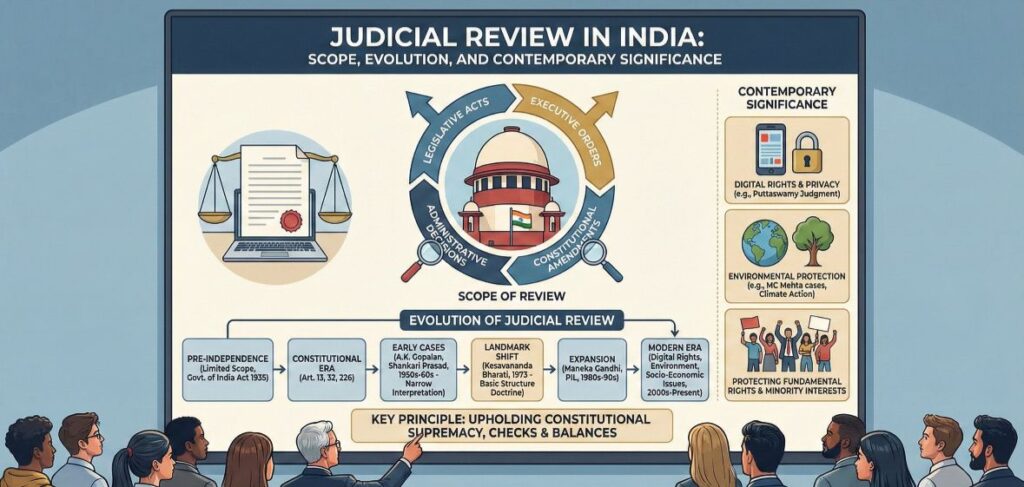
Judicial Review in India: Scope, Evolution and Contemporary Significance
Introduction
Judicial review forms the cornerstone of constitutional governance in India. It is the power of the judiciary to examine the constitutionality of legislative enactments, executive decisions, and administrative actions. The framers of the Constitution envisioned the judiciary as the guardian of fundamental rights and the protector of constitutional supremacy. Judicial review ensures that all organs of the State function within the limits laid down by the Constitution and do not violate the principles of democracy, rule of law, and separation of powers.
While the Constitution does not explicitly define “judicial review,” its foundations lie in Articles 13, 32, 131, 136, 137, 142, 226, and 227. Over time, judicial review has become a fundamental structural feature of the Constitution—one that cannot be diluted even by a constitutional amendment.
The scope and content of judicial review in India have been shaped through decades of judicial interpretation. From early judicial conservatism to the transformative jurisprudence of the post-Emergency era, it has evolved into a powerful tool of accountability. Today, judicial review extends to constitutional amendments, administrative discretion, electoral processes, federal disputes, and socio-economic rights.
This article explores the evolution of judicial review in India, its expanding scope, significant case laws, and its crucial role in contemporary constitutional democracy.
Evolution of Judicial Review in India
Judicial review in India emerged through several developmental phases, shaped by colonial jurisprudence, constitutional debates, and judicial decisions.
1. Colonial Foundations
During the British era, judicial review was limited. The Privy Council allowed courts to strike down laws only where they exceeded legislative competence. There was no concept of fundamental rights or judicial scrutiny on grounds of arbitrariness.
2. Constituent Assembly and Constitutional Design
The framers, influenced by the U.S. and Irish Constitutions, deliberately incorporated provisions for judicial review. Key members including Dr. B.R. Ambedkar, K.M. Munshi, and Alladi Krishnaswamy Ayyar emphasised that judicial review was necessary to safeguard rights and maintain constitutional supremacy.
3. Early Judicial Approach (1950–1970): Conflict Between Parliament and Courts
In the initial decades, the courts often clashed with Parliament on issues of land reform and the scope of fundamental rights.
Key developments included:
- Disputes over the right to property
- Introduction of the Ninth Schedule
- Amendments made to override judicial verdicts
The judiciary gradually asserted the authority to review constitutional amendments.
4. Post-Emergency Expansion (1976–1990)
The Emergency period (1975–77) highlighted the dangers of unchecked executive power. In the post-Emergency era, the judiciary transformed into an active protector of civil liberties, resulting in:
- Public Interest Litigation (PIL)
- Expansion of Article 21
- Greater scrutiny of administrative actions
5. Contemporary Judicial Review (1990–Present)
In modern times, judicial review has expanded to include:
- Fundamental rights disputes
- Constitutional morality
- Electoral reforms
- Environmental protection
- Socio-economic rights
- Review of digital and technological governance
Today, it forms an essential bulwark against arbitrary power in a rapidly changing society.
Scope of Judicial Review in India
Judicial review can be broadly categorised into three major heads:
1. Judicial Review of Legislation
The judiciary can invalidate laws that:
- Violate fundamental rights (Article 13)
- Exceed legislative competence
- Violate basic structure
- Are arbitrary or manifestly unreasonable
This ensures constitutional supremacy over parliamentary sovereignty.
2. Judicial Review of Administrative Action
Under Articles 32, 136, 226, and 227, courts oversee administrative actions based on the principles of:
- Reasonableness
- Proportionality
- Legitimate expectation
- Natural justice
- Non-arbitrariness
- Fairness in procedure
This prevents abuse of power by bureaucratic authorities.
3. Judicial Review of Constitutional Amendments
A unique aspect of Indian constitutional law is that even constitutional amendments are subject to judicial review. While Parliament can amend the Constitution under Article 368, it cannot alter the Basic Structure.
Significant Case Laws on Judicial Review
1. Shankari Prasad v. Union of India (1951)
The Supreme Court upheld Parliament’s power to amend fundamental rights. This marked the early phase of judicial deference toward legislative authority.
2. Golaknath v. State of Punjab (1967)
In a dramatic shift, the Court held that Parliament cannot amend fundamental rights. This ruling emphasised constitutional supremacy but led to political backlash, resulting in subsequent amendments.
3. Kesavananda Bharati v. State of Kerala (1973)
A landmark judgment that established the Basic Structure Doctrine, holding that:
- Parliament can amend any part of the Constitution
- But cannot alter its basic structure
Judicial review itself was held to be part of the basic structure, making it non-amendable. This case is the bedrock of modern constitutional jurisprudence.
4. Indira Nehru Gandhi v. Raj Narain (1975)
The Court struck down the 39th Constitutional Amendment, holding that judicial review of election disputes forms part of the basic structure. This strengthened judicial independence during a politically turbulent period.
5. Minerva Mills v. Union of India (1980)
The Supreme Court held that:
- Judicial review is essential for maintaining constitutional balance
- Parliament cannot enlarge its own amending power to destroy the basic structure
This judgment restored equilibrium between fundamental rights and directive principles.
6. L. Chandra Kumar v. Union of India (1997)
The Court held that:
- Judicial review under Articles 32 and 226 forms part of the basic structure
- Tribunals cannot replace the High Courts and Supreme Court in exercising judicial review
This reinforced the hierarchical authority of constitutional courts.
7. I.R. Coelho v. State of Tamil Nadu (2007)
The Court ruled that:
- Even laws placed in the Ninth Schedule after 24 April 1973 (post-Kesavananda) are open to judicial review
- Any law violating the basic structure can be struck down
This decision curtailed misuse of the Ninth Schedule as a shield for unconstitutional laws.
8. Puttaswamy v. Union of India (2017) — Right to Privacy
The nine-judge bench declared privacy as a fundamental right, expanding judicial review’s role in digital and technological governance. The Court held that State actions must satisfy:
- Legality
- Necessity
- Proportionality
- Procedural safeguards
This case significantly broadened the scope of judicial scrutiny.
9. Anuradha Bhasin v. Union of India (2020)
Addressing internet shutdowns, the Supreme Court held:
- Freedom of speech includes online communication
- Restrictions must be reasonable, temporary, and reviewable
- Orders must be published for judicial review
This reflects the court’s oversight over executive powers in the digital era.
Contemporary Significance of Judicial Review
Judicial review plays a critical role in contemporary India, especially amidst rapid social, political, and technological change.
1. Protecting Fundamental Rights
Courts routinely strike down laws and executive actions that infringe upon:
- Privacy
- Free speech
- Equality
- Dignity
- Personal liberty
Judicial review acts as a constitutional safeguard against majoritarian excess.
2. Ensuring Accountability of the Executive
The judiciary ensures that executive actions comply with:
- The rule of law
- Principles of natural justice
- Procedural fairness
This prevents arbitrary governance and abuse of discretion.
3. Limiting Legislative Excess
Through the basic structure doctrine, the courts prevent Parliament from:
- Undermining democratic institutions
- Diluting federalism
- Erasing judicial independence
- Curtailing fundamental rights
4. Advancing Social and Environmental Justice
Through PILs and expansive interpretations of Article 21, judicial review has been instrumental in:
- Recognising the right to clean environment
- Upholding human dignity
- Protecting labour rights
- Advancing gender justice
5. Regulating Digital Governance
In the age of:
- Aadhaar,
- Internet shutdowns,
- Data protection, and
- Artificial intelligence,
judicial review ensures checks on State surveillance and technological overreach.
Conclusion
Judicial review is the backbone of constitutionalism in India. It ensures that every organ of the State—executive, legislature, and even quasi-judicial bodies—acts within the constitutional limits. From early conflicts with Parliament to its modern role in digital governance, judicial review has evolved into a vibrant and indispensable mechanism of accountability.
Its significance is especially profound in a complex democracy like India, where the separation of powers must be constantly maintained and fundamental rights vigilantly protected. Judicial review not only prevents abuse of power but also nurtures constitutional morality and democratic resilience.
As India continues to grow socio-economically and technologically, judicial review will remain central to preserving liberty, fairness, and the rule of law.
Frequently Asked Questions (FAQs)
1. What is judicial review?
Judicial review is the power of courts to examine the constitutionality of laws and executive actions, striking them down if they violate the Constitution.
2. Which articles of the Constitution deal with judicial review?
Judicial review is supported by Articles 13, 32, 131, 136, 226, and 227.
3. Can constitutional amendments be reviewed by courts?
Yes. Amendments violating the basic structure (as held in Kesavananda Bharati) can be struck down.
4. Is judicial review a basic structure of the Constitution?
Yes. Judicial review forms part of the basic structure and cannot be removed even by amendment.
5. Why is judicial review important in contemporary India?
It ensures protection of fundamental rights, checks on executive power, and accountability in digital governance.
References
1. Constitution of India – Official Government Publication
https://legislative.gov.in/constitution-of-india
2. Kesavananda Bharati v. State of Kerala (1973) – Basic Structure Doctrine
https://indiankanoon.org/doc/2578761
3. L. Chandra Kumar v. Union of India (1997) – Judicial Review as Basic Structure
https://indiankanoon.org/doc/1914329
4. I.R. Coelho v. State of Tamil Nadu (2007) – Ninth Schedule Review
https://indiankanoon.org/doc/723510