
This article is written by Rashmi Devendra Brahmadandi, a student of LL. B III at N. B. Thakur Law College, Nashik, Maharashtra, India
The internet plays an important role in our daily lives by allowing people, businesses and governments to connect with each other through various channels that take place over the digital space. These are referred to as intermediary platforms or service providers, which allow users to create content via social networks, search engines or any type of marketplace. Over time in India, legislation has changed significantly with respect to the liability of these intermediaries.
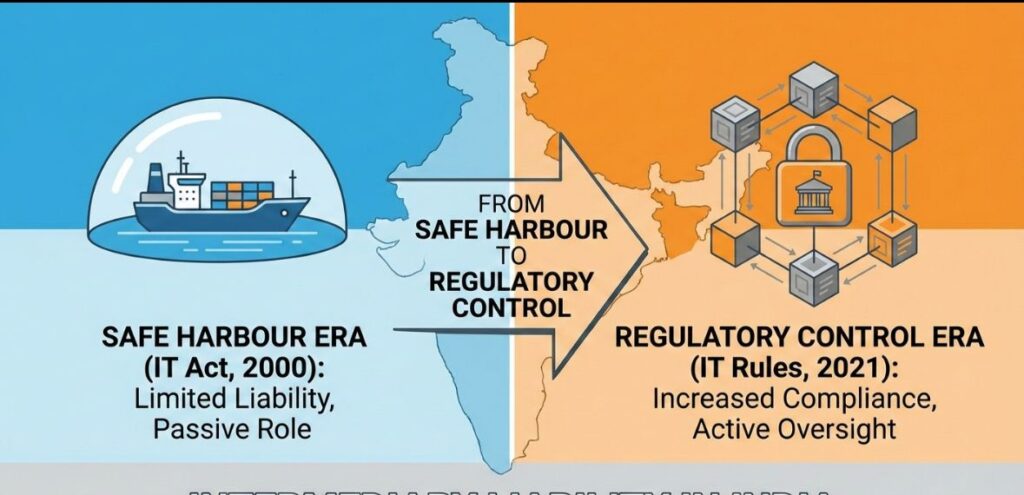
When first developed, all intermediaries were entitled to “safe-harbour” protections from being liable for third-party content posted on their behalf as long as they satisfied certain conditions. However, with the rise of various undesirable forms of Internet content, including misinformation, hate speech, cybercrime, and data misuse, the position of regulators regarding unregulated digital spaces has changed over time. As a result, Indian law has shifted from granting wide immunity to providing more regulatory oversight and accountability of intermediaries.
Meaning of Intermediary and Safe Harbour Protection
An intermediary is an online service or platform that provides users with a means to create, share and access information on the internet. Intermediaries include social media sites/ apps, search engines, e-commerce (online marketplaces) and internet service providers. In India, the concept of safe harbour was implemented to provide intermediaries with protection so as to encourage the growth of the digital economy in India.
The terms “safe harbour” refers to protection from liability for third-party unlawful activities that are on the intermediary’s site as long as they have not initiated or otherwise altered or exercised direct control over the content posted by users on the intermediary site. This allowed all intermediaries the ability to operate freely without being at risk of having constant legal claims against them.
Legal Framework Governing Intermediary Liability in India
Intermediary liability in India is guided through the operation of the Information Technology Act, 2000. Under Section 79 of the Act, intermediaries are given conditional immunity from liability in the case of third-party user content.
In order to be protected by this provision, intermediaries are required to follow due diligence obligations as defined by the Government, including publishing their terms of use informing users of prohibited use and assisting the government with lawful requests. Over the years, the nature of these obligations has been expanded by subordinate legislation to ensure responsible online usage.
Due Diligence Obligations of Intermediaries
Intermediary due diligence is essential to establish if the intermediary qualifies for safe harbour protection. Intermediaries must take reasonable steps to ensure they do not host or share illegal content. They must remove any content involving child sex abuse, terrorism, impersonation or misinformation upon proper notice.
In addition to conducting due diligence, intermediaries are also required to have an adequate grievance/redressal mechanism to effectively address user complaints. Not complying with any of these obligations will result in the intermediary losing safe harbour protection.
Rise of Regulatory Control in the Digital Space
Digital platforms have become larger and more pervasive over time, leading to many rising social concerns about fake news, harassment online, and the inappropriate use of private information. Therefore, as part of the government’s response, we have seen an increase in the regulation of all types of intermediaries through more stringent Information Technology Rules.
Some of these new regulatory requirements include appointing compliance officers, ensuring the publishing of transparency reports, and rapid responses to inquiries from the government as well as responding promptly to any complaints from users. These changes represent an evolution from a relatively unregulated industry to one that is being actively regulated.
Changing Responsibilities of Online Intermediaries
The movement from a safe smooth path to controlled regulations has greatly altered the intermediary’s role. Intermediary Platforms act as an active entity to help to maintain safety online whereas before they were merely facilitating interactions. This in turn improves the level of accountability and protects users, however there is an increase in the overall cost of operation for intermediaries, as well as increased regulation imposed on intermediaries. For users the shift from safe harbour to regulatory body increases user protection from online harm yet creates increased concern among users regarding privacy and freedom of expression. Therefore, it is necessary to develop and implement a regulatory framework that will be balanced.
Grievance Redressal and Accountability
This emphasis on the regulatory control approach has elevated the grievance redressal to an important task for the intermediaries. There is a need to prominently frame the mechanisms of grievance handling by the intermediaries within specified periods of time. The appointment of grievance and compliance officers can be seen as enhancing the aspect of accountability and transparency. This can thus be viewed as adding to the responsibilities of the intermediaries for the purpose of compliance, further reinforcing the hand of the State as a regulator.
Case Laws
Indian courts have played their part in determining the scope of intermediary liability and safe harbour protection. Among many, one important judgment is Shreya Singhal v. Union of India (2015) 5 SCC 808. The Supreme Court in this case explained that “the intermediaries would not be obliged to remove online content simply based on complaints by individuals”. The Court stated that content takedown is available only based on a court order or an appropriate government order upon the intermediaries to avoid the blocking of free speech and prevent abuse of takedown authority.
In Super Cassettes Industries Ltd. v. MySpace Inc. (2017) 236 DLT 478 (DB), the Delhi High Court addressed the liability of online intermediaries hosting copyrighted material. The Court held that while no intermediary could be expected to pre-examine every user-generated content, on receipt of specific notice for illegal material, they must act expeditiously to take down the said content.
Another important case is that of Avnish Bajaj v. State (NCT of Delhi) (2005) 116 DLT 427, which involved the online marketplace Baazee.com. The Court stated that safe harbour protection only applies when intermediaries are diligent and do not knowingly allow unlawful activities.
These decisions have, cumulatively, highlighted how courts have struck a balance between intermediary protection and the increasing accountability over the digital space.
Conclusion
Intermediary liability in India is an area of cyber law in India, which has seen considerable evolution with the rise of digital technologies and virtual communication modes. In the past, intermediary liability was based on a wide-reaching concept of safe harbour, but it has now evolved to come with high regulatory standards placed on the intermediary. It is pertinent to note that increased regulatory powers create new issues of concern having to do with privacy, compliance, as well as over-regulation of the intermediary.
Therefore, as is the case with most legal paradigms it is necessary that intermediary regulations be fair and have transparency in place because it could play an important role in creating trust in the virtual world without compromising fundamental rights in an increasingly interconnected society.
Frequently Asked Questions
What is an intermediary in Indian law?
An intermediary is defined as an online platform that assists users to create, share or access information over the internet. Some examples of this are social media sites, search engines, internet retailers, and internet service providers.
What is “Safe Harbour” in Intermediary Liability?
Safe harbour for example provides intermediaries with a measure of legal protection which relieves them of any liability for any illegal content contributed by users, provided that they exercise due diligence and have no direct control over it.
What law regulates intermediary liability in India?
The intermediary liability in India is based primarily on the Information Technology Act of 2000 and the rules framed thereunder.
When does an intermediary lose “safe harbour” protection?
An intermediary may lose safe harbour protection if it fails to comply with due diligence requirements, knowingly hosts illegal materials on its platform, or fails to follow legally legitimate instructions from government and courts.
Why has India opted for tighter regulation of intermediaries?
This can be attributed to the rise of issues such as fake news, online harassment, cybercrime, and abuse of digital media, which call for stronger accountability.
References
[3] Shreya Singhal v. Union of India (2015) 5 SCC 808 – https://indiankanoon.org/doc/110813550/
[4] Super Cassettes Industries Ltd. v. MySpace Inc. (2017) 236 DLT 478 (DB) – https://indiankanoon.org/doc/12972852/
[5] Avnish Bajaj v. State (NCT of Delhi) (2005) 116 DLT 427 – https://indiankanoon.org/doc/1308347/
[6] https://blog.ipleaders.in/safe-harbour-provisions-for-intermediaries-in-india-and-us/