This article is written by Khushi Tayal of Jiwaji University, Gwalior, Madhya Pradesh
On 15th August 1947, our country got independence following which in 1949 we adopted our constitution to run the nation without any obstacles. But there’s one state, the state of Jammu and Kashmir which also got independence, but it has its own separate constitution to run the state and govern the citizens of such a state. Therefore, since 1949, Jammu and Kashmir has had its own constitution under Article 370 of the Indian Constitution. According to article 370, the state has given a separate power to make laws for J&K subject to state government consultation. In 1957, the J&K constituency adopted the J&K constitution, and it was subsequently dissolved without recommending the removal of article 370. President’s rule was imposed in J&K in 2018 in accordance with article 356 of the Indian constitution. On 11th December 2023, the constitution bench of the Supreme Court upheld the union’s abrogation of article 370. They reasoned the imposition of article 370 as a temporary measure to ensure the integration of Jammu and Kashmir into India effectively.
Case Background
The constitutional position of Jammu and Kashmir has been one of the most intricate and contentious issues within Indian constitutional law since the country’s Independence. Article 370 of the Indian Constitution, introduced as a temporary provision, provided a special constitutional dispensation to the State of Jammu and Kashmir, which restricted the application of the Indian Constitution and provided a special measure of legislative autonomy to the State. However, the continued application of Article 370 over the years has led to serious questions regarding the constitutional integration of the State, the balance of federal power, and the extent of Parliament’s powers.
In August 2019, the Union of India struck down Article 370 and reorganized the State of Jammu and Kashmir, relying on the presidential powers under Article 370(1) and imposing President’s Rule under Article 356. This action led to a spate of constitutional challenges, largely questioning the validity of the strike-down in the absence of the Constituent Assembly of the State and the extent of the executive’s powers in modifying the constitutional provisions.
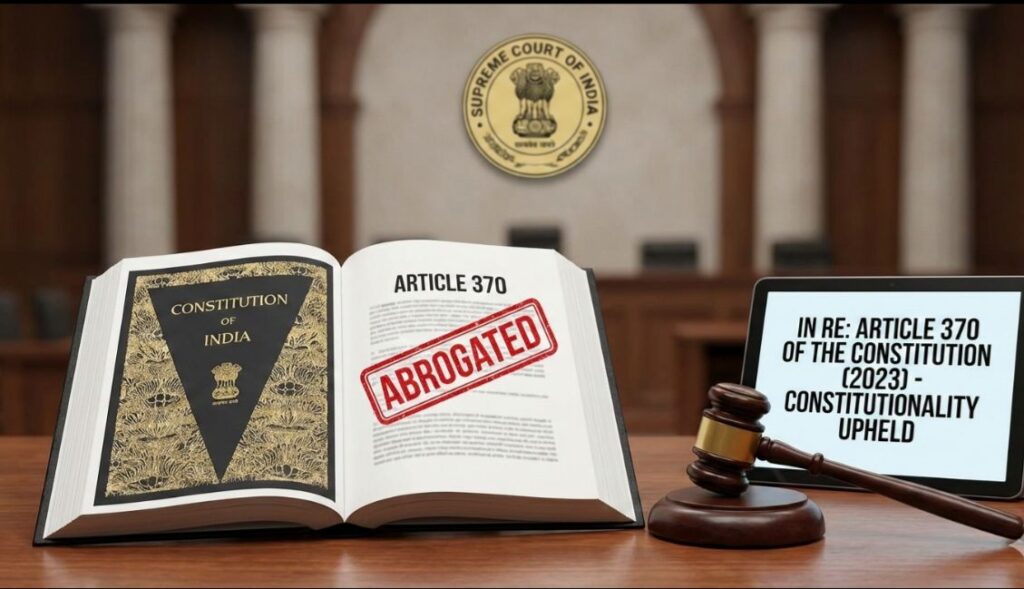
In the case of ‘In Re: Article 370 of the Constitution (2023)’, the Constitution Bench of the Supreme Court of India upheld the measures taken by the Union and held that Article 370 of the Indian Constitution was a temporary provision to enable the full integration of Jammu and Kashmir into the Union of India. This decision is a milestone in the jurisprudence of constitutional supremacy, federalism, and the scope of asymmetrical governance in the Indian Constitution.
Case Laws
- In Re: Article 370 of the Constitution: The five-judge Constitution Bench unanimously affirmed the abrogation of Article 370 and held that it was a temporary provision, and the President was competent to declare it inoperative even after the dissolution of the J&K Constituent Assembly. The Bench also affirmed the constitutional orders (CO 272 & CO 273) that gave the full application of the Indian Constitution to J&K and the competence of the Centre on constitutional integration.
- Prem Nath Kaul v. State of Jammu & Kashmir, 1959: Historic Supreme Court judgment examining the retention of internal sovereignty and legislative powers of the state in J&K, prior to its own Constitution. It was mentioned in the context of the purpose and coverage of Article 370.
- Sampat Prakash v. State of Jammu & Kashmir, 1970: Another important precedent on Article 370, particularly on whether the Article automatically lapsed after the dissolution of the Constituent Assembly and the manner in which it should be given effect to in the future.
- S. R. Bommai & Others v. Union of India, 1994: A major precedent on President’s Rule, federalism, and the powers of the Centre under Article 356.
- Rameshwar Prasad & Ors vs Union Of India & Anr 2006: Cited for constitutional standards regarding state–Union relations and judicial review.
Court’s observation
- Article 370 was a Temporary Provision: The Court held that Article 370 was of a temporary character, as clearly indicated by its location in Part XXI of the Constitution. The object of Article 370 was to enable the constitutional integration of Jammu and Kashmir with India.
- No Internal Sovereignty of Jammu & Kashmir: The Court emphatically repelled the contention that J&K retained any semblance of sovereignty after accession. After the execution of the Instrument of Accession, Jammu and Kashmir became an integral part of India, and the supremacy of the Indian Constitution prevailed.
- Dissolution of Constituent Assembly Did Not Freeze Article 370: The Court held that the absence of the J&K Constituent Assembly after 1957 did not make Article 370 permanent. The powers of Parliament under Article 370(3) did not lapse simply because the Constituent Assembly stood dissolved.
- Presidential Power Under Article 370(3) Is Not Conditioned Permanently: The requirement of “recommendation” of the Constituent Assembly was held to be context-specific, not eternal. Once the transitional phase ended, the President retained the power to declare Article 370 inoperative.
- President’s Rule Allows Parliament to Act as State Legislature: When the President’s Rule is imposed under Article 356, Parliament has the legal capacity to assume the powers of the State Legislature. Hence, the consultation/concurrence made during the imposition of the President’s Rule was legal.
- Article 370 Did Not Create a Federal Compact: The Court also dismissed the plea that Article 370 was the outcome of a bilateral or irrevocable agreement between the Union and J&K. It was a unilateral constitutional provision.
- Abrogation Did Not Violate Federalism: Indian federalism is asymmetric but not indestructible. The abrogation was declared to be within the constitutional framework and did not destroy the basic structure of the Constitution.
- Reorganisation of the State Was Not Ruled Unconstitutional: Although the Court upheld the reorganisation, it ordered that the statehood of Jammu and Kashmir must be restored at the earliest, and this will strengthen democratic governance.
- Purpose of Article 370 Has Been Fulfilled: The Court declared that Article 370 had fulfilled its historical task and that its continued existence was no longer constitutionally required once the process of integration was complete.
Conclusion
The Supreme Court’s ruling in the case of In Re: Article 370 of the Constitution (2023) finally and conclusively establishes the constitutional validity of the abrogation of Article 370. The Court is correct in identifying Article 370 as a temporary and transitional provision, which was meant to facilitate the gradual integration of the former State of Jammu and Kashmir into the constitutional structure of India. With the dissolution of the Constituent Assembly of Jammu and Kashmir in 1957 without recommending the continuation of Article 370, the provision ceased to have any operative significance.
The ruling also validated the exercise of power by the Union in the proclamation of President’s Rule under Article 356, where it was held that the President was well within his powers to assume the functions of the State Legislature and Government. As such, the concurrence required under Article 370 was obtained through constitutional means. The Court also held that the federal structure of India does not necessarily imply the indestructible sovereignty of states, and that Parliament has plenary powers in relation to reorganization and constitutional application.
Through the maintenance of the abrogation, the Court reiterated the supremacy of the Constitution, the doctrine of constitutional integration, and the unitary bias enshrined in Indian federalism during exceptional times. The decision, therefore, lays to rest the long-standing constitutional uncertainty over Article 370 and holds that its abrogation was neither an exercise of executive aggression nor ultra vires but a constitutionally sanctioned exercise of sovereignty.
Frequently Asked Questions
What was Article 370 and why was it incorporated into the Indian Constitution?
Article 370 was a temporary provision granting special constitutional status to Jammu and Kashmir due to its unique accession circumstances in 1947. It limited Parliament’s legislative powers over the state except in matters specified in the Instrument of Accession.
Was Article 370 a permanent or temporary provision?
The Supreme Court held that Article 370 was temporary, as explicitly stated in Part XXI of the Constitution. Its continuation depended on political circumstances, not constitutional permanence.
What role did the J&K Constituent Assembly play under Article 370?
The J&K Constituent Assembly had the power to recommend the modification or abrogation of Article 370. It dissolved in 1957 without making any recommendation.
Did the dissolution of the J&K Constituent Assembly make Article 370 permanent?
No. The Supreme Court rejected this argument, holding that constitutional provisions cannot become permanent by default or silence. Permanence must be explicit, not inferred.
How was Article 370 abrogated in 2019?
Article 370 was effectively abrogated through:
- Presidential Order C.O. 272 (2019)
- Application of the entire Constitution to J&K
- Passage of the Jammu and Kashmir Reorganisation Act, 2019
References
https://www.dhyeyalaw.in/in-re-article-370-of-the-constitution
https://www.livelaw.in/tags/in-re-article-370-of-the-constitution