
This Article is written by Jeyashri R, B.Sc. LL.B., Government Law College, Madurai.
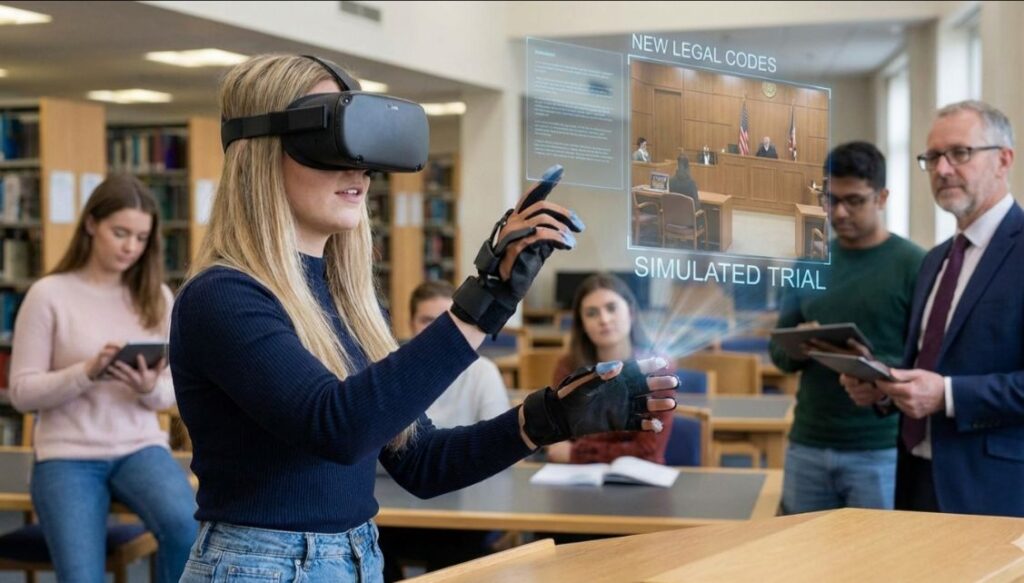
Education is the bedrock of the society because it reshapes the society by imparting ethical norms. A society that does not prioritize education and training will not achieve social transformation. Therefore, education and training are indispensable for a nation’s development. Our Indian judiciary has repeatedly emphasized the importance of education through interpretation of Article 21 A of the Indian constitution. Most particularly, legal education and training bridges the gap between society and justice, needs reforms. In this present digital era, reforms can be attained through an innovative approach called virtual reality. Therefore, training law students through virtual reality can help to achieve an inclusive and pluralistic society. This article examines the definition and evolution of virtual reality, how it helps to train law students in various disciplines of law and the challenges regarding its implementation in training law students.
NATURE AND DEFINITION OF VIRTUAL REALITY (VR):
The term ‘virtual reality’ can be defined in many ways. One such definition is, according to Cambridge University, ‘virtual reality’ is “a set of images and sounds produced by a computer that seem to represent a real place or situation that a person can take part in.” Moreover, virtual reality is often used as an umbrella term for simulated experiences, including related concepts like augmented reality, mixed reality, and extended reality. This concept is well explained through the picture below, which clearly shows the relationship between the physical world, digital world, augmented reality, virtual reality, and mixed reality.
EVOLUTION OF VIRTUAL REALITY:
The evolution of virtual reality began in the early 19th century and it took several developments. Firstly in the 19th century, Panoramax, Stereoscopex and Lenticular Stereoscope were invented.
Secondly in 20th century, the Link Trainer, View‑Masterx, first digital flight simulator, Sensorama, the sword of damocles, MIT Movie Map, eyephone glasses and a dataGlove, virtuality, sega VR, virtuality reality modelling language are the milestone in the development of virtual reality.
Finally in the 21st century, Oculus Rift, Cardboard, Samsung Gear VR and several developments including 3D models of real-world objects.
Particularly in the legal system, in February, 2023, the first Metaverse Judge in Columbia, Magistrate Victoria Quinones, found virtual reality and augmented reality tools helpful in facilitating remote testimony and witness examination.
VIRTUAL REALITY: IMPLICATIONS IN LEGAL DISCIPLINES
Virtual reality bridges the gap between legal theory and practical application of law. The following are some of the major disciplines of law, where virtual reality (VR) can transform the legal training:
CONSTITUTIONAL LAW
In India, the Constitution is supreme. Therefore, law students must possess a wide knowledge of constitutional law. The principles embedded in the Constitution must be enforced in the country to uphold citizens’ rights. Here’s how virtual reality can be used: at the first step, for proper interpretation of the Constitution, students should know the intent of the legislative assembly. Through virtual reality, it can be brought to the students. Then, from altering boundaries of the states to passing bills in both houses of the parliament and the President’s election can be taught through virtual reality. Fundamental Rights and Directive Principles of State Policy can also be taught through virtual reality by conducting virtual moot courts. Thereby justice, equality, liberty, and fraternity is ensured in the society.
HUMAN RIGHTS LAW
Human rights are the basic rights which must be guaranteed to every person. Universally, the term ‘human rights’ has a different meaning. In India, the legislation called the Protection of Human Rights Act, 1993 deals with violations of human rights. In which, Section 2(d) defines the term “human rights” means the rights relating to life, liberty, equality and dignity of the individual guaranteed by the Constitution or embodied in the International Covenants and enforceable by courts in India; This definition clearly shows that human rights are not only covered under the Constitution of India but also it is covered under international covenants and judicial precedents. In order to protect human rights, knowledge of laws dealing with it must be known. In such a case, virtual reality plays a crucial role. Here’s how virtual reality can be used: for example, the origin and development of human rights, World War I and II periods must be taught to law students through virtual reality to show the dark era in the world’s history.
CRIMINAL LAW
The criminal justice system in India is primarily governed by the three new criminal laws. They are the Bharatiya Nyaya Sanhita (BNS), Bharatiya Nagarik Suraksha Sanhita (BNSS), and Bharatiya Sakshya Adhiniyam (BSA), replacing the IPC, CrPC, and Evidence Act. Firstly, in the case of Bharatiya Sakshya Adhiniyam, both physical and digital evidence are involved. Here’s how virtual reality can be used: it can be used to recreate the crime scene and forensic evidence. Secondly, in the case of Bharatiya Nagarik Suraksha Sanhita (BNSS), through virtual reality, students can learn to understand the psychology of the accused, actus reus, mens rea, and pattern of the crime. Finally, Bharatiya Nagarik Suraksha Sanhita (BNSS), which deals with procedure, through virtual reality, law students can clearly understand the pre-trial, during trial, and post-trial procedure by conducting through virtual trial.
ENVIRONMENTAL LAW
In case of environmental jurisprudence, through virtual reality, students can understand the need to protect the environment by visualising how the ozone layer is depleted, global warming, air and water pollution, the Chernobyl disaster, the Bhopal Gas tragedy, etc. Especially, every law student must be trained to approach the National Green Tribunal and its proceedings, which can be done through virtual reality.
INTERNATIONAL LAW
International law primarily governs the relationship between nations, in which several conventions are ratified by India. For instance, complex topics like the Law of the Sea, Outer Space Law, extradition, and asylum can be taught through virtual reality for clear understanding. Most importantly, law students must be trained through virtual proceedings of the United Nation, International court of justice, International criminal court and other tribunals.
CHALLENGES OF VIRTUAL REALITY:
1. INFRINGEMENT IN INTELLECTUAL PROPERTY RIGHTS
In case of trademark law, there are several challenges that arise due to virtual reality. For instance, building a virtual version of the Eiffel Tower infringes trademark rights because it is prohibited for professional use without permission.
2. PRIVACY CONCERNS
The United Nations General Assembly in its resolution expressed concerns that virtual reality and the development of other technologies are powerful neuro technologies; those without proper safeguards have an impact on the enjoyment of the right to privacy and the right to freedom of opinion and expression, thereby leading to cyber-attacks.
3. INFRASTRUCTURE
Higher cost of hardware and software, inadequate high-speed internet, lack of sufficient power are major problems in the implementation stage.
Conclusion
Education is a human right and a constitutional right. Hence, the state has the duty to provide quality education and training. Notably, the Sustainable Development Goal 4 (SDG) ensures inclusive and equitable quality education and promotes lifelong learning opportunities for all. In case of higher education, recently, the Delhi High Court stated in the case Harshit Agrawal v. National Testing Agency and Others that the right to pursue higher and professional education, though not expressly stated in Part III, flows from Article 21. Despite several challenges and concerns, training law students through virtual reality is essential. Therefore, by enacting legal safeguards nationwide and by taking other safety measures, virtual reality can help in training law students.
Frequently Asked Questions
Who coined the term “virtual reality”?
The term “virtual reality” was coined by Jaron Lanier in 1987, which lays the foundation for immense technology used in multiple sectors including the legal field.
Which institution pioneered India’s VR-enabled metaverse platform for education?
In India, the IIT Guwahati developed Gyandhara, India’s first VR-enabled metaverse platform for schools.
Are law schools adopting virtual reality (VR) technology for training?
Yes, on April 10, 2025, the School of Law, UPES, inaugurated India’s first virtual reality/ augmented reality Legal Simulation Lab, which marks a significant reform in legal education.
What distinguishes virtual reality from augmented reality?
In the case of virtual reality, it is a fully immersive 360° digital environment through headsets and computer hardware. Whereas in augmented reality, smartphones overlay virtual 3D images over the physical world. Therefore, it can be implemented in legal education for better training the law students
How does virtual reality (VR) contribute to healthcare?
In healthcare, it assists doctors to prepare for a medical procedure by studying the patient’s body before an operation.
REFERENCES:
- https://mahafireservice.gov.in/firestation/SC%20order%20for%20School%20Building.pdf
- https://dictionary.cambridge.org/dictionary/english/virtual-reality
- https://digilib.stekom.ac.id/assets/dokumen/ebook/feb_cd8a2b4984f5255c5daf66e6e1c53f92d85eb349_1658668035.pdf
- https://fpf.org/wp-content/uploads/2021/04/FPF-ARVR-Report-4.16.21-Digital.pdf
- https://inapp.com/blog/a-brief-history-of-virtual-reality-vr/
- https://www.unesco.org/en/articles/exploring-impact-virtual-and-augmented-reality-courts
- https://www.thehindu.com/news/national/constitution-is-supreme-all-three-wings-of-democracy-work-under-it-cji-gavai/article69738702.ece
- https://www.mha.gov.in/sites/default/files/Protection%20of%20HR%20Act1993_0.pdf
- https://www.mha.gov.in/en/commoncontent/new-criminal-laws
- https://world-nuclear.org/information-library/safety-and-security/safety-of-plants/chernobyl-accident
- https://www.bhopal.org/continuing-disaster/the-bhopal-gas-disaster/union-carbides-disaster/
- https://pmindiaun.gov.in/pageinfo/NDA5
- https://www.toureiffel.paris/en/business/use-image-of-eiffel-tower
- https://documents.un.org/doc/undoc/gen/n22/762/14/pdf/n2276214.pdf
- https://www.un.org/sustainabledevelopment/blog/2022/09/education-is-a-human-right-un-summit-advisor-says-urging-action-to-tackle-crisis-of-access-learning-and-relevance/
- https://www.livelaw.in/high-court/delhi-high-court/right-to-pursue-higher-or-professional-education-is-a-fundamental-right-cant-be-curtailed-lightly-delhi-high-court-518437