
This article is written by Khushi Tayal of Jiwaji University.
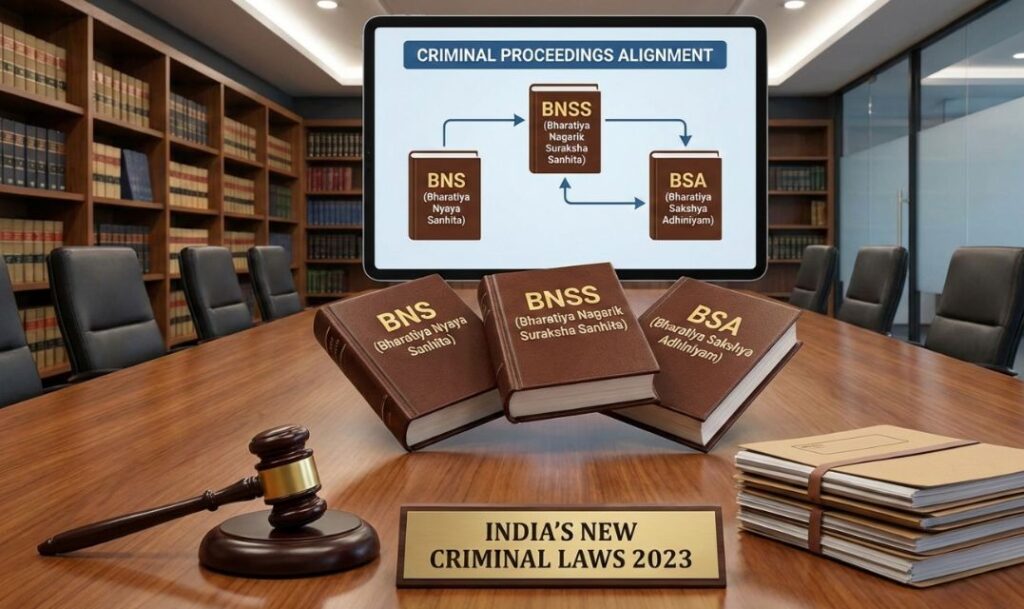
It’s been almost 80 years since our country has got independence. But we are still using British laws in our Indian legal system. But now the president of India has declared to amend those. So preceding year our country has undergone a serious change to modernize the main laws of Indian legal system that is the Code of Criminal Procedure, Indian Penal Code and Indian Evidence Act and hence they have been changed into Bhartiya Nagrik Suraksha Sanhita, Bhartiya Nyaya Sanhita and Bhartiya Sakshya Adhiniyam, respectively. The change has been seen to replace the Colonial/British era to the modern era that is the 21st century. The Indian Penal Code has been replaced by the Bhartiya Nyaya Sanhita which elucidate whether an act is a criminal act or not. The BNS criminalizes various acts as crimes which were not there in the IPC. The BNS further gender neutralizes certain crimes and provisions. The Code of Criminal Procedure has been replaced by the Bhartiya Nagrik Suraksha Sanhita which provides for the provisions as to the criminal proceedings under the criminal justice system. The Indian Evidence Act has been replaced by the Bhartiya Sakshya Adhiniyam which explain about the process of accepting and rejecting evidence under the criminal justice system. All the three criminal laws work simultaneously and are aligned to each other. A criminal or a civil proceeding cannot be carried out without leaving any of the one behind. The criminal laws simplify the process of judicial proceeding, and it is also effective in fulfilling the challenges that are faced in today’s world.
Introduction
The three criminal laws that are the Bhartiya Nagrik Suraksha Sanhita, the Bhartiya Nyaya Sanhita and the Bhartiya Sakshya Adhiniyam are three laws, but all are connected to each other and forms a criminal legal system in the Indian judiciary. All three are connected to each other in such a way that they have to work simultaneously and if any one of them is left then the Indian legal system will demolish. Hence the three laws are aligned to each other in the following ways:
1. The structural logic
A criminal justice system rests on the three most important pillars which are:
BNS: which act considers as a criminal act?
BNSS: how such criminal act is established?
BSA: what should be the proceeding of the criminal act
2. A three-way balance between the victim, accused and state
BNS: protects the societal and victim interest
BNSS: balances state power with individual liberty
BSA: protects factual accuracy
3. Substantive, procedural and evidentiary harmony
BNS: defines offences and prescribes punishments
BNSS: lays down the procedural framework for investigation, arrest, bail, trial and sentencing
BSA: governs the admissibility, relevance and evaluation of evidence
Key areas where BNSS aligns with BNS and BSA
Arrest and Detention
BNSS: Decides when, how, and for how long a person can be arrested and detained for those
offences. BNS: Decides what offences exist and how serious they are (punishment)
Under BNSS, the power to arrest is directly linked to the seriousness of the offence defined under BNS.
BNSS reinforces the principle that arrest is not mandatory in every BNS offence, especially for less serious crimes.
Investigation procedures
BNSS: Lays down how those crimes are investigated.
BNS: Defines what acts are crimes and how serious they are.
Under BNSS, investigation begins when information relating to a cognizable offence under BNS is received.
Electronic and Digital Evidence
BNSS: Procedural framework for collection, seizure, preservation, recording, and presentation of such evidence during investigation and trial.
BSA: Substantive rules on admissibility, relevance, and proof of electronic and digital evidence.
Evidence recognized by BSA must be procedurally secured under BNSS. Otherwise, it collapses
in court.
Chain of Custody and Forensic Evidence
BNSS: Governs how evidence is collected, handled, stored, transferred, and produced.
BSA: Governs whether that evidence is admissible, reliable, and credible in court.
Case Laws
State of Punjab Vs. Gurmeet Singh
Criminal procedure must be adopted in accordance with the nature of the offence which can be acknowledged through BNS, and such procedure must protect the dignity and interest of the victim which must be acknowledged through BNSS. The concept that process exists to give effect to substantive criminal law without sacrificing evidential fairness is a ruling which is embodied in the BNSS.
Maneka Gandhi Vs. Union of India
This case expanded the provision related to fairness, just and reasonableness. BNSS support this expansion and state that it must comply with Article 21 of the Constitution of India. The evidence which is collected will fail under the BSA if collected in violation of fair procedure.
State (NCT of Delhi) Vs. Navjot Sandhu
The court clarified in this case that electronic and technical evidence are admissible under the BSA. It states that under BNSS the procedural compliance is necessary. Under BNS organized crimes terrorist crimes are an offence and shall be punished in accordance with the law.
Selvi & Ors Vs. State of Karnataka & Anr
The case determined the admissibility of forensic techniques. It can be admissible only if the procedure is lawful and consent and other safeguards are respected. The admissibility of the forensic evidence is determined under the BSA. It also determines the procedure for collecting such evidence under the BNSS.
Zahira Habibullah Sheikh Vs. State of Gujarat
This case stated the validity of a trial in case of procedure failure. It states that evidence and
procedure cannot be treated as a failure in terms of technical obstacles.
Under the BNSS an offence is nothing if the procedure fails and under the BSA it will fail if
evidence is found to be compromised.
Conclusion
The alignment of BNSS with BNS and BSA represents a structural shift from colonial criminal law to a modern, integrated legal framework. BNS defines crimes, BSA governs proof, and BNSS operationalizes through coherent procedures. Together, they aim to create a faster, technology-driven, and victim-oriented criminal justice system.
The BNSS is in line with the BNS and the BSA in that it serves as the procedural linkage between the crimes and the rules of evidence. Whereas BNS heralds’ criminal behavior and the relevant punishment, and BSA defines the standards that must qualify evidence that is admissible and reliable, the process of investigation and prosecution and trial of offenses, within the bounds of the law, is operational zed under the BNSS and covers all substantive crimes under the BNS and the collection and evaluation of evidence as under the BSA through the incorporation of forensic science, technological evidence, evidence within timelines, and also the victim-justice safeguards.
Frequently Asked Questions
What issues does BNSS try to solve in alignment with BNS and BSA?
The Bharatiya Nagarik Suraksha Sanhita, 2023 (BNSS), alongside the Bharatiya Nyaya Sanhita (BNS) and Bharatiya Sakshya Adhiniyam (BSA), was primarily designed to solve the problems of an antiquated, slow, and colonial-era criminal justice system.
Does the BNSS change the investigation procedure to match it to BNS offences?
Yes, the Bharatiya Nagarik Suraksha Sanhita (BNSS), 2023 fundamentally changes investigation procedures to match the updated substantive offences in the Bharatiya Nyaya Sanhita (BNS), 2023, moving from a largely manual, paper-based system to a modern, digital, and forensics- driven process.
How does the BNSS align with the BSA in collecting evidence?
The Bharatiya Nagarik Suraksha Sanhita (BNSS) aligns with the Bharatiya Sakshya Adhiniyam (BSA) by transitioning from paper-based procedures to a digital-first, forensics-driven framework for evidence collection. While BNSS provides the procedural rules for how police
collect evidence, BSA defines the rules for admissibility of that evidence in court.
References
NEW INDIAN LAWS: BNS, BNSS and BSA-A Modern Shift in India’s Legal Framework – Ajit Kakkar.Com
How BNSS Aligns With BNS and BSA For Criminal Procedures Task1 | PDF | Crimes | Crime & Violence
New Criminal Codes 2025: BNSS, BNS, BSA Practical Guide – Legal Articles – Free Law
Forensic Science and New Criminal Laws BNS, BNSS, BSA, 2023 | PDF