
This Article is written by Rashmi Devendra Brahmadandi, a Student of LL.B. III at N. B. Thakur Law College, Nashik, Maharashtra, India
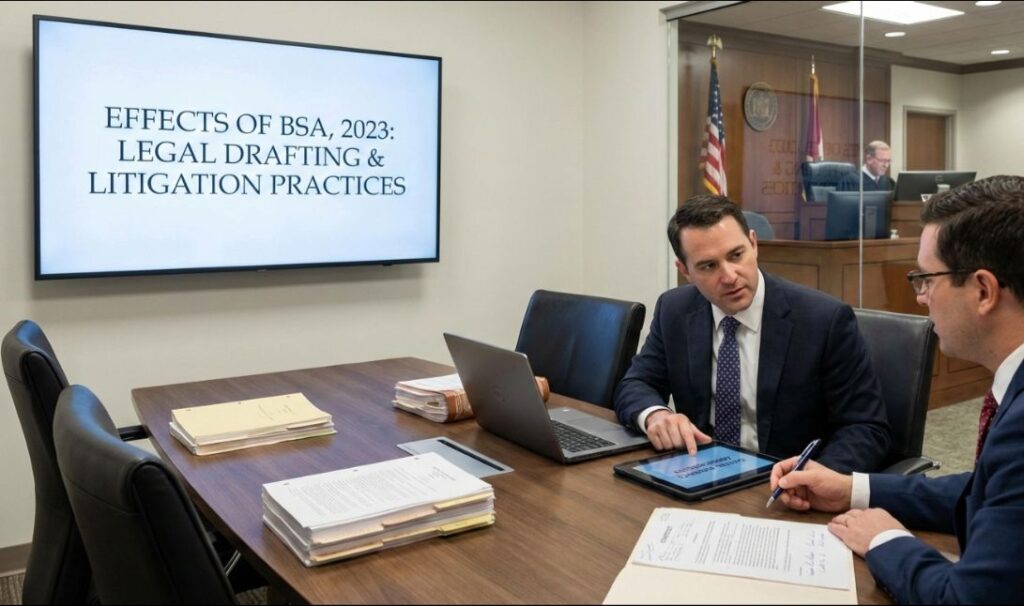
The Bharatiya Sakshya Adhiniyam, introduced in the year 2023, is a major change in the Indian law regarding evidence, as the country shifts from the old Indian Evidence Act of the colonial era, enacted in the year 1872. The Indian law regarding evidence now is clearly a change aimed at making the justice delivery system look more modern, clear, and accommodating to the needs of the current era. Also, with the rise of technology facilitating better communication through digital media and the collection of information in electronic form, the introduction of the Bharatiya Sakshya Adhiniyam (BSA) is aimed at making the Indian law regarding evidence
better organized by reflecting the use of electronic media and the collection of information in electronic form. Such a change affects the way in which the law is drafted, or litigation practices are adopted or reflected in the Indian judicial system.
Transition from Colonial Evidence Law to a Modern Legal Framework
Bharatiya Sakshya Adhiniyam, 2023, is a major paradigm change in terms of legislation relative to the law of evidence currently in force in our jurisdiction. For one, it repealed and replaced the Evidence Act, 1872. It is stated to have modernised the law of evidence, and it is a fact that the Evidence Act 1872 was not technologically empowered to tackle the challenges in contemporary litigation. Thus, the BSA was a much-needed legislation to simplify the law of evidence without compromising justice and fairness.
Impact of Expanded Definitions on Legal Drafting Practices
One of the notable impacts of the BSA on legal drafting is related to the expansion of certain important legal concepts. The definition of “document,” as well as “evidence,” has been significantly extended. Now, there is an explicit mention of “emails,” “digital messages,” “locational data,” “data on servers,” “data on devices,” and all of that. Thus, legal drafts need to be even more diligent and visionary in framing pleadings, contracts, and even legal notifications.
Simplification of Legal Language and Removal of Colonial Terminology
The BSA has also changed the current language and terminology that is currently in use by evidence law. The colonial era terminology that was previously in use has been changed entirely to use simpler and applicable vocabulary. This change will help young lawyers, litigants, and judges understand the law even better by avoiding references that may seem outdated and replacing them with Indian terminology that enhances clearer terminology in law drafting that is easy to understand.
Admissibility and Authentication of Digital Evidence under BSA
Another major change that the BSA has brought about is with regard to the admissibility or authentication of electronic evidence. There are specific guidelines provided in the BSA on the admissibility or authentication of electronic data. There was some degree of confusion with regard to the issuance or procurement of electronic certificates under the previous rules. This has now made the drafting process more precise about evidence-based pleadings.
Changing Role of Lawyers in Litigation Practice
From the litigation perspective, BSA has brought a change in the role of lawyers. It necessitates advocates to comprehend digital evidence, data authenticity, and technical compliance. Litigation is being coordinated increasingly with experts in forensics and technology. This shift has made litigation more skill-based and evidence-oriented rather than purely procedural.
Use of Technology and Digital Procedures in Courtrooms
Another significant factor about the BSA is that it accepts other electronic ways of presenting recorded evidence. Under the BSA, the courtroom can accept digital representations of oral statements as a form of evidence. Such a provision greatly facilitates virtual hearings and promotes efficiency in the hearings and court proceedings.
Practical and Infrastructure Challenges in Implementation
Offsetting these positive developments are a number of practical challenges. Many courts and agencies of investigation are still under-resourced technologically. Inconsistent practices in the treatment of digital evidence, coupled with a lack of technical training on its handling, undermine effective implementation. These deficits point to a need for capacity building in the justice system and for standard approaches to digital issues.
Overall Effect of BSA on Drafting and Litigation Culture
Overall, the Bharatiya Sakshya Adhiniyam, 2023, can be said to have greatly impacted the legal drafting process as well as the litigation practice in the Indian jurisdiction. Though some challenges still exist, the law has moved forward in a positive sense with the intention of providing an efficient future future-ready justice system.
Case Laws
Vibhor Garg v. Neha (2025) INSC 829
In the present case, the apex court has held that the evidentiary value of the secretly recorded telephone conversations of the two spouses can’t be ruled out as admissible evidence in the context of matrimonial disputes that lead to divorce or cruelty petitions filed by the other spouse. While reaching a judgment on the matter at hand, the SC highlighted that the protection given by Section 122 of the Evidence Act, which, as mentioned above, has been re-cast by the BSA, cannot serve as an objection to the admissibility of telephone recordings as evidence where the two parties are engaged in a contest with each other.
The SC has also added that the constitutional protection given to an individual’s privacy by the guarantee of protection under Article 21 does not preempt the institutional guarantee of a fair trial and the discovery of the truth in the context of a civil or criminal case.
Chandrabhan Sudam Sanap v. State of Maharashtra (2025) INSC 116
In this case, the Supreme Court has acquitted the appellant in a criminal appeal due to the lack of proper evidence, including digital evidence, ingenuity and ingratiate acumen, human nature, said to have been missing in this case, as the court relied heavily on the proper execution of Section 65B(4), which now relates to Section 63 of the BSA, that CCTV evidence or similar digital evidence in a criminal case will be inadmissible in court in the absence of a proper authenticity certificate, thus demonstrating the importance of accurate drafting in criminal evidence in digital age cases.
With these cases, the judicial approach to dealing with electronic evidence arguably changes with the advent of the new law of the Bharatiya Sakshya Adhiniyam.
Conclusion
Bharatiya Sakshya Adhiniyam, 2023, is a milestone in the new perceptions of evidence, its drafting, and its usage in the Indian legal system. This law on the law of evidence incorporates the reality of electronic records, digital modes of communication, as well as evidence in a new avatar. This law on evidence brings the law of evidence closer to the realities of the present day.
The BSA will purportedly help in reducing confusion, enhance the admissibility of evidence, and bring efficiency in litigation. The lawyers and judges need to change their way of handling the evidence, especially when algorithms and other digital evidence need to be dealt with. Therefore, it can be concluded that the BSA strengthens the justice delivery system in our country by making evidence-based law easy, practical, and relevant to our society.
Frequently Asked Questions
What is the Bharatiya Sakshya Adhiniyam, 2023 (BSA)?
The BSA, 2023 is a newly enacted law in India that institutions have adopted to modernize their processes of producing and recording evidence during trials. This law replaced some of the old provisions of the Evidence Act. There are modern ways of providing evidence during trials.
What is the effect of BSA, 2023 on legal drafting?
However, in drafting legal documents, evidence rules are now an essential consideration, as evidenced by the BSA. Legal practitioners have to ensure that there are adequate mentions of evidence collection, such as digital evidence, electronic evidence, and witness evidence, in a contract, agreement, or pleading, among others.
Will litigation practices be impacted by BSA, 2023?
Yes. More types of electronic evidence and digital documents can be admissible in court; thus, the dependence on the old forms of paper evidence will be lowered. Lawyers will need to cope with the requirement of presenting all the necessary proofs in formats considered valid under the BSA.
Does the BSA 2023 simplify the litigation process?
In some ways, yes. The legal process can help make evidence more presentable faster by accepting digital evidence and having clear evidence admissibility standards. However, lawyers need to be careful about the technicalities.
References
https://lawstreet.co/speak-legal/key-changes-in-the-law-of-evidence-bharatiya-sakshya-adhiniyam-2023