
Authored by Divya S. Sohoni
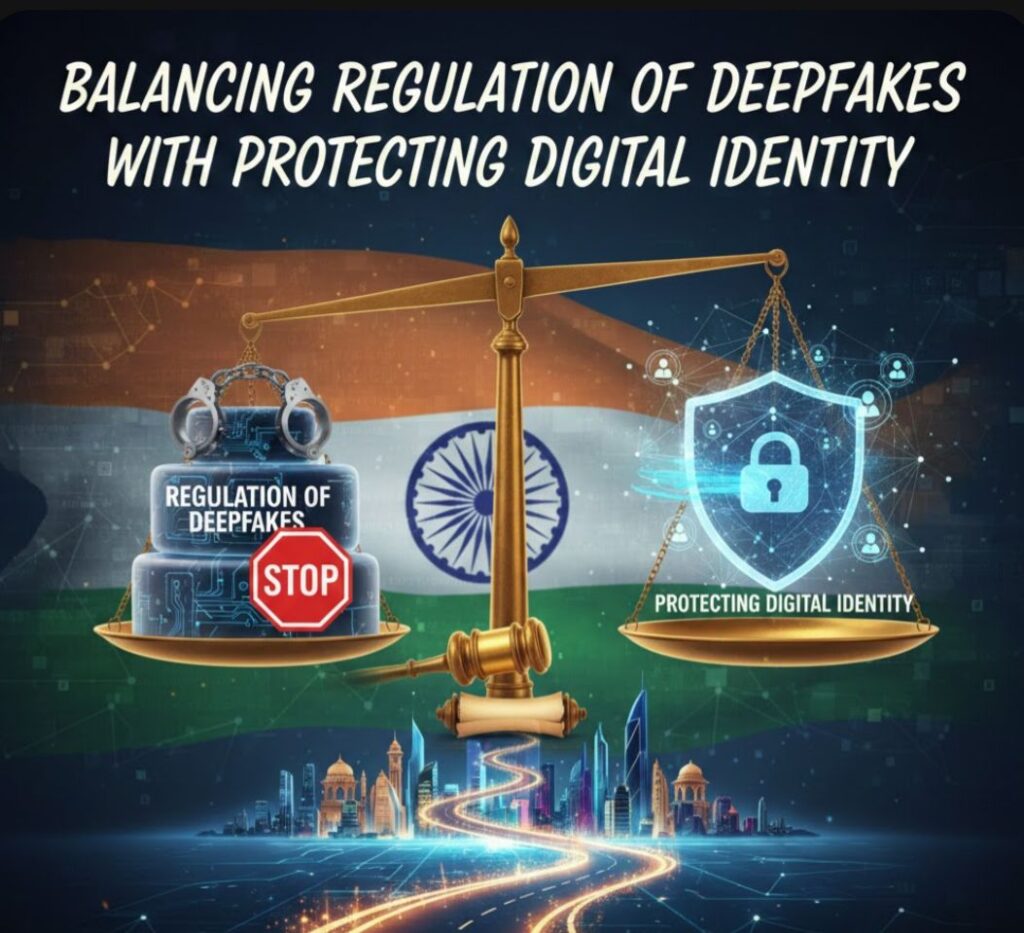
The Opportunities and Risks of Chatbots The proliferation of artificial intelligence (AI), in
the form of chatbots, is reshaping how people interact, communicate, and express themselves
in digital environments. Including Among the most disruptive products ever generated is that
of deepfakes; AI-generated media synthetic that accurately simulates human
appearance and behaviour. Powered by machine-learning architectures such as Generative
Adversarial Networks (GANs), deepfakes produce hyper-realistic videos and voice-overs of
people that can be easily used to impersonate real individuals. Though these technologies
bring advantages in the sphere of entertainment, accessibility, and other forms of creative
expression, there is misuse which is growing quickly in India. Deepfakes are now commonly
utilized for:
- Online sexual exploitation and revenge pornography
- Political manipulation and influence on elections
- Fraud, impersonation, and extortion
- Cyberbullying and character assassination
- Harassment of public figures, influencers, and ordinary citizens the difficulty is how to
regulate harmful synthetic media while ensuring the protection of free speech, creativity and
innovation in India’s digital space. This article explores whether India’s law as it stands
today, judicial trends so far, international responses and what amendments are necessary
would be able to protect one’s digital identity in the era of AI generated synthetic media.
The Rise of Deepfakes and the Threat to Digital Identity
The Rise of Deepfakes and the Risk to Digital Identity
An individual’s digital identity; in the form of their image, voice, manner of speaking,
and presence online; is now a key aspect of personal autonomy. The misuse of deepfakes
undermines this identity by posing a risk to:
- Control over one’s body (unauthorised use of an individual’s face or voice)
- Privacy and reputation
- Dignity and personal security
- Integrity of information and trust in public institutions
India has seen an exponential increase in incidents of deepfake pornography, political
impersonations, and fake videos targeting hapless citizens. A lot of these things are a viral
before the victims know they exist.
The widespread dissemination of such contrived content has also highlighted deficiencies in
Indias legal/regulatory regime and spurred reactions from the judiciary and legislature.
Judicial Trends and Landmark Cases
- Shreya Singhal v. Union of India, (2015)
Though this wasn’t a deepfake case (it didn’t exist back then), it set forth key principles that
have become relevant today. It also read down Section 66A of the IT Act as infringing on
free speech on vague grounds and urged the need to prescribe specific and narrowly drawn
restrictions on internet content.
Why this case is still important: Future deepfake laws must also pass constitutional tests of
(and we literally have to quote these stats because they apply to both Oregon criminal laws
AND potential future federal laws): Reasonableness Proportionality Non-arbitrariness - State of Tamil Nadu v. Suhas Katti (2004)
1 This is why it is significant that India secured its first conviction for the revenge porn
equivalent of now convicted child porn recovered from the victim’s computer and console.
The accused produced a bogus profile on the Web and uploaded obscene material to
persecute a woman. Although not a deepfake case, it signifies judicial concern for identity
impersonation and cyber-attack; two problems which are now intensified by deepfakes. - Recent Deepfake Pornography Cases (2023–2025)
In the last two years, Indian police have registered numerous FIRs against deepfake creation
and circulation involving:
Celebrated Bollywood and Tollywood actresses
Women students and private individuals
Influencers and journalists
Charges are often filed under:
Sections 66C, 66E, and 67 of the IT Act
Sections relating to forgery, defamation, and obscenity under IPC / Bhartiya Nyaya
Sanhita (BNS)
State cybercrime laws
These cases reveal the urgent need for a dedicated deepfake-specific offence in Indian laws.
- Global Lessons
United States
Several states, including Texas and California, have criminalized deepfake
pornography and political deepfakes.
Some states require explicit labelling of synthetic media.
European Union
The AI Act (2024) mandates transparency for AI-generated content.
Platforms must label deepfakes and ensure traceability of AI outputs.
China
Strictest global regime deepfake creators must obtain real-identity verification and
clearly watermark AI-generated content.
India can borrow from these models to strengthen its own approach.
Digital Identity Protection Under Indian Law
There are several laws in India which can be invoked, although no specific deepfake law
exists in India.
- Information Technology Act, 2000 (IT Act)
The IT Act is the primary legislation that deals with the cyber-crimes in India. Some new
key provisions: –
- Section 66C: identity theft is punishable
- Section 66E – Punishment for errors in privacy.
- Section 67&67A – Punishment for publishing and distribution of pornographic material.
- Section 69A – Powers of the Government to block the access of information through any
means of technology of information.
However, with respect to synthetic content generated by AI, the Act is not sufficiently
clear, resulting in demands for necessary revisions.
- Digital Personal Data Protection Act, 2023 (DPDP Act)
Deepfakes are based on biometric information like a person’s face or voice. This is
considered personal data, and processing without permission could be seen as:
- Breach of consent
- Misuse of personal data
- Breach of privacy
Among the rights individuals have under the DPDP Act to enhance protection are: - Correction of your data
- Erasure
- Consent withdrawn
- Data protection safeguards
This becomes critical in deepfake contexts.
- Bhartiya Nyaya Sanhita, 2023 (BNS) / IPC
Offences related to the creation and distribution of deepfakes include:
- Defamation
- Forgery (also digital forgery)
- Cheating and impersonation
- Disturbing the decency of women
- Sexually explicit content crimes
These crimes take place when deepfakes are used to cause reputational or physical harm.
- Intermediary Guidelines & Digital Media Ethics Code (2021)
Meta, Instagram, X, and YouTube, among others, need to:
- Take down illegal content within 24 hours of notification
- Use automated technology to identify child sexual abuse material (CSAM) and
deepfake content - Have complaint redressal systems in place
However, the “enforcement is patchy because the amount of content is so huge and the
accuracy of detection so limited.”
Regulatory Gaps in India
In spite of having laws, India does not have:
- A specific clear statutory definition for deepfakes
- A separate criminal offence for the production/distribution of deepfakes
- Duties of mandatory watermarking or labelling
- Strict liability for platforms acting as hosts to manipulated content
- Better recourse for victims of sexual exploitation via deepfakes
- Takedown processes on a fast-track basis
These loopholes result in delayed prosecutions and inadequate protection of victims.
Recommendations for Strengthening India’s Deepfake Governance
- Create a Separate Offence under the IT Act The statute should criminalize:
- Creation,
- Distribution,
- Possession, or Marudanayagam
- Monetization Is of Seeking harmful deepfake content synthetic sexual or impersonation
media in particular.
- Require Watermarking and Labelling Watermark?
- Visible watermark
- Invisible digital signature
- Metadata tracing All media generated with ai should have an identifiable mark in the form
of a visible watermark and be embedded with an invisible digital signature in the metadata.
- Digital Identity Protection Act (draft) India may also think about the Digital Identity
Integrity Act to penalize the use of biometrics for deepfakes.
4.Platform Responsibility Should social media intermediaries be mandated to:
- Install sophisticated AI detection tools
- Automatically flag suspicious uploads
- Deactivate anonymous accounts that produce harmful content
- Awareness and Public Education Campaigns
•How to spot deepfakes
•How to report them
•Privacy hygiene
•Safe behaviour on line public awareness and education on: might help avoid damage a lot. - Mechanisms for Fast-Track Takedown Victims should also be able to:
- Report deepfakes immediately
- Get them removed instantly
- Restore their identity
- Compensate them for emotional, reputational, and financial immolation “the damage
caused by deepfakes.
Conclusion
Deepfake technology is both a revolutionary advancement and a complex threat to personal
dignity, autonomy, and democratic stability. As India embraces digital transformation, it must
proactively construct a legal and regulatory ecosystem that protects individuals without
stifling innovation.
The solution lies in a balanced framework one that punishes malicious deepfake creation,
empowers victims with strong rights, holds platforms accountable, and simultaneously
encourages ethical AI development.
With comprehensive reforms, India can safeguard digital identities and build public trust in
an era where “seeing is no longer believing.”
FAQs
1. What are deepfakes?
generated synthetic media that mimic real people’s appearance, voice, or actions.
2. Are deepfakes illegal in India?
There is no specific deepfake law, but provisions under the IT Act, DPDP Act, and IPC/BNS
apply.
3. Can deepfake pornography be punished?
Yes. Offences involving obscenity, privacy violation, identity theft, and defamation are
punishable.
4. How can individuals protect themselves?
Limit public sharing of images, adjust privacy settings, and report manipulated content
immediately.
5. Why does India need deepfake-specific laws?
Current laws are fragmented and insufficient for addressing AI-driven impersonation and
manipulation.
References