
This article is written by Shreyansh Tripathi, B.B.A L.L.B., Symbiosis Law School, Noida.
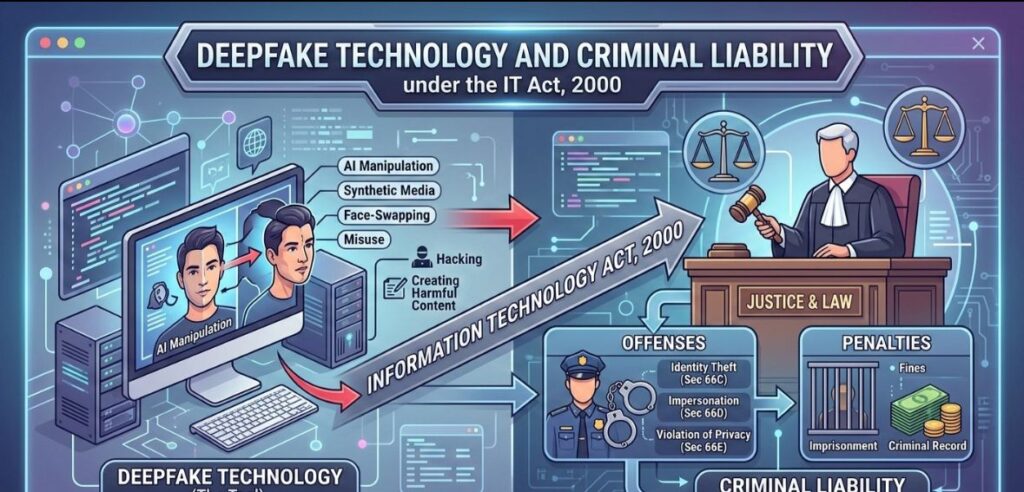
The recent explosive development of Artificial Intelligence (AI) has spawned the so-called deepfake technology, digitally manipulated audio, video, or images, which convincingly portray a person saying or doing something that he or she had never accomplished. Although deepfakes were originally intended to be used in the fields of entertainment and research, nowadays, they are connected with cyber fraud, political misinformation, defamation, identity theft, and non-consent explicit content.
In India, the main legal framework which regulates cybercrimes is the Information Technology Act, 2000. Even though the Act does not directly state the definition of deepfake, a number of its provisions, when applied in conjunction with the Indian Penal Code and constitutional rights under Article 21 (Right to Privacy), may be applied to establish criminal responsibility. The law issue is how to integrate old statutory laws to new technologically advanced misconducts.
Learning about Deepfake Technology
Deepfakes have generally been accomplished by machine learning, like the Generative Adversarial Networks (GANs), which overlie the face or voice of one individual onto the body or voice of a different one. The resulting media seems genuine hence hard to detect.
Deepfakes can be used for:
- Intimate content without consent.
- Electoral and political manipulation.
- Financial fraud and impersonation
- Reputational damage and defamation.
- Corporate sabotage
Since they have the potential to erode individual dignity, voting integrity, and economic stability, it becomes necessary that they are regulated to ensure that they do not eradicate them.
Relevant Provisions in Information Technology Act, 2000
Even though the IT Act is older than the deepfake technology, there is a number of sections that are applicable:
Section 66C – Identity Theft
This part makes it a crime to engage in fraudulent use of electronic signature, password, or other distinctive feature of another individual. A profound fake on behalf of the identity of the person can come under the scope of liability, under this provision.
Section 66D – Cheating by Personation
In case a deepfake has been used to inflict a person into believing in it, say, to steal money, pretending to be a CEO, it can be classified as cheating by personation using computer resources.
Section 67 – Publishing or Transmitting Obscene Material.
In cases when the content of the deepfake is obscene or sexually explicit and this is done without the consent of the individual; this section is relevant.
Section 67A is used to punish sexually explicit content and Section 67B focuses on child sexual abuse content. In the case of Deepfake pornography that would involve minors, it would face intense punishment as per Section 67B.
Section 72 – Breach of Confidentiality and Privacy
The unauthorized usage of personal picture or information in order to generate deepfakes can be considered as a violation of the compliance of privacy requirements in this provision.
Moreover, the clauses of Indian Penal Code, including defamation (Section 499 IPC), forgery and criminal intimidation can be applied either in conjunction with the IT Act.
Constitutional and Privacy Aspects
The Supreme Court acknowledged the rights to privacy in Justice K.S. Puttaswamy v. Union of India. The Court believed that privacy is inherent in Article 21 of the Constitution. Deepfakes in general, and non-consent intimate images, in particular, blatantly infringe upon informational and bodily privacy.
Therefore, criminal responsibility in the IT Act should be construed to agree with the constitutional safeguarding of dignity, self-determination, and reputation.
Case Laws:
Shreya Singhal v. Union of India
The Supreme Court declared section 66A of the IT Act vague and unconstitutional. The Court also made it clear that any limitation of online speech should be strictly narrow, and should be within the limits of Article 19(2). The case is noteworthy in the deep fake situation since any regulation system must focus on the balance between free speech and harm prevention. General criminalization of manipulated content can be constitutionally challenged.
In the case, the Supreme Court elucidated whether electronic evidence is admissible as provided in the Indian Evidence Act in Section 65B. The Court decided that electronic records must be well certified to be admissible. The establishment of the authenticity and the demonstration of digital manipulation will greatly rely on adherence to evidentiary requirements established in this case, in deepfake prosecutions.
K.S. Puttaswamy v. Union of India
The Court proclaimed privacy as a basic right in Article 21. It acknowledged informational privacy and means of protection against unqualified use of personal information. The misuse of personal image and biometric similarity, which is provided by Deepfake technology, can be criticized as breach of constitutional privacy. This ruling contributes to the need to impose tougher regulations and criminal penalties.
New Criminal Liability Issues
Lack of Precise Definitiveness
Deepfake is not expressly stated in the IT Act. General provisions have to be used by the prosecutors and this creates interpretational challenges.
Jurisdictional Issues
Deepfakes may be produced in a single nation and distributed throughout the world. The extraterritorial jurisdiction as in section 75 of the IT Act is a complicated issue as it is difficult to enforce.
Mens Rea and Attribution
It is challenging to create an intention when AI tools are used to manipulate it. The unknown originator and the difference between the creator and the distributor make the liability difficult.
Intermediary Liability
The safe harbour to the intermediaries is provided in Section 79 of the IT Act provided that due diligence is exercised by the intermediaries. It is controversial to determine when platforms need to eliminate deepfake content.
Need for Legislative Reform
India may require:
- A legal meaning of deepfake.
- Special punitive acts of the wicked artificial media.
- Comprehensive requirements on watermarking or detecting.
- Well, defined intermediary liability for timely takedown.
- Remedies that are victim-based such as compensation.
A number of jurisdictions around the world are already developing particular deepfake laws, especially in the field of election and sexual exploitation. To combat the increasing menace, India can be a follower.
Conclusion
Deepfake technology is an extensive technological upheaval with grave legal implications. As the Information Technology Act, 2000 offers some solutions that can be used to combat identity theft, obscenity, cheating, and invasion of privacy, it was implemented when the sphere of manipulation by the use of advanced AI had not developed. As a result, the enforcement is based on the interpretation of expansion but not the recognition through statutes.
The court system has provided a solid constitutional basis by establishing privacy rights and curbing speech on the internet. Nevertheless, the lack of a special deepfake infrastructure is doubtful. It needs a balanced legislative solution- one that keeps people safe in their dignity, privacy, and trust to the populace without an unnecessary curtailment of the freedom of expression. With the development of digital technology, the criminal law ought to improve accordingly to ensure that the integrity of truth in the digital era is not compromised.
Frequently Asked Questions
Is deepfake technology in India illegal?
The deepfake technology in itself is not unlawful. Nonetheless, its abuse like in the case of fraud, obscenity, defamation, or identity theft may be subject to criminal responsibility as stipulated by the IT Act and the IPC.
What is the subdivision of the IT Act that is applied to deepfake pornography?
Section 67 and 67A refer to obscene and sexually explicit data. When it comes to minors, the punishment is stricter as per the Section 67B.
Is it possible that a subject of a deepfake content asserts infringement of privacy?
Yes. Privacy is a right after the Puttaswamy ruling. The unauthorized use of an image of the individual or likeness could be a violation of Article 21.
Should social media sites be responsible of deepfake?
Section 79 allows platforms to invoke safe harbour in the event that they have acted in due diligence and takedown. Loss of action following a notice can be of a liability.
Does that mean that deepfakes require new legislation?
Yes. Although the current laws do not leave the problem unattended, a dedicated statutory framework would guarantee the presence of clarity, enhanced enforcement, and protection to the victims.
References
- The Information Technology Act, 2000: Governing the Digital Age in India – LIS (Library & Information Science) Academy
- NATLEX – India – Information Technology Act, 2000 (Act No. 21 of 2000).
- Legislations – Ministry of Information Technology, Communication and Innovation
- The Legal Alliance
- Database of Legislation
- The Information Technology Act, 2000, India, WIPO Lex
- Artificial Intelligence, Justice K.S. Puttaswamy v. Union of India, OpenAI, Cambridge-Analytica scandal, deep fakes, Ministry of Electronics & Information Technology, European Union’s AI Act, TRAI