
This Article is written by Aishwarya Jain of DES’s Shri Navalmal Firodia Law College, Pune.
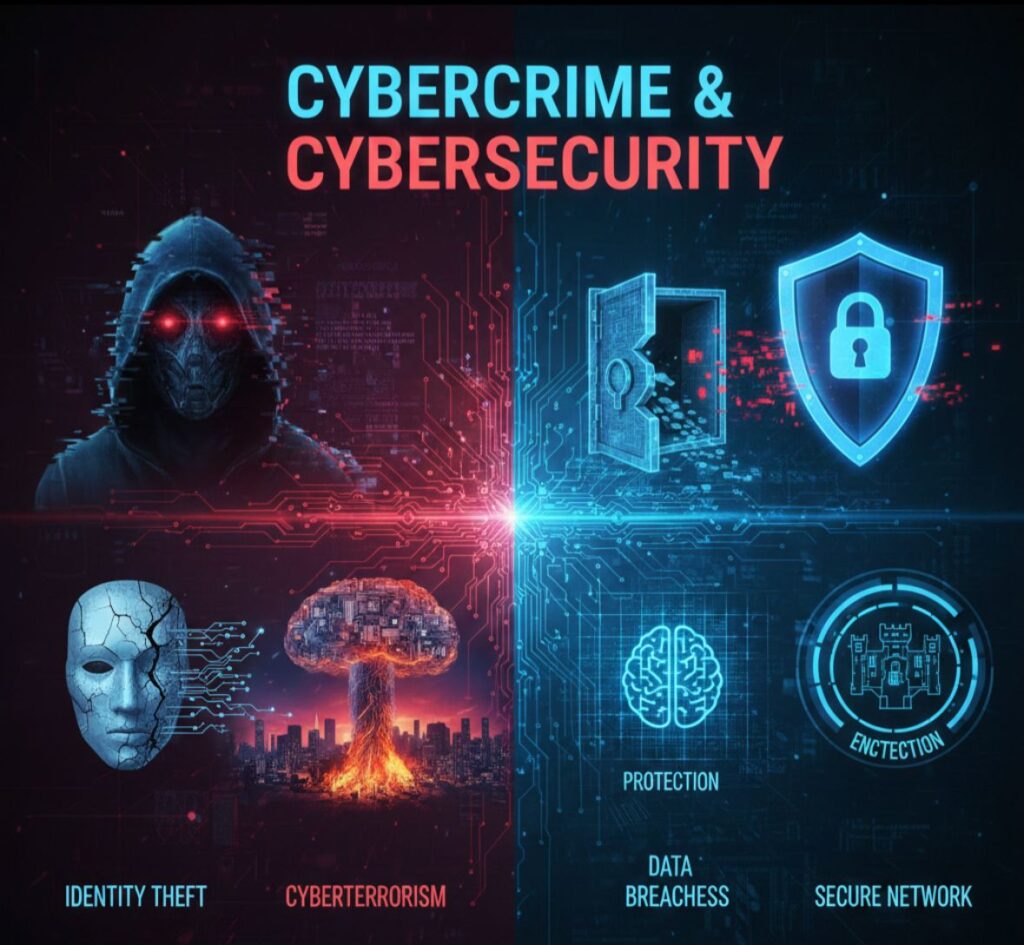
The internet is now an essential component of contemporary life. Technology has changed how people, businesses, and governments operate. Examples include social media, digital payments, online education, e-governance, and online courts. Cybercrime is a new type of crime that has emerged as a result of the digital revolution, which has also brought speed, convenience, and connectivity. Unlawful actions carried out via computers, digital devices, or the internet are referred to as cybercrime. Cybercrimes are challenging to identify and look into because, in contrast to traditional crimes, they frequently don’t require physical presence. An offense that affects victims worldwide can be committed by someone sitting in one nation. Because cybercrime has no geographical boundaries, it presents significant difficulties for legal systems and law enforcement. To counter these threats, the concept of cybersecurity has gained immense importance. Cybersecurity focuses on protecting computer systems, networks, and data from unauthorized access, damage, or misuse. It acts as a preventive mechanism against cyber offences. This article aims to explain four major areas of cyber law; identity theft, cyberterrorism, data breaches, and organizational security mandates; in a clear and simple manner, supported by important judicial decisions.
Identity Theft
One of the most prevalent and dangerous types of cybercrime is identity theft. It happens when someone deceitfully obtains and uses another person’s personal information without that person’s consent, usually for fraudulent or illegal purposes. Aadhaar numbers, PAN card details, bank account and debit/credit card information, passwords and OTPs, and biometric data are examples of personal information that can be used for identity theft. When scammers call people posing as bank employees and coerce them into disclosing OTPs or card information, that is a typical instance of identity theft. Once acquired, this data is utilized for online purchases, loans, and money transfers. The Information Technology Act of 2000 is the main law in India that addresses identity theft. Identity theft is specifically addressed in Section 66C of the IT Act. It stipulates that anyone who uses another person’s electronic signature, password, or unique identifying feature fraudulently or dishonestly faces up to three years in prison and/or a fine. Because identity theft directly violates a person’s right to financial security and privacy, it is especially dangerous. Long-term repercussions for victims frequently include lowered credit scores, psychological distress, and legal issues. Knowledge of cyber law is essential for aspiring attorneys because, from a legal perspective, proving identity theft requires reliance on electronic records, call data, IP addresses, and digital trails.
Cyberterrorism
Cyberterrorism is considered one of the gravest cyber offences due to its impact on national security and public order. It involves the use of cyberspace to intimidate governments, threaten sovereignty, spread fear among the public, or disrupt essential services. Attacking government or defense websites, hacking vital infrastructure, such as power grids or financial networks, disseminating extremist propaganda online, and stealing sensitive or classified national data are some examples of cyberterrorism. Cyberterrorism does not directly involve physical harm, in contrast to traditional terrorism. But its repercussions can be just as hazardous. A successful cyberattack on vital infrastructure has the potential to completely stop a country’s operations. Section 66F of the IT Act, 2000 addresses cyberterrorism in India. According to this clause, cyberterrorism is defined as actions carried out with the intention of endangering India’s unity, integrity, security, or sovereignty or inciting fear among the populace by gaining illegal access to computer resources. Given the gravity of the crime, cyberterrorism carries a life sentence.
Data Breaches
When private or sensitive information is accessed, revealed, or pilfered without permission, it is referred to as a data breach. Organizations gather enormous volumes of personal data in today’s digital economy, which makes them appealing targets for cybercriminals.
Data breaches can include:
- Theft of financial or corporate information
- Exposure of medical records
- Unauthorized access to government databases
Weak security systems, carelessness, insider threats, and sophisticated cyberattacks like ransomware can all lead to data breaches. Organizations frequently neglect to notify users right away, which exacerbates the damage. In India, data protection is still evolving. Although a complete data protection law has not yet been fully implemented, data breaches are covered by the following legal frameworks:
- The IT Act of 2000’s Section 43A and the IT Rules on Reasonable Security Practices
- Fundamentals of tort and contract law-
1. According to Section 43A, a body corporate that handles sensitive personal data is required to compensate affected parties if it fails to maintain acceptable security procedures and causes unlawful loss.
2. Legal protection against data breaches is further strengthened by the Supreme Court’s recognition of the right to privacy as a fundamental right.
3. Data breach instances serve as a reminder to law students of the increasing significance of accountability, consent, and privacy in the digital era.
Organizational Security Mandates
With increasing cyber threats, organizations are legally required to take adequate steps to protect digital data and systems. These commitments are referred to as organizational security mandates. Organizational security standards include the use of firewalls and encryption, regular security audits, secure data storage and access controls, staff cybersecurity training, and the employment of cybersecurity or data protection officers. These responsibilities in India are outlined in the Information Technology (Reasonable Security Practices and Procedures and Sensitive Personal Data or Information) Rules, 2011. Organizations are required by these requirements to:
- Obtain consent before collecting sensitive data
- Utilize data only for authorized purposes
- Maintain appropriate security standards
Noncompliance with these standards may result in legal ramifications, financial penalties, reputational damage, and a drop in customer confidence. Legally speaking, organizational cybersecurity obligations link cyber law to corporate governance, compliance, and consumer protection.
Case Laws
1. Union of India v. Shreya Singhal (2015)
Section 66A of the IT Act was declared illegal and ambiguous in this historic ruling. The Supreme Court stressed how crucial it is to safeguard free expression while controlling internet content. The case is essential to comprehending how to strike a balance between fundamental rights and cybersecurity.
2. Suhas Katti v. State of Tamil Nadu (2004)
One of the first convictions under the IT Act of 2000 was this one. The offender was sentenced for publishing pornographic and libelous material online. The case emphasized the importance of digital evidence and showed how powerful cyber laws are.
3. Union of India v. K. S. Puttaswamy (2017)
The Supreme Court recognized the right to privacy as a fundamental right under Article 21. This decision has significant implications for cybersecurity, data protection, and governmental oversight and highlights the need of preventing the misuse of personal data.
4. Avnish Bajaj v. State (NCT of Delhi) (2008)
This case concerned intermediary liability with regard to online platforms. The court’s analysis of website operators’ responsibility to prevent cybercrimes is pertinent to organizational security requirements.
Conclusion
Cybersecurity and cybercrime are now major concerns in contemporary legal systems. Data breaches jeopardize privacy, identity theft endangers people’s financial and personal security, cyberterrorism undermines national sovereignty, and inadequate organizational security can simultaneously impact millions of users. Indian cyber laws offer a fundamental framework to address these issues, especially the IT Act, 2000. Indian cyber laws, particularly the IT Act of 2000, provide a basic framework to deal with these problems. However, constant legal reform and stronger enforcement strategies are required due to the rapid advancement of technology. For second-year law students to comprehend how the law evolves in response to technological advancements, they must have a solid understanding of cybercrime. As our reliance on technology increases, lawyers will play a crucial role in establishing cybersecurity regulations, protecting individual rights, and ensuring accountability in cyberspace. Cyber law is more than just a technical subject; it is a crucial part of justice in the digital age.
Frequently Asked Questions
1. What is involved in cybercrime?
The term “cybercrime” refers to illegal activities involving computers, mobile devices, or the internet, such as identity theft, online fraud, and hacking.
2. What laws in India regulate cybercrime?
The primary piece of legislation is the Information Technology Act of 2000, along with its modifications and regulations.
3. What is identity theft according to Indian law?
According to Section 66C of the IT Act, identity theft is defined as the unauthorized use of another person’s digital or personal identity information.
4. Why is cybersecurity so important for companies?
Data breaches, financial losses, reputational damage, and legal liability can all be avoided with the help of cybersecurity.
5. Why should law students study cyber law?
Due to the growing prevalence of digital conflicts, electronic evidence, and privacy concerns.
References
https://share.google/aw2rVaqstbmd7O2OR
https://share.google/X7OT1gDJzrO5WI04G