
This article is written by Ammara Mehvish Khalilullah Shaikh, a third-year BALLB student at Government Law College, Mumbai.
The Human Stories Behind Cybercrime Cases in India Today
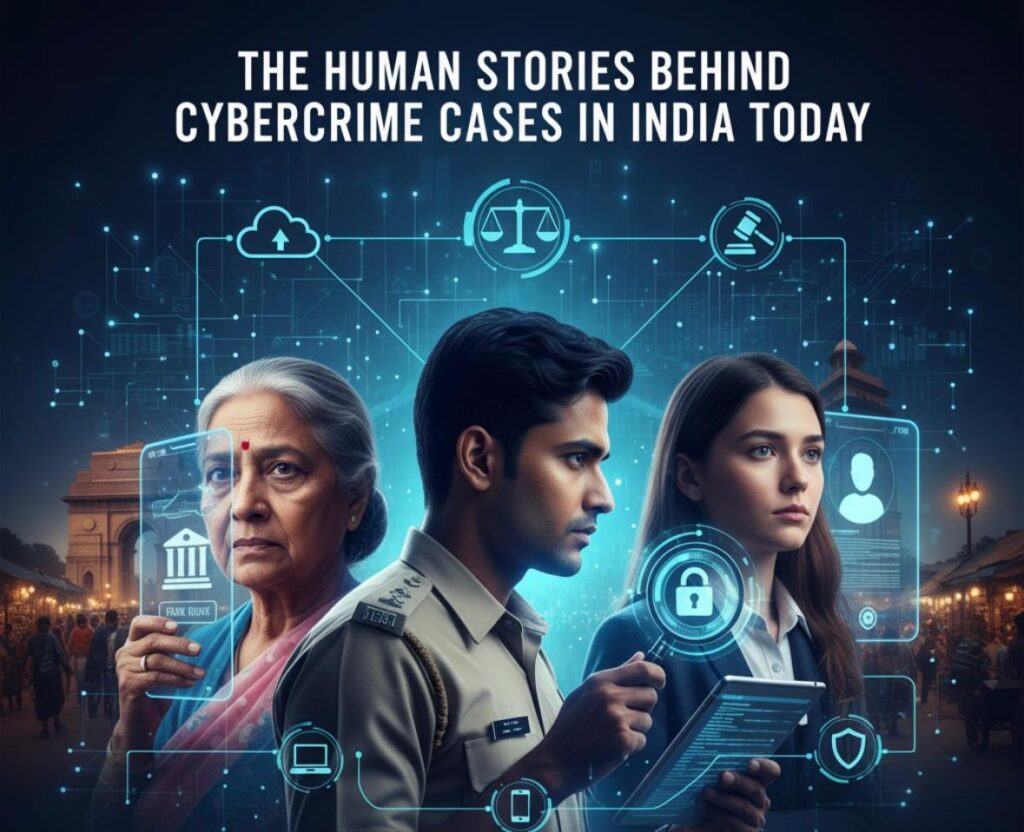
Keywords: cybercrime, India, human impact, Information Technology Act, digital fraud
Introduction
When we talk about cybercrime, people imagine some high-tech hacker sitting behind multiple computer screens in some dark room. But actually in India today, it’s not that kind of picture only. It’s more everyday, more real and sadly more painful for common people. Cybercrime has slowly become part of almost everyone’s life – from school students to retired citizens.
Sometimes it’s a fake call, sometimes a message, or even a link that looks genuine. But behind every such link or call there is someone waiting to steal your data or your money or sometimes even your peace of mind. The Information Technology Act, 2000, and now the Bharatiya Nyaya Sanhita (BNS), 2023 are supposed to help stop such things but when we see actual human stories, it’s visible that laws alone cannot really stop everything.
The people who go through cyber frauds don’t just lose money, they lose their confidence, they lose trust in system, they get anxious, embarrassed, even depressed. I read one victim saying that she couldn’t sleep for days because she kept replaying the fraud call in her head. That’s the human side of cybercrime we mostly ignore when we just discuss “statistics”.
In this article I am trying to show not only the law side but the real human experience of people who suffered from cybercrimes in India today. Because behind every report or FIR number, there is someone whose normal life got shaken.
Simple Understanding of the Law
The IT Act 2000 was the first big step of India into the digital legal world. Back then internet was new, only few people were using computers. But now everything is online – our banks, our IDs, our schools.
So the Act says in Section 43, that if someone uses your computer or system without your permission and causes damage or steals information, they must pay for that. It’s kind of like trespassing but in digital sense.
Then Section 66 adds a criminal angle – if you do that with wrong intention or dishonesty then it becomes hacking, which is punishable. For example if someone breaks into your email or bank account and deletes or transfers data that’s an offence.
Section 67 deals with sharing obscene or private content online which is very common now especially revenge videos or morphed pictures. It’s one of the most hurtful forms of cybercrime, specially for women.
Under new Bharatiya Nyaya Sanhita also cyber offences are recognised, showing that government now takes it seriously. But still, practical enforcement is very hard. The laws are there but the procedure, awareness, and speed are not matching with how fast online frauds are growing.
Sometimes people even don’t know under which section they can file complaint. Or police stations don’t have proper cyber units. The real gap is between law on paper and protection in real life.
Real People, Real Stories
There was this one story from Mumbai that really stuck in my head. A 64-year-old retired woman got a call from people pretending to be from Anti-Terror Squad. They told her that her account is used for funding terrorism and she will be arrested soon. She panicked. They even sent fake ID cards of officers. They made her transfer ₹22 lakh for “verification”. Later she realized it was a scam. Can you imagine the fear she felt?
Another case from Jamnagar, Gujarat, where a brass trader got cheated through fake helpline number 1930. The fraudster said his account is frozen and demanded money to unfreeze it. The man lost huge amount and his business suffered.
Then there are countless young people, job seekers, small town students, homemakers who get scammed by fake job portals, fake investment apps, or even fake love relationships online. One girl shared how a fraudster on Instagram pretended to be her friend, then got access to her private photos and blackmailed her.
These stories make it clear that cybercrime is not technical issue only; it is emotional crime also. The criminals know how to play with people’s trust, their fear, their loneliness.
One victim said, “I didn’t just lose money. I lost my sleep and my smile.” That sentence alone shows the whole emotional loss that no law can actually calculate.
Why Cybercrimes Keep Rising So Fast
Honestly the numbers are scary. According to NCRB data, in 2018 there were around 27,000 cases of cybercrime. In 2022, nearly 66,000 cases. And many more are not even reported because victims feel embarrassed or they think nothing will happen.
There are many reasons. Firstly, internet has reached every home but awareness has not. Many elders don’t know about fake OTP calls or phishing links.
Secondly, emotional pressure – scammers talk in a way that makes you feel if you don’t act quickly, you’ll be in trouble. They use words like “urgent,” “police case,” “immediate verification.” Under that stress people forget common sense.
Thirdly, slow process – even when you report, the freezing of money takes time, evidence disappears. Scammers move money through multiple accounts in minutes.
Also, there is poor coordination between banks, telecom companies, and police. By the time they talk to each other, the damage is done.
It’s like the criminals are always one step ahead, and the system is running behind trying to catch up.
Human and Mental Cost of Cybercrime
What is often invisible is the psychological pain. Law can punish someone, but who helps the victim emotionally? A woman from Delhi who was harassed through fake loan apps said, “They called my family and boss, said I owe money, sent my morphed pictures.” She stopped going to work out of fear.
Students too get badly affected. Many cases involve fake trading or crypto schemes. They invest small amounts and lose everything. The shame of being fooled often keeps them silent.
Mental health impact is huge. Anxiety, sleeplessness, anger, even suicidal thoughts in some extreme cases. Society also judges victims harshly, calling them “careless.” But most of them are ordinary people who simply trusted the wrong person or clicked the wrong link.
Cybercrime doesn’t only steal money, it steals peace. The legal documents mention “damage” but never talk about emotional trauma.
Bridging the Law and the Reality
Now if we think practically, the gap can only be reduced through both awareness and reform. Laws must become more victim-friendly.
Firstly, we need more digital awareness programs in schools and senior citizen groups. Most people don’t know what phishing or OTP fraud means.
Secondly, simplified complaint portals where anyone can easily file without fear of technical jargon. The cyber helpline 1930 is good but needs faster response.
Thirdly, training police officers to treat victims with empathy. Many victims said police laughed at them or delayed filing FIRs. That discourages reporting.
Also, banks and telecoms must be made responsible to freeze and trace accounts quickly. Without their coordination, cyber investigation is incomplete.
And honestly, there should be counselling too for victims. Legal justice is not enough if someone is emotionally broken.
Society’s Attitude Toward Victims
One of the biggest problems is how people react to victims. Many say, “How could you fall for that?” or “You should have known better.” But truth is these scams are becoming so convincing that even educated professionals fall for them.
People who face sextortion or data blackmail often hide their story due to shame or fear of reputation loss. Especially women victims get judged more.
So society must change how it looks at cyber victims. They are not stupid, not careless – they are victims of very calculated crimes.
Just like we normalised discussions about domestic violence or financial scams, we need to normalise talking about cybercrimes too. That will make others alert and reduce stigma.
Some Reflections and Law in Context
Cases like ITC Ltd. v. Central Park Estates Pvt. Ltd., though mainly about trademark misuse online, show how the internet has power to damage reputation instantly. In that case, the court directed that the mark “Bukhara” be recognised as a well-known mark to stop misuse online. It shows courts are aware how reputation and identity can be stolen in cyberspace.
Similarly, in Shreya Singhal v. Union of India, the Supreme Court struck down Section 66A of IT Act because it restricted free speech but also discussed the importance of balancing freedom with safety online. These cases show the continuous evolution of law around cyberspace.
But still, while big companies get attention, individual victims rarely do. The justice system needs to treat cyber harms to individuals with equal seriousness as corporate damages.
Conclusion
To be honest, cybercrime in India today is not about computers anymore; it’s about people. Behind every number there’s a human face who believed something and lost something.
The laws like IT Act 2000 and Bharatiya Nyaya Sanhita 2023 are strong but the human side of enforcement is weak. Victims need not only justice but also support, counselling and empathy.
Cybercrime is now part of our society just like theft or cheating was once on streets. Only difference is that it happens behind screens. And maybe that’s why it feels lonelier.
If India wants to truly become a “Digital India,” it must also become a safe digital India. Not only through strong laws but through understanding, awareness and kindness towards those who suffer silently after losing their digital trust.
FAQs
Q1: Why do people even fall for cyber scams? I mean, can’t they see it’s fake?
Honestly, it’s easy to say this when you’re not in that moment. But when someone calls and says your bank account will be blocked, or your Aadhaar is misused, your mind freezes. You panic. These scammers sound so confident and official that even educated people get trapped. It’s not about being dumb, it’s about being human – scared, rushed, trusting.
Q2: What should I do the second I realize I’ve been scammed?
First thing, don’t blame yourself. Just take a breath. Then call 1930 – it’s the national cyber helpline. Report fast because the quicker you report, the more chance to freeze your money. File a complaint at cybercrime.gov.in too. Keep screenshots, messages, payment details ready. And don’t delete anything in panic.
Q3: I feel too embarrassed to tell my family or friends. What if they laugh?
You’d be surprised how many people go through this and say the same thing. But silence helps the scammer, not you. Talk to someone you trust. If you lost money, tell your bank immediately. If you were blackmailed, contact police or cyber cell – don’t give in. You are not the only one, and you definitely don’t deserve shame for being tricked.
Q4: Are police actually helpful in such cases? I’ve heard they ignore it.
It depends a lot on which city or officer you get. Some cyber cells are very active, but in small towns they might not have proper training. Still, you must report – it creates record, and sometimes money is recovered later. If one police station doesn’t help, go higher or try online complaint. Persistence matters.
Q5: What about mental stress? Who helps with that part?
This is the saddest part – nobody really does. Once the case is filed, people think “done.” But inside, victims are broken. I think there should be free counselling for cybercrime victims just like for physical crimes. Even talking to a friend or support group helps. Cry if you need to, it’s okay. Healing is part of justice too.
Q6: How can we stop this from happening again and again?
Not only by laws, honestly. People need awareness, like basic online safety taught in schools. Also, senior citizens must be trained because they are easy targets. Banks and apps must stop using confusing messages that scammers copy. And social media platforms should act faster when people report fake IDs. It’s a teamwork thing – law, tech, and people all together.
Q7: What if someone leaked my personal photos or videos online? I feel ruined.
First thing, it’s not your fault. File a complaint under Section 67 of the IT Act, and also approach cyber police. Take screenshots as proof, report the link or page to the platform (Instagram, Facebook, etc.) to take it down. You can also ask police for immediate removal. Don’t hide, the shame belongs to the criminal, not you.
Q8: Why is cybercrime growing so much in India?
Because internet has reached faster than awareness. Everyone’s online now, from kids to grandparents, but very few know how to protect themselves. Also, it’s easy money for criminals and very hard for police to trace across states or countries. It’s like digital pickpocketing, only the street is virtual now.
Q9: Is it true that once the money is gone, it’s impossible to get it back?
Mostly yes, but not always. If you act within few hours, sometimes banks can freeze the account. But scammers are super fast — they move the money through multiple layers. Still, don’t lose hope. Many people have recovered partial money because they didn’t delay the complaint.
Q10: What’s one advice you’ll give to everyone reading this?
Never trust urgency online. If someone says “do it now” or “you’ll be arrested” or “your account is blocked,” stop right there. Take five minutes, call your bank or official helpline to confirm. And please tell your parents, friends, everyone about new scams. Awareness spreads faster than fear if we all talk about it.
References
https://indianexpress.com/article/explained/rise-cybercrime-women-up-ncrb-report-2023-10283715
https://www.indiatoday.in/india-today-insight/story/cyber-crime-the-new-big-con-2763693-2025-07-30
https://prsu.ac.in/backend/web/theme/iqac_accr_new_cycle/150520240146501.pdf