
This Article is written by Anshul, a student at BPS Women’s University.
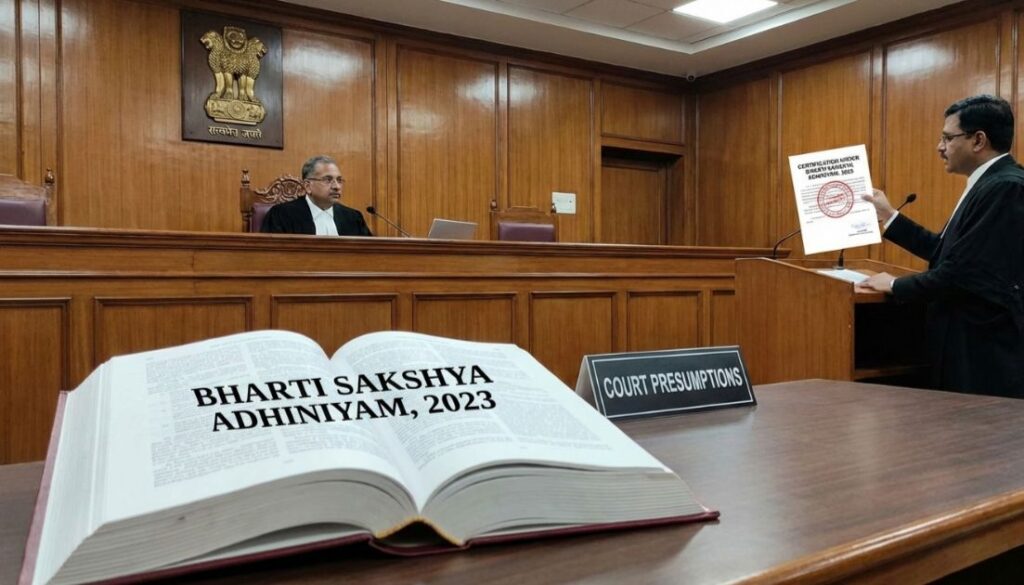
In 2023, the Bharatiya Sakshya Adhiniyam 2023 has replaced the Indian Evidence Act, 1872. One of the important concepts under BSA is presumption and certification. Presumptions help courts decide cases faster by allowing them to accept some facts as true without asking for strict proof in every case. On the other hand, certification helps in proving the authenticity of any document. In this article, we will understand this concept in detail.
Meaning of Presumption
A presumption means a legal assumption made by the court. When one fact is proved, the court accepts another related fact as true unless someone proves the opposite. In simple words, the court believes something to be true because it usually happens that way. A presumption is not final proof it can normally be challenged. For example, if a person is found with stolen goods soon after theft, the court may presume that he is the thief, or he knew the goods were stolen until the contrary is proved.
Types of Presumptions
There are basically three types of presumptions which helps the court in determining whether a particular thing is true or not. These types are as follows:
May Presume – When the law says that the court “may presume” a fact, it means the court has its discretion. The court may either accept the fact as true or ask the party to prove it with evidence. The court is not bound to accept or reject the fact. The court decides based on the facts and circumstances of each case. For instance, if a letter is properly written, stamped, and posted, the court may presume that the letter was delivered to the person to whom it was sent. However, if the addressee shows evidence that the letter was never received, the court may refuse to accept the presumption.
Shall Presume – When the law says the court “shall presume” a fact, the court has no choice. It must accept the fact as true unless it is disproved by the opposite party. This presumption is mandatory but rebuttable. The court must presume the fact initially, but the opposing party has the right to challenge it by providing strong contrary evidence. For example, if a certified copy of a public document is produced, the court shall presume that the document is genuine. The court cannot ask the person producing it to prove its genuineness. The burden shifts to the other party to prove that the document is forged or incorrect.
Conclusive Presumption – When the law declares a fact to be “conclusive proof,” the court must accept it as final. The other party is not allowed to disprove it. This presumption is absolute and irrebuttable. Once
the fact is established; the court cannot consider any contrary evidence. Example: If the law declares that a child below a specific age is incapable of committing an offence, the court must accept this fact conclusively. No evidence can be given to show that the child was mature or understood the consequences.
Presumption under BSA 2023
Under BSA 2023, this concept is mentioned in sections 78-93, which are divided into certain categories as mentioned below:
Presumptions Relating to Documents (Sections 78–84)
The BSA allows courts to presume the genuineness of certain official documents to speed up trials.
Section 78 states that the court shall presume that certificates or certified copies issued by a Government officer are genuine.
Section 80 provides that Government Gazettes, newspapers, and official journals are presumed genuine.
Section 83 states that maps or plans made under the authority of the Central or State Government are presumed to be accurate.
If these documents are produced in the proper legal form, the court accepts them as genuine unless the opposing party disproves them.
Presumptions Relating to Electronic Evidence (Sections 63 & 85-93)
The BSA gives strong recognition to electronic records by treating them as primary evidence under Section 57.
Section 63 states that although not a presumption, a certificate in the prescribed format is required for the court to accept electronic evidence.
Section 86 states that the court shall presume that an electronic agreement bearing electronic signatures was validly executed.
Section 87 states that the Information stated in an Electronic Signature Certificate is presumed to be correct.
The court may presume the authenticity of electronic records that are at least five years old and come from proper custody, as mentioned under Section 93.
General Presumptions of the Court
Under Section 119 of the Bharatiya Sakshya Adhiniyam, 2023, courts may presume certain facts based on common human behavior, natural events, and ordinary business practices. For example, the court may presume that judicial and official acts have been properly performed. These presumptions allow courts to rely on logic and experience instead of demanding formal proof for routine matters.
Certification under the Bharatiya Sakshya Adhiniyam, 2023
Meaning of Certification
Certification means a formal written confirmation stating that a document or electronic record is genuine and has been produced in the proper manner prescribed by law. In simple words, it is a guarantee of authenticity given to the court so that the court can rely on the evidence without doubt.
Purpose of Certification
The main purpose of certification is to build trust in evidence, especially electronic evidence. Certification helps courts avoid technical disputes and focus on the real issues of the case.
Who Can Issue a Certificate
A certificate can be issued by a person who has lawful control over the device or system that
produced the electronic record.
Contents of a Certificate
A valid certificate usually mentions:
- the identity of the electronic record,
- the device used to produce it,
- confirmation that the device was working properly,
- assurance that the record has not been altered.
These details help the court trust the electronic evidence.
Effect of Certification
Once a proper certificate is produced, the court presumes the electronic record to be genuine. After this, the burden shifts to the opposite party to prove that the record is false, manipulated, or unreliable.
Certification under BSA vs Old Law
Under the Indian Evidence Act, 1872, certification of electronic evidence was complicated and often led to rejection of evidence on technical grounds. The BSA simplifies this process by clearly recognising electronic records and giving more flexibility in proving them.
Judicial Interpretation and Precedents
As the Bhartiya Sakshya Adhiniyam (BSA), 2023 replaces the Indian Evidence Act (IEA), the judiciary continues to rely on established legal principles to interpret the new provisions. The following landmark judgments serve as a bridge between the old and new regimes, specifically regarding the certification and presumption of documents.
Arjun Panditrao Khotkar v. Kailash Kushanrao Gorantyal (2020) 7 SCC 1
The Supreme Court settled a long-standing debate by ruling that the production of a certificate is a mandatory condition for the admissibility of electronic records. Under the BSA, this principle is strengthened by the requirement of an expert’s signature alongside the custodians. The court held that oral evidence cannot substitute for this certificate.
Kailash S/o Bajirao Pawar v. State of Maharashtra (2025)
In this recent judgment, the Supreme Court clarified that once the requirements of Section 63 (certification and hash value) are satisfied, video evidence (like a CD or CCTV footage) is fully admissible as a document. The court observed that it is not strictly necessary for witnesses to explain the video or for transcripts to be prepared, as the court is capable of viewing and interpreting the record itself.
State of Rajasthan v. Kashi Ram (2006) 12 SCC 254
The Court reaffirmed the “Presumption of Regularity.” It held that when a government official issues a certificate or performs a judicial act, the court may presume that all official duties were performed correctly. This reduces the burden on the prosecution to prove every step of the administrative routine, provided the certificate appears genuine on its face.
Tomaso Bruno v. State of Uttar Pradesh (2015) 7 SCC 178
The Apex Court states that the production of electronic evidence is important due to the rising impact of digitalization. If a party has such evidence and refuses to produce it, the court may draw an adverse assumption presuming that the evidence would have gone against that party if it had been produced.
Conclusion
The provisions on presumptions and certification under the BSA 2023 make the process of proving facts simpler and faster. Presumptions help courts avoid unnecessary proof in routine matters, while certification ensures that documents, especially electronic records, can be trusted. By giving clear rules for documents and electronic evidence, the BSA removes many technical difficulties that existed under the old Evidence Act. Overall, these changes help courts deliver justice more efficiently while maintaining fairness in trials.
Frequently Asked Questions
What does “presumption” mean under the BSA?
A presumption is a legal rule that allows courts to assume certain facts or the authenticity of documents to be true unless proven otherwise. The BSA distinguishes between “shall presume” (mandatory but rebuttable) and “may presume” (discretionary and rebuttable) presumptions.
What is the presumption regarding certified documents?
Under Section 78 of the BSA, courts presume that certified copies, certificates, or documents issued by authorized government officers are genuine, provided they are in the prescribed form and executed according to law.
How are records of judicial proceedings treated?
Section 79 of the BSA allows courts to presume the authenticity of records of evidence, statements, or confessions presented from judicial proceedings, unless challenged with contrary evidence.
Do presumptions apply to electronic and digital records?
Yes. The BSA expands presumptions to cover electronic and digital records, recognizing their validity and authenticity in the same way as traditional documents, unless proven otherwise.
Can presumptions under the BSA be challenged?
Absolutely. Presumptions are rebuttable, meaning the opposing party can present evidence to dispute the authenticity or truth of the presumed fact or document. Courts then evaluate the evidence before making a final determination
References
https://www.lexisnexis.com/blogs/in-legal/b/law/posts/decoding-bharatiya-sakshya-adhiniyam-2023-com
https://www.indiacode.nic.in/bitstream/123456789/20063/1/aa202347.pdf
https://www.lexology.com/library/detail.aspx?g=d258e6dd-7a24-4d91-a28a-b3681e0c0148