
This Article is written by Nameera Meraj, Aligarh Muslim University.
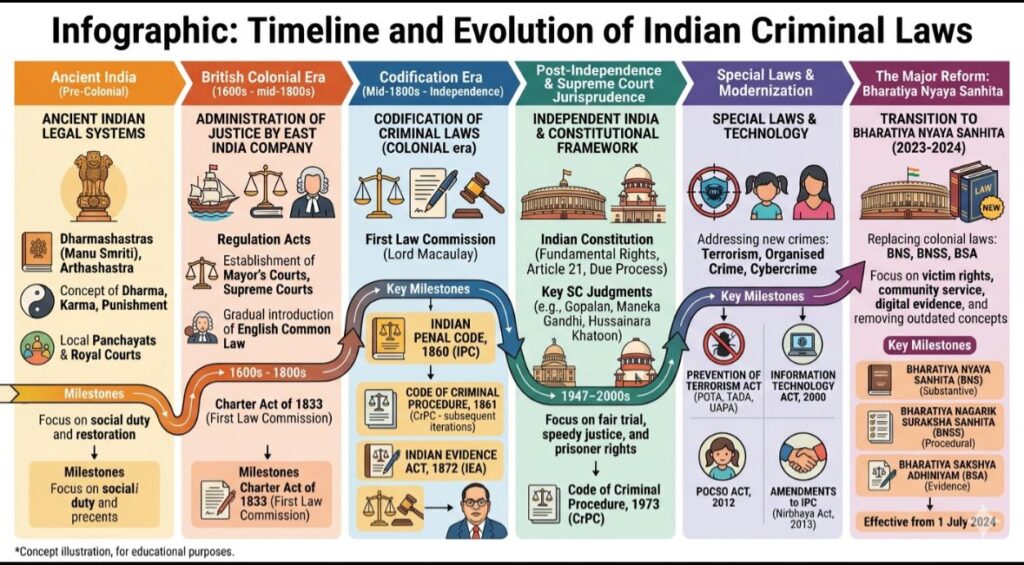
Indian criminal law has developed over centuries, shaped by changing political structures, social needs, and evolving notions of justice. What began as a system rooted in moral and religious principles gradually transformed into a codified legal framework during colonial rule, and eventually into a rights-based system guided by constitutional values. This evolution reflects a broader shift from ruler-centric authority to a system that increasingly prioritises individual rights and procedural fairness.
Ancient and Medieval Foundations
In ancient India, criminal law was closely tied to the concept of Dharma, which emphasised duty, morality, and social order. The king was considered the ultimate authority responsible for enforcing justice through Danda, or punishment. Texts like the Arthashastra outlined various offences and corresponding punishments, indicating an early attempt at structured governance. At the same time, dispute resolution was often decentralised, with village panchayats playing a significant role in maintaining order.
Ancient Indian criminal law was not limited to Arthashastra; texts like the Yajnavalkya Smriti and Narada Smriti played a crucial role in shaping rules of evidence, procedure, and punishment.
- Crime was often viewed as a moral or religious transgression (sin) rather than a wrong against the state.
- Punishments depended on caste, intent, and social hierarchy, reflecting the stratified nature of society.
- Despite this, the emphasis on deterrence and maintenance of order shows an early foundation of criminal justice principles.
During the medieval period, particularly between the 12th and 18th centuries, Islamic jurisprudence influenced the legal system. While civil matters often differed across religious communities, criminal law became more centralised under state authority.
- While early Islamic law treated offences like murder as private wrongs, the state gradually increased its control over serious crimes.
- Judicial officers such as qazis interpreted law, but local customs continued to influence decisions, creating a hybrid system.
This period reflects a transition from community-based justice to more centralised state authority. The legal system followed a hierarchical structure, with the emperor at the top, assisted by qazis and muftis at provincial and local levels.
Punishments during this period were classified into four main categories: Hadd (fixed punishments prescribed by religious texts), Qisas (retaliatory justice), Diyya (monetary compensation), and Tazir (discretionary punishments). A major development was the compilation of the Fatawa-e-Alamgiri under Emperor Aurangzeb, which sought to bring greater uniformity to legal practices.
Colonial Codification (1750–1947)
The colonial period marked a turning point with the introduction of a uniform and codified legal system. Before British intervention, India’s legal structure was pluralistic, with different communities following their own religious laws. While this reflected cultural diversity, it lacked consistency in criminal administration.
The establishment of the First Law Commission in 1833 under Lord Macaulay led to the creation of a structured legal framework. This effort resulted in three key legislations that continue to influence Indian criminal law today: the Indian Penal Code, 1860; the Code of Criminal Procedure; and the Indian Evidence Act, 1872.
Impact of the 1857 Revolt and Police System-
- After the Indian Rebellion of 1857, the British strengthened administrative control.
- The Indian Police Act, 1861 established a modern policing system, which became essential for enforcing criminal law.
- This shows that colonial reform was not only about codification but also about institution-building for control and surveillance.
Early Judicial Institutions and Adalat System-
- The judicial plan of Warren Hastings (1772) introduced Diwani and Faujdari Adalats, marking the beginning of structured criminal courts in India.
- It laid the foundation for a formal justice delivery system under British administration.
These laws brought clarity, uniformity, and predictability. However, they were primarily designed to maintain colonial control rather than ensure justice in the modern sense. The emphasis was on order and authority, often at the cost of individual freedoms.
Post-Independence Constitutional Transformation (1950–2023)
After independence, India retained much of the colonial legal structure but subjected it to constitutional scrutiny. The Constitution of India, adopted in 1950, became the supreme legal framework, ensuring that all laws aligned with fundamental rights.
Judicial Safeguards Against State Abuse
One of the most significant developments was the interpretation of Article 21. Initially, in A.K. Gopalan v. State of Madras, the Supreme Court adopted a narrow view, holding that any procedure established by law was sufficient. However, this changed dramatically with Maneka Gandhi v. Union of India, where the Court held that such procedure must be fair, just, and reasonable.
1959 – K.M. Nanavati v. State of Maharashtra
The case exposed the shortcomings of the jury system, particularly its vulnerability to public opinion. This led to the abolition of jury trials in India, with the Code of Criminal Procedure being structured around a judge-based adjudication system, ensuring greater consistency and legal certainty.
- Maneka Gandhi v. Union of India 1978- The Supreme Court expanded Article 21 by requiring that any procedure depriving personal liberty must be fair, just, and reasonable. This interpretation influenced subsequent procedural reforms under the Code of Criminal Procedure, 1973, strengthening safeguards against arbitrary arrest and detention.
- Hussainara Khatoon v. State of Bihar 1980 – Recognised the right to speedy trial as a fundamental right. This led to reforms such as legal aid programmes, release of undertrial prisoners, and emphasis on timely investigation and trial procedures under criminal law.
- D.K. Basu v. State of West Bengal 1997- The Court laid down detailed guidelines to prevent custodial torture and arbitrary arrest. These principles were later reflected in amendments to the CrPC, including provisions requiring arrest memos, informing relatives, and medical examination of accused persons.
- Vishaka v. State of Rajasthan 1997– The Vishaka Guidelines filled a legislative vacuum on workplace sexual harassment. These guidelines directly led to the enactment of the Sexual Harassment of Women at Workplace (Prevention, Prohibition and Redressal) Act, 2013, integrating gender justice into the broader criminal law framework.
The Constitution also strengthened procedural safeguards through Articles 20 and 22, protecting individuals against arbitrary arrest, double jeopardy, and self-incrimination. Judicial activism further expanded the scope of rights, as seen in cases like Hussainara Khatoon (right to speedy trial) and Vishaka (guidelines against workplace harassment).
Articles 20 and 21 of the Constitution of India fundamentally transformed criminal jurisprudence by introducing protections such as:
- Protection against ex post facto laws
- Double jeopardy
- Self-incrimination
Over time, criminal law began to shift from a purely punitive model to one that also considered the rights of victims and the dignity of individuals, including prisoners.
Decolonisation and the 2024 Transition
A significant recent development is the replacement of the Indian Penal Code with the Bharatiya Nyaya Sanhita, 2023. This marks an attempt to move away from colonial-era laws and align criminal law with contemporary realities.
- Bharatiya Nyaya Sanhita, 2023 (BNS) – Replacing IPC, 1860
The Bharatiya Nyaya Sanhita, 2023 introduces substantive changes to criminal law:
- Sedition removed and replaced with offences relating to acts endangering sovereignty and unity.
- Organised crime and mob lynching recognised as specific offences.
- Introduction of community service as a punishment for minor offences, promoting reformative justice.
The new sanhita also put Greater emphasis on crimes against women and children.
- Bharatiya Nagarik Suraksha Sanhita, 2023 (BNSS) – Replacing CrPC, 1973
The BNSS strengthens procedural efficiency and accountability, addressing long-standing issues such as delays, lack of transparency, and limited victim participation:
- Mandatory video recording of search and seizure to ensure transparency.
- Use of electronic communication (e-FIR, digital summons) for faster procedures.
- Time-bound investigation and trial provisions to reduce delays.
- Enhanced rights of victims, including information about case progress.
- Bharatiya Sakshya Adhiniyam, 2023 (BSA) – Replacing Evidence Act, 1872
The BSA aligns evidence law with the digital age, making criminal trials more responsive to cybercrime and technologically complex offences.
- Formal recognition of electronic and digital evidence (emails, server logs, digital records).
- Expansion of admissibility standards for modern technological evidence which also helps in Streamlining of evidentiary procedures to suit digital investigations.
The new framework introduces several changes. It removes the traditional offence of sedition and replaces it with provisions addressing threats to national integrity. It also recognises community service as a form of punishment, signalling a shift toward reformative justice.
Additionally, the law addresses emerging forms of crime such as organised crime, terrorism, and mob lynching. It incorporates technological advancements by recognising electronic evidence and promoting the use of digital tools in investigation. Another notable feature is the inclusion of gender diversity, reflecting a broader understanding of equality.
Emerging Challenges in the Digital Age
Despite these developments, modern criminal law faces new challenges. The rise of cybercrime, artificial intelligence-based fraud, and deepfake technology has created complexities that traditional legal frameworks struggle to address.
There are also practical issues, such as inadequate forensic infrastructure and limited international cooperation in tackling cross-border crimes. At the same time, increasing surveillance raises concerns about privacy and civil liberties.
Addressing these challenges requires not only legal reform but also investment in technology, institutional capacity, and global collaboration.
Conclusion
The evolution of Indian criminal law demonstrates a gradual but significant shift from moral and religious governance to a codified colonial system, and eventually to a constitutional framework centred on rights and justice. While recent reforms like the Bharatiya Nyaya Sanhita represent an effort to modernise and decolonise the law, their success will depend largely on effective implementation and institutional readiness.
References
- Upendra Baxi, The Crisis of the Indian Legal System (Vikas Publishing, 1982).
- Kautilya, Arthashastra (R. Shamasastry trans., 1915). Available at: https://share.google/6ZrHAjm6TKWdXaxB1
- M.P. Jain, Outlines of Indian Legal and Constitutional History (LexisNexis, 7th ed., 2016).
- Tahir Mahmood, Family Law Reform in the Muslim World (N.M. Tripathi, 1972).
- Law Commission of India, First Report on the Indian Penal Code (1834). Available at: https://share.google/4MWS12iMjzJpLO836