
This article is written by Kashish Varshney. It looks at the recent Transgender Amendment Bill, 2026, what it changes in law, and why the debate around identity and verification has become so intense.
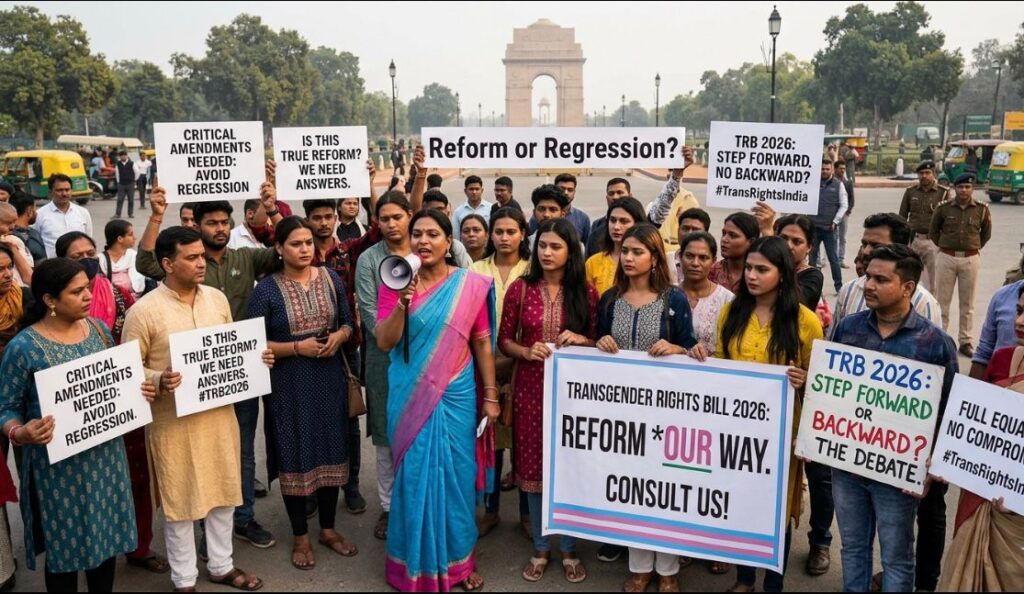
The Transgender Amendment Bill, 2026, has brought back a question that Indian law had, at least on paper, settled more than a decade ago: who has the final say over a person’s gender identity?
The bill was passed in the Lok Sabha, and the opposition walked out in protest. That political reaction is important, but it is not the real issue. The real issue lies in what the bill quietly changes.
At one level, it talks about classification, certification, and procedure. But underneath that, it shifts something more fundamental from trusting an individual’s declaration to requiring institutional approval.
That shift is where the debate begins.
What the 2019 Law Tried to Do
When Parliament enacted the 2019 law, it attempted to create a basic protection framework for transgender persons. It addressed discrimination in education, employment, healthcare, and access to public services.
But more importantly, it recognised self-identified gender.
A person did not have to prove who they were. They could submit an affidavit and obtain a certificate from the District Magistrate. The process was not perfect, but it was accessible. It treated identity as something that belongs to the individual.
This approach was not accidental. It reflected what the Supreme Court had already said in the NALSA judgment: that gender identity is closely tied to dignity, autonomy, and personal liberty under Article 21.
In simple terms, the law started from a position of trust.
What the 2026 Amendment Changes
The 2026 Bill moves away from that starting point.
It narrows the definition of who can be recognised as transgender. Instead of a broad, self-identification-based understanding, it introduces specific categories: socio-cultural identities, intersex variations, and persons who have undergone medical procedures.
At the same time, it leaves out those who identify as transgender without medical or biological markers.
The certification process also changes in a significant way.
Earlier, a declaration was enough. Now, a medical board must first examine and approve the claim. Only after that does the District Magistrate issue the certificate.
This is not just a procedural adjustment. It changes who controls recognition: the individual or the system.
The Government’s Position
The government’s position is built around two concerns.
First, it argues that the earlier definition was too wide. According to this view, a broader definition made it difficult to ensure that benefits reached those who genuinely needed protection.
Second, there is a concern about misuse. If identity alone is enough to access certain benefits, the possibility of false claims cannot be ignored entirely.
Seen from this perspective, the amendment tries to make the system more targeted. It attempts to draw clearer boundaries and introduce a layer of verification.
At the same time, the Bill increases penalties for offences against transgender persons, raising the punishment to as much as fourteen years. That suggests that the intention is not only to regulate identity but also to strengthen protection.
The Constitutional Concern
The problem is not that the Bill introduces structure. The problem is how that structure operates.
The Supreme Court, in the NALSA judgment, did not treat gender identity as something that needs validation. It treated it as something that a person determines for themselves.
The new requirement of medical approval moves in the opposite direction.
Once identity becomes something that must be certified, it stops being purely personal. It starts resembling a status granted by an authority.
That shift may look administrative, but it has deeper consequences
The Real-World Tension
It is easy to take a clear side here, but the issue is not that simple.
There is a real concern about misuse. In a country where access to benefits is often contested, the idea of having no verification at all can make policymakers uncomfortable.
At the same time, the solution creates its own barriers.
Medical procedures are expensive. Even consultations and documentation are not easily accessible for everyone. If recognition depends on medical validation, then access will depend on resources.
That means the law may end up creating a divide within the community itself, between those who can meet these requirements and those who cannot.
A system that tries to prevent misuse by tightening access must also answer who gets left out in the process.
Identity vs. Verification: What Matters More?
The crux of the debate is not just legal but also philosophical in nature.
Is identity simply stated, or must it be verified?
The supporters of the bill have claimed that some sort of verification must be done to prevent abuse and ensure the integrity of the welfare program. Any system can be abused if no form of verification is done.
While critics argue that identity, especially gender identity, is deeply personal and cannot be reduced to medical tests or external approval.
Both sides have shown some level of understanding of the issue. The problem lies in finding a balance between the two.
Social Implications
The bill has some implications other than its legal definitions.
Requiring medical certification may give the impression that transgender identity can only be legitimate if it can be medically certified.
This may have some implications for the way society perceives people who do not have the money for medical procedures.
On the other hand, the threat of abuse, especially when it comes to sensitive issues like work quotas, may be affecting public opinion.
These are some of the extreme ways of viewing the issue. In reality, the things are a bit more complicated.
Where the Debate Stands Now
The bill has already been passed by the Lok Sabha and is currently under consideration in the Rajya Sabha.
Indications of the reports, including those published in The Hindu, show that there have been recommendations for reconsideration of some aspects of the law, especially in aspects of self-identification.
This suggests that the debate is far from settled.
Conclusion
The Transgender Amendment Bill, 2026, is a bill that balances rights, policies, and practical concerns.
It tries to prevent misuse and protect rights, but in doing so, it is amending one fundamental right: rights to self-identify.
Whether this is justified or not will depend on how one balances one right against another.
As this bill is sent to the Rajya Sabha for further consideration, the debate is no longer about whether this bill needs to be reformed but what form this reform needs to take.
Author’s Note
This is not a question with an easy answer.
There is a legitimate concern on both sides about misuse, about being left behind, and about being treated with dignity.
What makes this matter tricky is that being too firm on one side will mean being too lenient or blind to one aspect.
The problem is not defining identity but doing so without being unfair, unrealistic, and respectful to individual rights.