This article is written by Shreya Goyal of NIMS University, Jaipur.
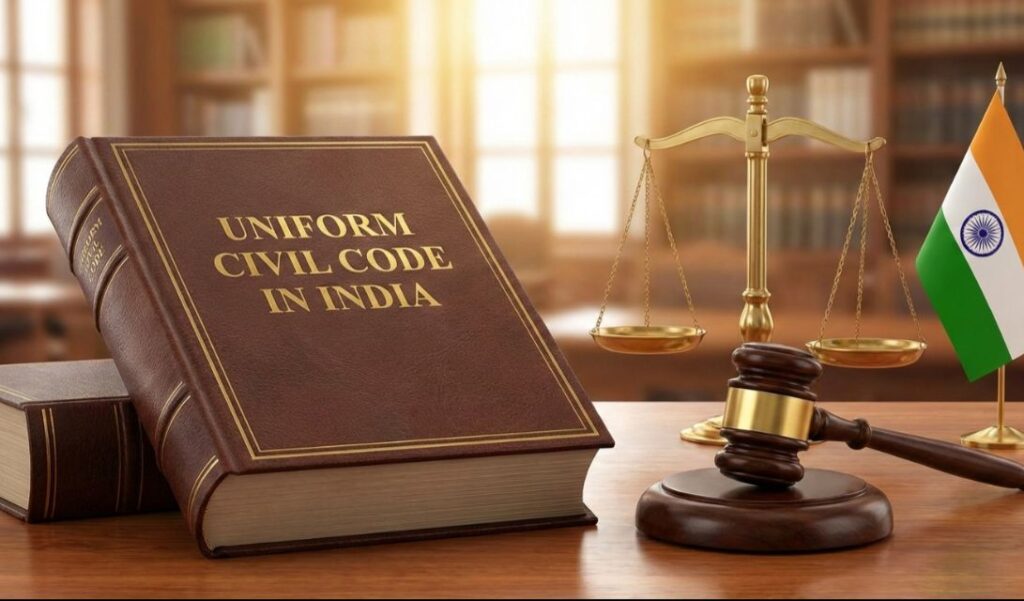
The idea of a Uniform Civil Code (UCC) has become one of the most controversial and delicate topics in the Indian constitutional law. The UCC that is described as a Directive Principle of State Policy in Article 44 of the Indian constitution envisages a uniform set of civil rules to regulate personal issues like marriage, divorce, succession, inheritance and adoption to all citizens regardless of their religions.
The Uniform Civil Code (UCC) has not been in reality but has largely been a constitutional notion throughout the decades. This has however changed over the last few years especially as Uttarakhand has been very keen on the adoption of the UCC in 2024. This political action has drawn deep-seated discussions and controversies in the political, legislative and social arenas in as far as secularism, gender equality, freedom of religion, and constitutional ethics is concerned.
There is constitution with the Uniform Civil Code
Constitution Article 44 states:
The State will strive to establish a Uniform Civil Code to every citizen on the territory of India.
Article 44 as a Directive Principle cannot be applied by the judiciary yet it acts as a guide to the State when coming up with laws.
The authors of the Constitution had a vision of the UCC that would foster equality before the law and gender justice, serve to encourage a sense of nationhood, but at the same time address the diversity and pluralism of India.
In the meantime, the UCC intersects Article 25 that is the freedom of religion. This social reform and religious liberty agreement in the constitution has been the primary concern in the formation of standard civil order.
The History of Uniform Civil Code in India
The proposal to have a Uniform Civil Code in India is not novel. The British society in the colonial era was such that it made certain that the personal law of different religious groups was applied to avert any form of dissent so as to maintain the social stability. Accordingly, legal rules such as marriage, divorce, and inheritance which involved personal issues were still bound to religion practices. During the discussions at the Constituent Assembly some of its members insisted on the creation of a Uniform Civil Code on the ground that it was impossible to organize a modern democratic republic without such a Code, but they felt it had to be gradually and consensually implemented. In order to arrive at a compromise, this was contained in the Directive Principles and not a Fundamental Right.
During the post-independence era, India took a steady course in some of her aspects such as criminal law and procedural law though personal laws did not change much. Although a Hindu personal law like Hindu marriage act or Hindu succession act was implemented by enacting legislative changes, the same was not applied quite commonly in all communities and this state of affairs has legal imbalances.
New Updates: Uttarakhand Uniform Civil Code, 2024
Uttarakhand was the first state in India to introduce the law on a Uniform Civil Code in 2024. This is a law that targets individual matters such as:
o Marriage and divorce
o Live-in partnerships
o Succession and heredities.
o Matrimonial and partnership coupons.
The UCC in Uttarakhand is meant to create gender equality by eliminating discriminations that are present in some personal laws. Nonetheless, this law has been criticized to be intrusive of the personal rights and religious convictions.
With the enactment of the law, the debate of whether or not to introduce a national UCC and have it implemented at the state level has been rekindled with the constitutional intentions.
Case Laws
Mohd. Ahmed Khan v. Shah Bano Begum (1985)
Shah Bano case is one of the most notable cases as far as the Uniform Civil Code is concerned. In a scenario that a Muslim lady was divorced, the Supreme Court ruled that she was not denied maintenance under the provisions of the Section 125 of the Criminal Procedure Code despite the divorce. The Court pointed out that the immediate need to employ a Uniform Civil Code is great because Article 44 is yet to become effective. The ruling meant that individual laws do not necessarily create uniformity and thus lead to injustice particularly to women.
Sarla Mudgal v. Union of India (1995)
The Supreme Court evaluated the question in this case of Hindu men who had changed their religion to Islam to do a second marriage when they were still married to the first wife. The Court declared that such marriages were invalid which made the necessity of Uniform Civil Code a primary one to avoid misuse of personal laws. The Court underlined that a Uniform Civil Code would help create national unity and reduce the conflicting loyalty along the religious lines.
John Vallamattom v. Union of India (2003)
This case contested the Christian personal law of inheritance that was discriminatory. The Supreme Court pronounced the controversial provision as unconstitutional and repeated the need to put Article 44 into effect to provide equality. The case highlighted that the personal laws were not to be left without the constitutional test.
Shayara Bano v. Union of India (2017)
This case usually referred to as the Triple Talaq case stated that the practice of instant triple talaq was unconstitutional. Although the case did not directly employ a Uniform Civil Code, it supported the concept of the personal laws being in line with the constitutional principles, particularly the ones pertaining to gender justice and dignity.
The Sex Equity and Equal Civil Code
Among the reasons that have been presented in support of the Uniform Civil Code is the fact that it could lead to gender equality. Some of these personal laws have clauses that are not favourableto women especially in divorce, maintenance, guardianship and inheritance. In most cases, these inequities had to be rectified by the court system and that is a major weakness of the respective legal systems.
In many decisions, the Supreme Court has noted that individual laws can never exist without the constitutional principles. The iniquitous asset secession rights, the randomness of the divorce procedures and non-provision of sustenance are all disputed due to the sense of dignity and equality.
The Uniform Civil Code of the state of Uttarakhand has made a significant effort to highlight the equality of rights of women by balancing the marriage registration, the law of inheritance, and the law of maintenance. Although the lawfulness of the legislation can be contested, it represents a major movement on the path of accepting women as equal legal persons and not as people who are dependent on their families.
Suggestions in Favour of Uniform Civil Code.
Gender Justice
Most personal legislation is discriminatory especially those relating to women. An equal right in issues of marriage, divorce, and inheritance is provided by a Uniform civil code (UCC).
Equality Before Law
Article 14 ensures the absence of discrimination. Homogeneous civil laws offer one and the same standard of law to all citizens irrespective of their religion.
National Integration
Harmonious civil structure facilitates solidarity and minimizes inter-group conflicts.
Automation of the Legal System.
Many of the separate laws are ambiguous and inconsistent. A UCC would harmonize civil law and would aid in minimizing litigation.
Reasons Why Uniform Civil Code should be rejected.
Religious Freedom
Some laws, according to critics, belong to the religious traditions and are included in Article 25.
Cultural Diversity
In India, the pluralism is based on the notion of the differences. The cultural identities would be weakened due to the singleness of a code.
Fear of Majoritarian Bias
It is feared that UCC can be prejudiced according to the majority society values.
Implementation Challenges
It is extremely hard to devise a single and universally applicable set of codes that may cut across all communities.
Conclusion
The Uniform Civil Code is also among the controversies in the constitutional aspirations of India. Though the introduction of the UCC in Uttarakhand is a positive move, it also points to the social and legal issues of implementing uniformity in a multi-ethnic community. Judicial decisions in the years have been a consistent argument in terms of the constitutional purpose of a UCC, especially in promoting gender justice and equality. However, the creation of the nationwide UCC should be supported as well by the large-scaleconsultations, creating the consensus, and embracing diversity of religion and culture. Tightly designed and comprehensive Uniform Civil Code can bring the constitutional priorities closer to the social fact and enhance the dedication of India to justice, equality and secularism.
Frequently Asked Questions
What is the Uniform Civil Code?
It is an all-inclusive civil law on personal affairs that relates equally to all the citizens, irrespective of their religion.
Is the Constitution a requirement to UCC?
No, it is an Article 44 Directive Principle and cannot be enforced in courts.
Which became the original state to adopt UCC?
In 2024, Uttarakhand was the first state to implement a Uniform Civil Code.
Does UCC violate the freedom of religion?
The argument is still going on through the courts have decided that individual laws should be aligned to the principles of the constitution.
Is UCC implementable on the national level?
Yes, it may be, but it must be well-designed, should be politically willed, and reached the consensus on the part of the society.