This Article is written by JEYASHRI R, B.Sc. LL.B., Student at the Government Law College, Madurai, Tamil Nadu. This article examines the history of the POCSO Act, its positive and negative impacts, the Romeo-Juliet clause and the accepted countries.
Globally, the rate of young individuals facing serious sexual abuse is alarming. Often, child sexual abuse and exploitation were Unreported. From the review of the UNICEF study, it is found that 1 in 8 children in the world (12.7%) before reaching the age of 18 had been sexually abused. Young girls especially are being exploited. To address this issue, numerous international conventions were established. In the case of India, the Protection of Children from Sexual Offences Act (POCSO), 2012 was enacted. Despite the implementation of this act, a large number of young girls are still being exploited.
On the other hand, the question arises whether the POCSO Act, 2012, is gender neutral. Because it was silent about the concept called consensual relationships. This came to light in a case, State of Uttar Pradesh v Anurudh and Another (2026), in which the Supreme Court of India advised the parliament to insert the Romeo – Juliet clause in the POCSO Act, 2012.
HISTORY OF THE POSCO ACT, 2012
Internationally, in 1974, the United Nations General Assembly adopted the Declaration on the Protection of Women and Children in Emergency and Armed Conflict. This declaration and the Beijing rules paved the way for the United Nations Convention on the Rights of the Child (UNCRC), 1989, which ensures the rights of every child. India ratified this convention in 1992. The Indian Penal Code, 1860, had provisions dealing with matters that were considered inadequate. To enforce this convention and such other conventions relating to the protection of children, the Indian parliament enacted several Acts, which include the Protection of Children from Sexual Offences (POCSO) Act, 2012. It was amended in 2019 to introduce stricter punishments.
THE IMPLICATIONS OF THE POSCO ACT
Positive Impact of the POSCO Act
After the enforcement of the POSCO Act, several sexual abuse cases were filed. Further, it ensured speedy and fair justice to young victims. For instance, according to Section 19 of the POSCO Act, any person, including the child, who has apprehension that an offence is likely to be committed or has knowledge that such an offence has been committed, shall inform to
(a) The Special Juvenile Police Unit; or
(b) The local police.
Every such report shall be recorded in writing and must be entered in a book by the Police Unit. Any failure to report the commission of an offence will be considered as an offence and imprisoned either with description which may extend to six months or with fine or with both as per the Section 21 of the POSCO Act, 2012. These provisions in the POSCO Act, 2012, ensure transparency in the proceedings.
In case of, Alakh Alok Srivastava Versus Union of India 2018 Cri LJ 2929 (SC), the Supreme Court of India issued several guidelines for the speedy disposal of cases involving sexual offences against children. Some of the guidelines include providing a child-friendly atmosphere in the Special Courts and ensuring proper investigation and others.
Negative Impact of the POSCO Act
Despite several positive impacts of the POSCO Act, 2012, in society, there are several issues not yet addressed. In which, the major issue is a consensual relationship before reaching the majority age. In such a case, Sections 29 and 30 will affect the person involved in the relationship. In the case of Navtej Singh Johar versus Union of India, Ministry of Law and others [2019 (1) SCC (CRI) 1], the Supreme Court of India recognised the right to choose a life partner as a fundamental right under Articles 19 and 21 of the Constitution.
Even though the consent of the minor girl is immaterial, bail is granted to the accused based on mutual love held in the case Shri Silvestar Khonglah & Anr. versus State of Meghalaya & Anr [Crl.Pet.No. 45 of 2022]. Further, in Vijaylaskshmi vs. State [Crl.O.P.No. 232 of 2021], the Madras High Court observed that the POCSO Act was enacted with the aim of protecting and rendering justice to victims and survivors of child abuse, and it was not the objective of the POCSO Act to punish the man or adolescent boy involved in a consensual relationship with a minor girl.
Recently, in State of Uttar Pradesh versus Anurudh and Another (2026), the Supreme Court of India advised the legislature to insert the Romeo-Juliet clause in the POCSO Act, 2012.
ROMEO AND JULIET CLAUSE
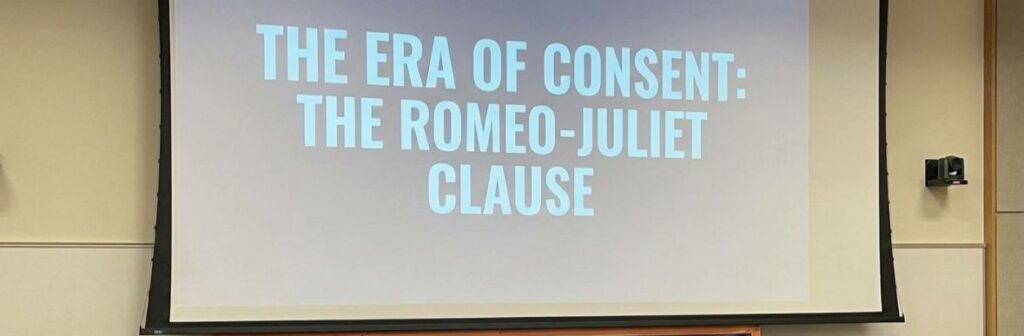
To establish the POCSO Act as a gender-neutral legislation, it is the need of the hour to insert the Romeo and Juliet clause in our legislation. The term “Romeo and Juliet” was derived from the famous play Romeo and Juliet written by the playwright William Shakespeare. This play narrates the love story of two young lovers, Romeo and Juliet. Later, the consensual relationship between young couples was called the Romeo and Juliet law. In the 21st century, Romeo-Juliet laws originated in the United States of America to prevent consensual or close-in-age teenage relationships from being prosecuted as statutory rape or sex crimes. But it is not explicitly mentioned in any statute; they gave a remedy through the 2013 Florida Statute Section 943.04354 by removal of the requirement to register as a sexual offender in special circumstances.
COUNTRIES WHICH HAVE THE ROMEO-JULIET CLAUSE
Totally, worldwide, 20 countries have accepted the Romeo and Juliet clause. Some of them are Russia, Italy, Canada, Sweden, Austria, Switzerland and others. In the case of Canada, if the defence alleges the complainant gave consent, an exception is granted under Section 13 of Tackling Violent Crimes Act, 2008, subject to the age category. In the case of the United States of America, the age of consent and the Romeo-Juliet laws differed in each state. That is, twenty-six states in the USA have the Romeo-Juliet laws. Likewise, in Australia, the age of consent and the Romeo-Juliet law differ in each of its states.
CONCLUSION
This article examines the positive and negative implications of the Protection of Children from Sexual Offences Act (POCSO) Act, 2012 and the Romeo-Juliet clause. In the final analysis, it is clear that out of 193 countries, only 20 countries were following the Romeo and Juliet laws. But, on the other hand, many innocent young people are affected by the strict interpretation of the POCSO Act, 2012. In such a case, the legislature may let the judiciary take a decision and grant bail. Because Bail is a rule, jail is an exception laid down in the case State of Rajasthan versus Balchand alias Baliya 1977 AIR 2447. The Universal Declaration of Human Rights Article 11 states that the right to be presumed innocent until guilt is proven. This principle is violated by Section 29 of the POSCO Act, 2012. In conclusion, the Court should be given discretion to decide in the case if the consensual relationship is proved beyond a reasonable doubt. This discretion must be exercised with reference to the age of the girl, likely between 16 and 18. A similar approach is followed in Romeo and Juliet laws practicing countries such as Canada and others.
Frequently Asked Questions
What is the definition of a child under the Protection of Children from sexual offences Act, 2012?
Under the POCSO Act, Section 2 (d) defines “child” as any person below the age of eighteen years.
In which case, it was held that the right to marriage comes under the purview of Article 21 of the Indian Constitution?
In Shafin Jahan vs Ashokan and Others (Criminal Appeal No. 366 of 2018), the Supreme Court held that the right to marriage is part of Article 21 of the Indian Constitution.
What does the term “consensual” mean?
For the subject matter of this article, the term “consensual” means with the approval or voluntary relationship between a girl and a boy.
Whether the Convention on the Rights of the Child has been ratified by many countries?
Yes, 196 countries have become State Parties to this Convention.
In which court are the POSCO cases tried?
Under Section 28 of the POSCO Act, 2012 provides for the establishment of Special Courts for the purpose of ensuring speedy trial.
References
- https://www.unicef.org/media/89096/file/CSAE-Report-v2.pdf
- https://www.indiacode.nic.in/bitstream/123456789/2079/1/AA2012-32.pdf
- https://indiankanoon.org/doc/127737197/
- https://www.unicef.org/child-rights-convention/convention-text
- https://www.casemine.com/judgement/in/57b47851bc416857b539d101
- https://childsafety.cgpolice.gov.in/assets/img/resource/Summary_-_Alakh_Alok_Srivastava_vs_Union_Of_India1.pdf
- https://indiankanoon.org/doc/168671544/
- https://share.google/9jXtWz09BoExt8gnp
- https://www.oxfordlearnersdictionaries.com/definition/english/romeo-and-juliet
- https://www.coursehero.com/file/189948039/ARTS-340-Wk-4-Program-Music
- https://www.flsenate.gov/PublishedContent/Session/2012/InterimReports/2012-214cj.pdf
- https://www.flsenate.gov/Laws/Statutes/2013/943.04354
- https://worldpopulationreview.com/country-rankings/age-of-consent-by-country
- https://www.parl.ca/documentviewer/en/39-2/bill/C-2/royal-assent/page-4
- https://indiankanoon.org/doc/8258/
- https://www.un.org/en/about-us/universal-declaration-of-human-rights
- https://www.unicef.org/child-rights-convention/frequently-asked-questions