This article is written by Pragati Trivedi, B.B.A LL.B., NIMS University, Jaipur, Rajasthan.
A constitutional democracy is anchored on the behaviour of free and fair election. This exercise of democracy is based on the making and maintenance of the electoral rolls in India. Without an effective and complete voter list, the principle of universal adult suffrage which is enshrined in Article 326 of the Constitution of India is a far-fetched concept. At the same time, Article 324 of the Constitution vests the superintendence, direction and control of elections, including the revision of electoral rolls in the Election Commission of India (ECI).
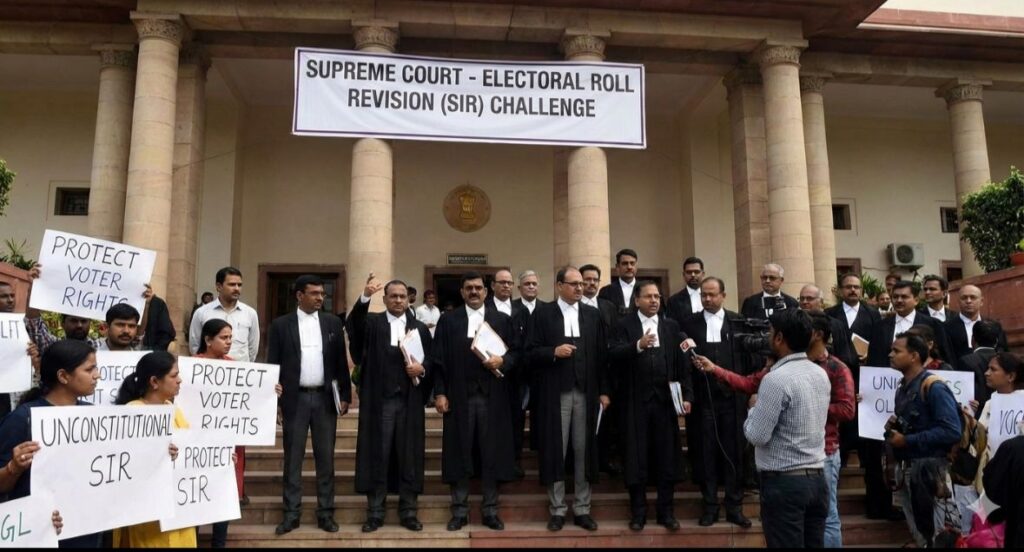
In 2025–26, the Election Commission initiated a Special Intensive Revision (SIR) of electoral rolls in several states. The SIR is also unlike the regular summary revisions that are usually carried out on an annual basis, and they include a lot of door-to-door checks and rechecks on the voter information and new documentation. The Commission claimed that the exercise was necessary to purify the electoral rolls by eliminating duplicate, dead and ineligible voters. Nonetheless, the exercise has raised much constitutional controversy, and it is being challenged in the Supreme Court of India.
Civil society organizations and political entities among other petitioner’s state that the SIR process could result in mass disenfranchisement, undue imposition of documentation burdens on the marginalized communities, and probably may surpass the statutory requirements of the Representation of the People Act, 1950 and the Registration of Electors Rules, 1960. The constitutional dilemma is therefore a matter of a fine line to maintain election integrity but at the same time not to tarnish the democratic right of participation.
The controversy raises some of the simplest questions, which include:
- Article 324 put an open door to the ECI?
- Is the tightness of the verification measures going to violate Article 14 and 21 of the Constitution?
- Would the mass deletion of voters be risky since it might contravene the fundamental principle of freedom and fair elections as enshrined in the basic structure?
These are the issues that should be of concern regarding the current judicial challenge of the SIR process.
Case Laws
1. Mohinder Singh Gill v. Chief Election Commissioner (1978) 1 SCC 405
This historic ruling made the meaning of Article 324 clear. The Supreme Court maintained that the Election Commission had plenary powers where legislation did not exist. Nonetheless, these powers cannot be absolute and should work within the constitutional and statutory limits.
Application to SIR:
It is based on this case that the ECI justifies its power to undertake intensive revisions. Nevertheless, critics claim that Article 324 is unable to supersede statutory protection under the Representation of the People Act. The reasoning of the Court indicates that discretion should not be arbitrariness.
2. Indira Nehru Gandhi v. Raj Narain (1975) Supp SCC 1
In this landmark decision, the Supreme Court has pronounced that the free and fair elections are a constituent part of the basic structure of the Constitution.
Application to SIR:
When the SIR involves deletion of legitimate voters in large numbers or in an unjust manner, particularly around the election time, it can be in breach of the fairness of elections hence it would be offensive to the basic structure doctrine.
3. Lakshmi Charan Sen v. A.K.M. Hassan Uzzaman (1985) 4 SCC 689
The Court stated that electoral rolls can in the ordinary course not be tampered with after an election has been initiated and that small mistakes in election rolls do not nullify the election.
Application to SIR:
The time when SIR is practiced is constitutionally sensitive. Then there is the issue of fairness and electoral stability as it can be raised when intensive revision is conducted just before elections.
4. E.P. Royappa v. State of Tamil Nadu (1974) 4 SCC 3
This case expanded the scope of Article 14 by introducing the doctrine that arbitrariness is antithetical to equality.
Application to SIR:
If voter deletions occur mechanically, without proper notice or opportunity of hearing, such action may be challenged as arbitrary and violative of Article 14.
5. People’s Union for Civil Liberties (PUCL) v. Union of India (2003) 4 SCC 399
The Court realized the value of voter awareness and transparency in elections.
Application to SIR:
The electoral processes should ensure that they encourage informed and inclusive participation. Any revision process should protect democratic inclusion but not limit it.
Constitutional Issues in the SIR Challenge
1. Scope of Article 324
Article 324 gives the ECI supervisory power. However, judicial precedents explain that this power is not absolute. It must be exercised:
- In line with the statutory provisions.
- Trends with basic rights.
- Subject to judicial review.
The central issue is to be able to determine whether the SIR is a legitimate administrative action or massive power abuse.
2. Right to Vote and Adult Suffrage
The right to vote is not a fundamental right but a statutory right. But Article 326 the principle of universal adult suffrage is under the protection of the Constitution. Although Parliament controls the mechanics of voting, it is necessary that it must exclude individuals based on due process.
When SIR procedures affect only specific groups out of proportion with certain groups being targeted more than the rest, like rural voters, migrant workers, undocumented women or low-income citizens, substantive equality questions are raised.
3. Procedural Fairness and Natural Justice
Natural justice is the doctrine that demands:
- sufficient prior warning of deletion,
- Opportunity to respond,
- Transparent criteria,
- Proper redress of grievances.
When the SIR process results in making timelines shorter or additional documentation requirements that most citizens would not realistically fulfil, it might fail the fairness test in Articles 14 and 21.
4. Basic Structure Doctrine
The Constitution provides free and fair elections. Any activity which substantially interferes with the electoral exercise may be under severe judicial review.
The petitioners suggest that a massive removal near the election can interfere with the elections, thus, affecting democracy
Ongoing Judicial Developments
The Supreme Court has been so far cautious in the current petitions that question SIR. It has:
- Refused to suspend the revision process altogether.
- Reiterated that electoral lists did not stay the same.
- Told the ECI to embrace sensible and accommodating documentation principles.
Suggested that judicial intervention would be welcome in cases of arbitrary or massive wrongful deletions.
This strategy is a sign of a balancing act: the respect of the autonomy of a constitutional authority and protection of constitutional rights.
The final decision of the Court can explain:
- Procedural safeguards necessary in revisions of an election,
- The administrative discretion of Article 324,
- The judicial review criteria of election.
Conclusion
The constitutional test of Special Intensive Revision of electoral rolls can be viewed as an important step in the development of democracy in India. The conflict is not just an administrative one, but it goes right to the core of constitutional governance.
On the one hand, proper electoral lists are needed to eliminate fraud, duplication and manipulation. On the other side, the democratic pledge of mass involvement requires the exclusion of no eligible citizen by the rigidity of rules or the usurpations of administration.
The Supreme Court is to reconcile two constitutional demands; electoral integrity and electoral inclusion. Although Article 324 gives the Election Commission very wide powers, these powers must work within the context of equality, fairness, and constitutional responsiveness.
Finally democracy also survives not just by clean electoral rolls but also inclusive participation. The SIR litigation will probably determine the outlines of the electoral jurisprudence in India and stipulate the outlines of constitutional electoral power in the decades to come.
Frequently Asked Questions
What is the Special Intensive Revision (SIR)?
It is an overall electoral roll checking system whereby door-to-door checks and revalidation of voter records are done to eliminate ineligible or duplication of records.
Why has SIR been challenged in court?
Petitioners claim that it can lead to arbitrary deletions, place undue documentation burdens and usurp statutory power.
Does Article 324 give unlimited powers to the Election Commission?
No. The powers are general but can be restricted by the constitution, statutory law as well as judicial review.
Is the right to vote a fundamental right?
The right to vote is constitutional, whereas the free and fair elections belong to the basic Constitution framework.
What could be the impact of the Supreme Court’s decision?
The ruling may clarify procedural safeguards, define the scope of electoral authority, and influence future electoral reforms.
References
- The Constitution of India (1950)
https://www.indiacode.nic.in/bitstream/123456789/19150/1/constitution_of_india.pdf - Election Commission of India – Electoral Rolls Manual & Guidelines
https://www.eci.gov.in/manuals - Ongoing Proceedings: Association for Democratic Reforms v. Election Commission of India (2025–26)
https://en.wikipedia.org/wiki/Association_for_Democratic_Reforms_v._Election_Commission_of_India