
This article is written by Shreyansh Tripathi, B.B.A L.L.B., Symbiosis Law School, Noida.
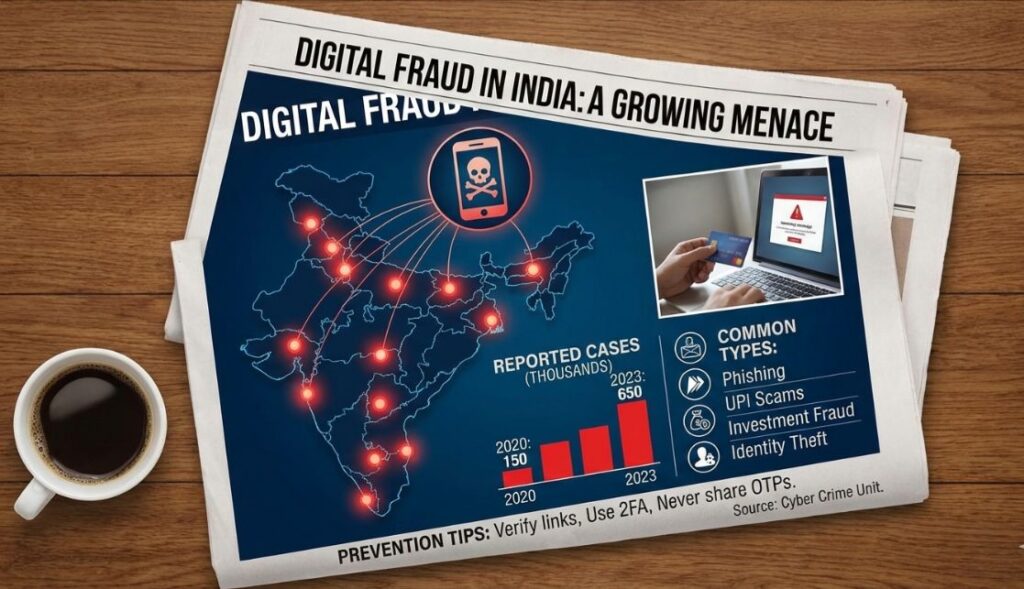
Another fast-evolving cybercrime in India is digital arrest fraud where scammers impersonate police, courts or regulatory bodies to threaten their victims into handing over money or giving up sensitive personal information. Despite the fact that in India the idea of a digital arrest lacks any legal basis, fraudsters take advantage of the fear of criminal prosecution through the method of forged court orders, fake video calls, and impersonation. This kind of cybercrime has not only received recent court scrutiny, with even the Supreme Court intervening Suo motu, but has also received notice as an attack on popular belief in legal institutions as well as a recurrence of financial fraud.
Nature and Modus Operandi
Fraudsters impersonate themselves as employees of the CBI, the Enforcement Directorate, the police, or the telecom authorities. The victims, who are usually aged citizens, are contacted over the phone or video call and presented with counterfeit judicial orders, counterfeit arrest warrants or modified identity records. The scammers purport that the victim is being investigated due to one or more crimes, like money laundering or telecom fraud and require urgent payments to avoid being arrested or clearing charges. The Supreme Court has seen that these crimes are becoming more dangerous as they are being committed through forged judicial documents and across-state networks than the traditional cyber frauds.
Current Legal System to regulate Fraud in digital arrest
The prosecution of digital arrest fraud uses a set of provisions of cybercrime and criminal law. The Information Technology Act, 2000 under section 66D criminalises the practice of cheating through personation by use of computer resources, which encompasses impersonation-based frauds. Courts have provided that the liability in Section 66D will require the demonstration of both digital impersonation and fraudulent intent, and this is where the electronic evidence in the form of call records, emails, and transaction logs is important. Also, crimes can be prosecuted under cheating, forgery, criminal intimidation and extortion sections of Bharatiya Nyaya Sanhita (BNS) and this aspect further demonstrates the multi-tiered character of prosecution.
Recognition of Judicial Response and Policy
The Supreme Court of India has also assumed Suo motu awareness of the digital arrest frauds in which fake court orders and imprisonment of judicial officers are used. The Court explained the crimes as a serious challenge to the dignity of the judicial system and the faith in the rule of law as the country must have a concerted effort to enforce laws across the country. To curb the increasing magnitude of these scams, the Supreme Court has ordered a pan-India CBI probe into the cases of digital arrest fraud, and the importance of inter-state collaboration, increased bank surveillance, and international agency participation, including Interpol. A newer decision of the Court saw banks being criticized over their inability to prevent fraudulent transfers and called on the adoption of Standard Operating Procedures (SOPs) as a way of restoring stolen money and improving the response system to cybercrime.
Supreme Court Mandates SIM Binding for WhatsApp
The Union Government has advised the Supreme Court that it is essential to mandate WhatsApp with SIM-binding in order to prevent digital arrest frauds. The move will help to eliminate the abuse of cloned, foreign, or anonymous numbers to masquerade as law enforcement personnel by connecting accounts to active physical SIM cards. The DoT and MeitY suggested hardware-based SIM verification as a method to implement only verified users to use messaging accounts. The Centre claimed that the CIOR system has been successful in preventing spoofed foreign calls as well as emphasizing AI-based bank surveillance and SOPs to identify and freeze fraudulent accounts. Nonetheless, the Supreme Court has advocated prompt enforcement according to the Telecommunications Act, 2023, which has enhanced better digital accountability.
Regulatory and Enforcement Problems
The issue of jurisdictional complexity is one of the main obstacles in resolving the problem of digital arrest frauds since any scammer can act in different states and countries. The investigators will be required to trace the layered financial transactions to be channeled via mule accounts, foreign fintech applications, and overseas ATMs. The Supreme Court has observed that bank systemic failures and the lack of real-time fraud detection applications are some of the factors that make the crimes successful. Though AI based monitoring tools have been implemented by the Reserve Bank of India, the courts have noted that the adoption between banks has been inconsistent, undermining fraud prevention. The second issue is the absence of knowledge among the general population concerning the criminality of the so-called digital arrest, which exposes vulnerable groups at risk of the psychological manipulation of the population, particularly among older people.
Require Tighter Legal and Regulatory Changes
India needs to reinforce its preventive and punitive actions in an attempt to prevent digital arrest fraud. Legal changes might involve better legal definition of digital impersonation and judicial document forgery as aggravated cybercrimes. Strict Know Your Customer (KYC) requirements on SIM cards and bank accounts should be required by regulatory bodies so as to limit the establishment of mule accounts. The police services need more digital forensic capacity and real-time financial intelligence access to trace suspicious channels of money. The inter-agency coordination centers as suggested by the Supreme Court are needed as well as public education campaigns in order to guarantee timely intervention and support of the victims.
Case Laws
The Supreme Court sued motu to address the issue of digital arrest scams with fake court orders and impersonation of law enforcement agencies, declaring it to be a grave concern of the judicial system as a whole and the trust of the people.
Sandeep Varghese v. State of Kerala (2010)
The Kerala High Court, decided that digital impersonation together with a fraudulent intent is liable under 66D of the IT Act, which supports the burden of evidence needed to make a conviction.
Suhas Katti v. State of Tamil Nadu (2004)
The court also established the enforceability of provisions of IT Acts against online misconduct, which was the first conviction of cybercrime in India, and which formed the basis of current cybercrime jurisprudence.
The new Supreme Court orders to have a pan-India CBI investigation into the digital arrest scams are another manifestation of judicial recognition of the transnational and organized character of this threat.
Shreya Singhal v. Union of India (2015) 5 SCC 1
The Supreme Court declared Section 66A invalid and affirmed that it relied on valid cyber fraud clauses such as Section 66D.
Lucknow Digital Arrest Scam Case (Debashish Rai, 2024-2025)
This case was an alleged con of a Lucknow court which convicted an accused, who had falsely posed as a CBI officer and extorting money under a digital arrest scam under Section 66D of the IT Act, 2000.
Conclusion
Digital arrest fraud is a threat of cybercrime, psychological influence, and institutional identity. It not only destroys the trust of the citizens in the law but also has devastating financial and emotional consequences on the victims. Even though Indian courts and regulators have started to act in response with more aggressive directives of enforcement and policies, a long-term reform is required to combat the dynamic scam tactics. Proper fortification of digital evidence models, improved supervision of banks, improved publicity and prompt inter-agency coordination can help to protect people against this new cyber threat.
Frequently Asked Questions
What is Digital Arrest Fraud?
It is a form of cyber scam in which fraudsters pose as law enforcement or court and intimidate the victims to send them money or other sensitive information.
Is Digital arrest legal in India?
No. Digital arrest is not a legal concept in Indian law.
What are the laws that govern Digital Arrest Fraud?
Section 66D of the IT Act, 2000, and applicable cheating, forgery, and extortion type of provisions of criminal law.
Who are the common targets?
The aged citizens, the professional, and those who are not aware of cybercrime tricks.
What can be done by the victims to report such fraud?
By reporting at National Cyber Crime Reporting Portal (cybercrime.gov.in) or the local cybercrime police departments.
What is the way to defend oneself?
Check official sources of communication, do not panic payment and do not provide personal or banking information to strangers.