
This article is written by Pragati Trivedi, B.B.A. LL.B., NIMS University, Jaipur, Rajasthan. This article analyses gamifying legal education, how the concept applies in learning new laws, effectiveness of interactive quizzes, advantages, issues, and the future prospects of gamifying legal education in the development of modern legal education.
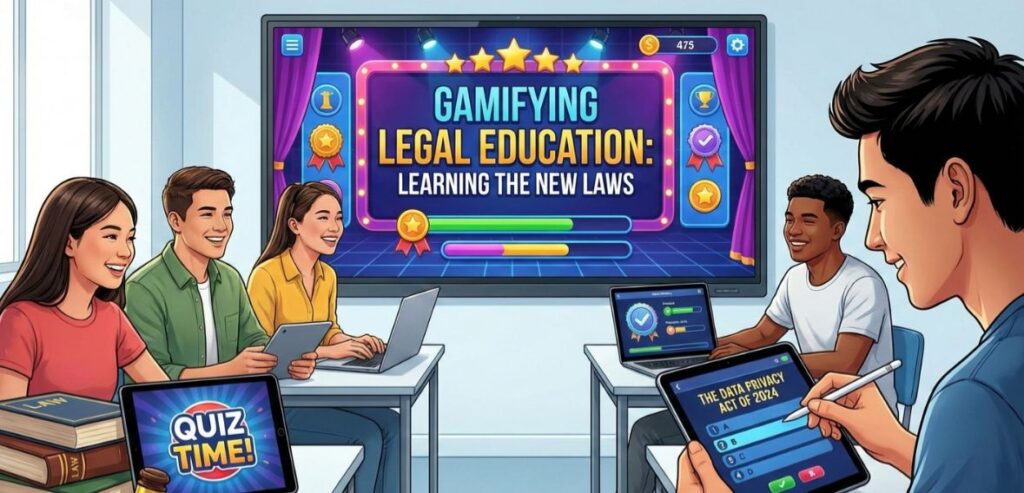
Traditionally legal education has been based on textbooks, lectures and analysis of case law in imparting knowledge. although this traditional method has worked for decades, it no longer remains effective, especially with the rise of digital technology and the shrinking attention span of modern learners. The introduction of new laws, amendments, and judicial interpretations often makes the learning process more difficult as it is quite hard to keep up and stay motivated when law students and professionals.
Gamification, in this respect, has become a new teaching methodology in law schools. It entails the implementation of game design features, including points, levels, quizzes, challenges, and rewards in non-gaming contexts to make them more engaging and improve the learning experience. Gamification, when used in learning legal education, and particularly through interactive quizzes, changes the passive learning process into an active and participatory process. This is especially useful in interpreting and memorizing new laws like the Bharatiya Nyaya Sanhita, Bharatiya Nagarik Suraksha Sanhita and Bharatiya Sakshya Adhiniyam.
Gamification in Legal Education
Gamification in legal education involves the systematic use of game-based elements to enhance student engagement and learning. Unlike traditional lecture-based teaching, gamification promotes active learning, continuous assessment, and critical thinking. Legal education requires students to interpret statutes, analyze factual situations, and apply legal principles to real-world problems; skills that interactive and experiential learning develops far more effectively.
Interactive quizzes form the core of gamified legal education. These quizzes test knowledge of statutory provisions, procedural rules, and conceptual distinctions while providing instant feedback. They are particularly useful for understanding newly enacted laws, as they familiarize learners with updated terminology, legislative intent, and structural changes, thereby improving retention and conceptual clarity.
Gamification also supports self-paced learning, allowing students to revisit complex topics without academic pressure. Features such as progress tracking and performance metrics further motivate learners by helping them monitor improvement. By making legal learning interactive and engaging, gamification enhances both confidence and competence among law students, preparing them for academic success and legal practice.
Studying New Legislation by Interactive Quizzes
The emergence of new laws is a major learning problem for law students and lawyers. New laws are often accompanied by new terminology, a new legal framework, and new processes. Traditional methods such as reading bulky books, commentaries, and explanatory notes consume excessive time and energy, especially when students must understand both the legal content and its practical application within very limited time
Interactive quizzes make this learning experience easier since they condense complex statutory provisions into smaller and more digestible matters. Through the way it delivers legal concepts, whereby it takes place in a question-and-answer format, quizzes allow the learner to concentrate on certain areas of the law at a time. This will help to decrease the cognitive overload and to get a better and more systematic understanding of new legislative frameworks.
Quizzes in the form of scenarios are also quite effective when it comes to learning something new about laws. These quizzes use real-life or hypothetical scenarios, and the learners are asked to locate and implement the pertinent provisions of law. These activities encourage critical thinking, legal reasoning, and the application of statutory rules practically. This approach is similar to the way that the law works in reality, where legal principles are applied to certain factual circumstances as opposed to being studied in a vacuum.
The learning process also improves with the use of timed quizzes, where conditions are simulated to be more like an examination and a workplace scenario. They also aid learners in accuracy, efficiency, and decision-making when under time pressure, which is vital in the judicial examinations and in the practice of law. Interactive quiz forms can be used to offer immediate feedback to learners so that they are able to identify errors and rectify misinterpretations, and to instill positive interpretations at the time of learning. Also, it is possible to implement quizzes with increasing difficulty levels, and the learner can gradually gain confidence and competence. That is why interactive quizzes are a good and efficient method to study and learn the recently adopted laws.
Case Laws
Even though the Indian courts did not explicitly state the very idea of gamification in legal education, there are several landmark decisions of the Supreme Court of India that emphasize the necessity to ensure quality, flexibility, and success in legal and professional education. The above judicial observations form a good basis to embrace new teaching techniques like interactive quizzes and learning technology-based tools.
Mahipal Singh Rana v. State of Uttar Pradesh, (2016) 7 SCC 1
With this historic case, the Supreme Court was highly concerned with the declining levels of legal education in India. The Court noted that law schools should make sure to provide proper training of students, not only as regards theory, but also in terms of practical legal skills. The decision highlighted the need to make reforms in the legal institutions and regulatory bodies in order to make the legal professionals in the future more competent. The case gives a strong argument in favour of interactive and learning tools, including gamified quizzes, to improve the understanding and retention of newly introduced laws.
Bar Council of India v. Bonnie Foi Law College, (2009) 7 SCC 1
The case brought to the fore, through the Supreme Court, the importance of the Bar Council of India in ensuring that there is maintenance of standards and quality in legal education. It acknowledged that legal training should be designed in such a way that it will train students to be professionals in the legal field. The ruling, in a way, confirms the necessity of new teaching methods, such as electronic and interactive learning tools, to make sure that students are able to learn complex legal issues in a meaningful way.
Bar Council of India v. Aparna Basu Mallick, (1994) 2 SCC 102
In this ruling, the Supreme Court repeated that legal education could not stay the same and needed to move with newly emerging societal and professional needs. The Court recognized that regulatory authorities have to promote practices that can improve the learning outcome. This verdict promotes the adoption of the educational innovations that are driven by technology, which include gamification to facilitate and streamline the learning of new laws.
Modern Dental College and Research Centre. State of Madhya Pradesh, (2016) 7 SCC 353
Even though this case applies to the area of professional education in most cases, the Supreme Court acknowledged that quality education needs constant change and innovation. These tenets are also applicable to education in law, and it is appropriate to adopt interactive learning processes that enhance student engagement and comprehension, particularly where legal frameworks are often changing.
T.M.A. Pai Foundation v. State of Karnataka, (2002) 8 SCC 481
The Court in this case stressed and highlighted the significance of educational excellence and institutional autonomy. It is believed that schools were free to implement educational strategies that were most suited to the achievement of academic goals. Such autonomy allows law schools to use gamified learning tools and interactive quizzes to make their curriculum more engaging and effective in learning.
All these judicial remarks prove the thought that innovation in legal education is necessary and just.
Conclusion
Gamifying legal training is a dramatic change from a learner-centred and application-focused teaching. In a world where legislative reforms are frequent and the complexity of the law is on the rise, interactive quizzes offer an efficient method of simplifying the intricate legal provisions as well as enhancing retention. Gamification increases the level of engagement, analytical thinking, and the connection between theory and practicality.
Although gamification will not be able to replace the classical learning of the doctrines, it is a worthy and supportive tool that enhances knowledge and flexibility. Gamified learning has the potential to considerably enhance the process of teaching and learning new laws when carefully designed and supervised academically. Gamification has great potential to produce skilled, self-assured, and forward-thinking legal practitioners as the field of legal education keeps changing.
Frequently Asked Questions
What is gamification in legal education?
Gamification entails the application of game-related activities like the use of quizzes and other challenges to improve engagement and learning in legal education.
What is the benefit of interactive quizzes in learners of new laws?
They facilitate participation, give immediate feedback and encourage the practical use of the law provisions.
Is gamification appropriate to legal education in India?
Yes, when used alongside the conventional technique, gamification improves understanding and memorization.
Is gamification the future of traditional legal education?
No, it is not a substitute of doctrinal learning but its supplement.
What does gamification in legal education entail in the future?
In blended learning models, gamification is bound to be part of law schools and legal training institutions.
References
- Mahipal Singh Rana v. State of Uttar Pradesh, (2016) 7 SCC 1 https://indiankanoon.org/doc/665015/
- Bar Council of India v. Bonnie Foi Law College, (2009) 7 SCC 1 https://indiankanoon.org/doc/18983454/
- Bar Council of India v. Aparna Basu, (2018) SCC OnLine SC 1903 https://indiankanoon.org/doc/6445/
- Modern Dental College and Research Centre v. State of Madhya Pradesh, (2016) 7 SCC 353 https://indiankanoon.org/doc/136836661/
- T.M.A. Pai Foundation v. State of Karnataka, (2002) 8 SCC 481 https://indiankanoon.org/doc/665015/
- Bar Council of India Legal Education Rules, 2008 https://klc.ac.in/wp-content/uploads/2020/07/IBR-Rules.pdf
- University Grants Commission (UGC) – Digital Learning Initiatives https://www.ugc.gov.in/MajorInitatives
- World Economic Forum – Education 4.0: The Future of Learning https://www.weforum.org/publications/education-4-0-india
- OECD – Innovative Learning Environments https://www.oecd.org/en/publications/2013/09/innovative-learning-environments_g1g331b7.html
- Harvard Law School – Teaching and Learning Innovations https://hls.harvard.edu/today/moving-legal-teaching-into-the-future/