This article is written by Ankita Ghosh, Brainware University.
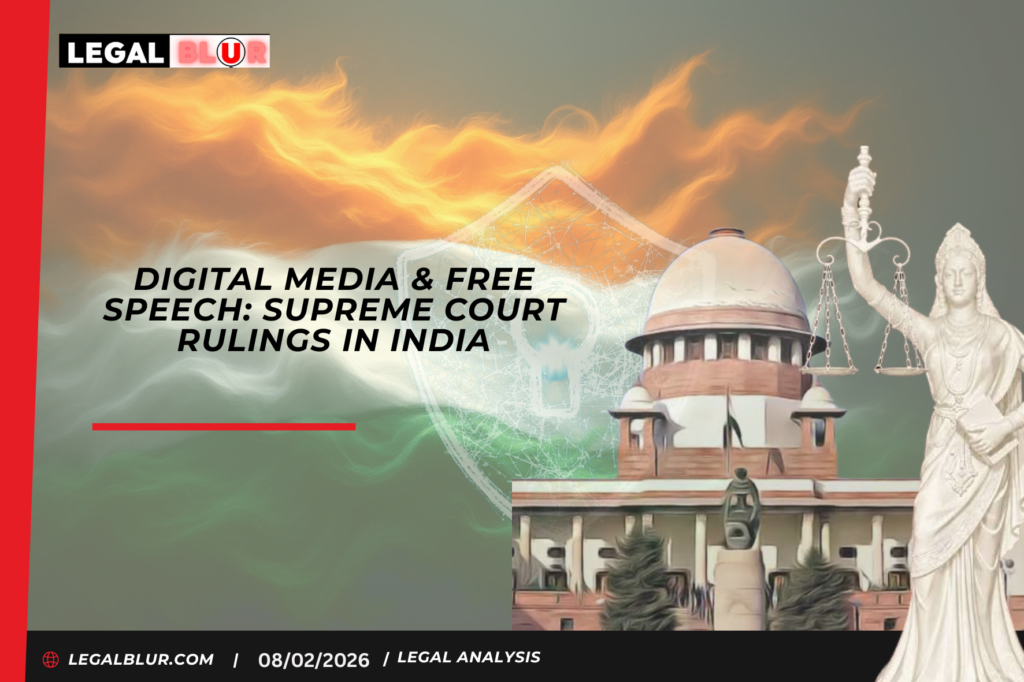
The digital media has changed the way that speech is produced, distributed, and consumed in India. The internet has established the new and the contemporary public square, whether it is social media networks such as X (the ex-Twitter), Instagram, and YouTube, or independent web-based news portals and blogs. Facts do not spread as easily as opinions do. Stories are constructed within seconds. And dissent has lost its spatial localization.
The core of this transformation is in the Article 19(1)(a) of Constitution of India that declares the right to the freedom of speech and expression. Nevertheless, this right is not absolute. Article 19(2) allows the State to put in place reasonable limitations in the name of sovereignty, public order and decency, morality and national security.
Indian courts have been confronted with the issue of balancing free speech in the digital realm with State control, misinformation, hate speech, and civil order particularly the Supreme Court. The Supreme Court has passed landmark rulings on the course of the past decade that outline the principles of freedom of speech in the online era. Such decisions not only secure personal freedom but also the future of digital authority in India.
Constitutional Framework for Digital Free Speech
Digital media are not mentioned in the Constitution. However, it has always been the opinion of the Supreme Court that constitutional protections keep up with technology. The right to speech is not merely protected by the fact that it is delivered online and not offline.
Under Article 19(1)(a): Online blogs, videos, posts, tweets, and digital journalism are all considered as being Speech and expression. Speech facilitated by digital platforms needs to be regulated, but it should undergo constitutive review. Any limitation of digital speech should: subjugate to one of the grounds under Article 19(2). Be reasonable Be clear or have a clear nexus with the objective that is to be attained. This framework lays the basis of judicial review in the digital free speech case.
Shreya Singhal v. Union of India (2015) AIR 2015 SC 1523
The case forms the basis of the jurisprudence of digital free speech in India.
Issue: The constitutionality of Section 66A of the Information Technology Act, 2000, that made it a crime to post an offensive or annoying message on an electronic communication.
Supreme Court’s Ruling: Section 66A was declared by the Court to be unconstitutional.
Key Observations: Both the words grossly offensive and menacing were subjective. Unclear laws pose a chilling effect on the freedom of speech. The reasonable restriction test in Article 19(2) was passed by the provision.
Significance: This decision held that electronic speech is entitled to the same protection of the constitution as actual speech. Criminalizing unpopular or uncomfortable speech cannot be part of the role of the State. The case continues to serve as an effective cloak against arbitrary censorship in cyberspace.
Anuradha Bhasin v. Union of India (2020) 3 SCC 637
Issue: The constitutionality of the protracted internet blocking in Jammu and Kashmir following the repeal of Article 370.
Supreme Court’s Ruling:
- Freedom of speech and expression depends on the availability of the internet.
- The shutdowns of the internet that are not time-limited are illegal.
- Internet blockade has to be temporary, commensurate and have to be reviewed by the court.
Key Principles Laid Down:
- The internet provides freedom of speech that is constitutionally protected.
- The State should issue shutdown orders and give justification.
Significance: This ruling saw that digital access had ceased to be a luxury but a need especially to the journalists, businesses, and the citizens.
Amish Devgan v. Union of India 2020 SC 930
Issue: Whether hate speech broadcasted using digital television and online platforms is under the safeguard of free speech.
Supreme Court’s Ruling: Hate speech is not part of free speech because it encourages violence or any attacks on communities. The context, intent, and impact are important in deciding whether a speech was illegal or not.
Significance: This ruling made it clear that digital platforms are not safe haven areas. Threatening speech to fraternity or to the public is regulable.
Digital Media regulation: IT Rules, 2021. Information Technology (Intermediary Guidelines and Digital Media Ethics Code) Rules, 2021 greatly enlarged the governmental control over the social media intermediaries. Digital news portals OTT platforms These Rules mandate Redressal mechanisms of grievance. Mandatory content takedown. Government control committees. Some of the provisions have been taken to court claiming that they were against free speech.
False News vs Freedom of Speech
The courts have to balance between fake news prevention and dissent protection. Platform Accountability It is still a challenge to determine the liability of the intermediaries without making them private censors. Court Trends and Problems. Chilling Effect Increased regulation results in journalists and users self-censoring democratic discourses.
Benefits of Supreme Court decision on Digital Media and Free Speech
Among the greatest merits of the decisions made by the Supreme Court, there is the constitutional quality of digital speech as the expression of the constitutional protection on the ground of Article 19(1)(a). By making historic decisions like Shreya Singhal v. Bhasin v. Anuradha Bhasin (2015). The Court stated that the constitutional status of online speech was identical to offline speech (Union of India, 2020). This identification enhances democratic participation in that citizens are allowed to openly debate and dissent and criticize issues on the digital platforms without any fear of arbitrary criminalisation.
The other significant benefit is the judicial safeguard of ambiguous and arbitrary laws. The Supreme Court upheld the principle that any limitation to free speech should be specific, fair, and precise by invalidating Section 66A of the Information Technology Act. It is a way of restricting executive discretion and avoiding the abuse of the law to silence the unpopular or objectionable voice. It also leaves a positive precedent of confronting any future digital regulations that will pose a threat to constitutional liberties.
Weaknesses and disadvantages of Supreme Court Decisions
Although these strengths are associated with judicial rulings, one of the major drawbacks is the case-specific and fragmented nature of judicial rulings. The Supreme Court has dealt with the issues of digital free speech on a case-by-case basis, which creates the lack of overall and consistent structure. Such a bit-by-bit method creates confusion in enforcement and unfair interpretation among jurisdictions. Lastly, the fast rate of technological development is also a limiting factor to judicial intervention. Courts act when a wrong has been done, and algorithms continuously develop artificial intelligence, a deepfake, and an algorithm moderation in digital communication. Consequently, the courts are at times unable to keep up with new challenges of digital speech.
Conclusion
The Supreme Court of India has been instrumental in the formulation of the laws of free speech during the digital age. The Court has been mostly liberty-focused since it started to strike down ambiguous criminal codes and, as a result, the Court has implemented a liberty-based approach towards the recognition of internet access as a right.
Nevertheless, the dynamic aspect of technology poses endless challenges. As much as the digital media enables voices, it escalates evil. The challenge before us is to make sure that it is not repression rather than regulation and it is not liberty rather than governance.
Finally, constitutional morality, proportionality and judicial vigilance have to be instrumental in influencing free speech in digital India. The position of the Supreme Court will always be essential in protecting democracy in the era of algorithms.
Frequently Asked Questions
Is article 19(1)(a) applicable to online speech?
Yes. It is quite evident that the Supreme Court has ruled that speech, which is articulated in digital platforms, receives constitutional protection similar to traditional speech.
Is it possible for the government to close the internet?
Yes, but on a temporary basis, only, to necessity, proportionality and judicial review as provided in Anuradha Bhasin v. Union of India.
Does social media get protection over hate speech?
No. The Article 19(1)(a) does not cover speech that provokes violence, hate or is such that it threatens the peace.
Are digital news portals regulated by the government?
Yes, under the rules of IT, 2021, but this regulation should agree with the constitutional guarantees.
Which is the most threatening aspect to free speech in digital media nowadays?
Imprecise legislations, imprecision of provisions, and overreach by the executive, which results in a chilling effect on speech.
References
https://legislative.gov.in/actsofparliamentfromtheyear/information-technology-act-2000
https://legislative.gov.in/constitution-of-india
https://indiankanoon.org/doc/1965344
Anuradha Bhasin v. Union of India (2020) 3 SCC 637, https://indiankanoon.org/doc/82461587
Amish Devgan vs Union of India, 2020 SC 930 https://indiankanoon.org/doc/179868451