
This Article is written by Choudhary Bhavna Nemaram, B.B.A. LL.B., Nims University, Jaipur, Rajasthan.
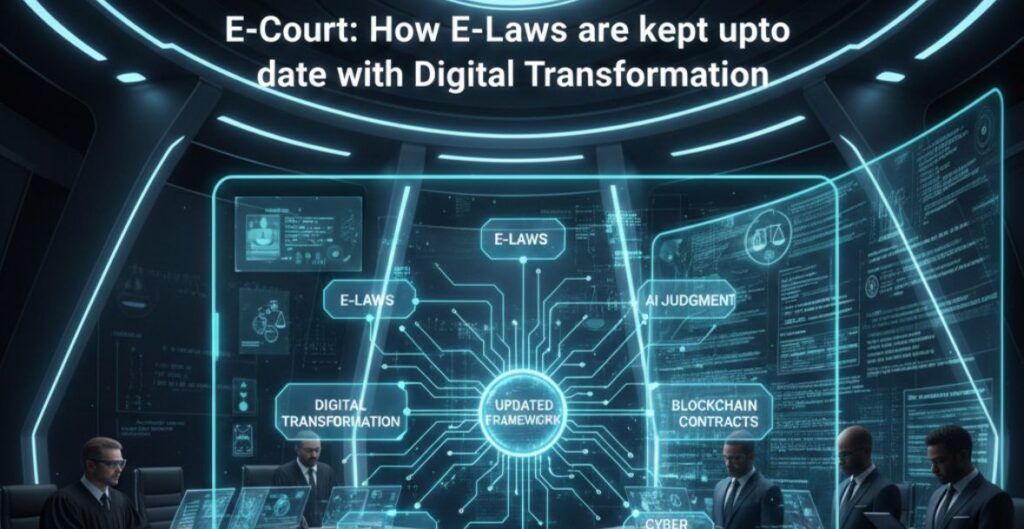
The international system of justice delivery is currently experiencing an extensive shift in the twenty-first century, with an increasing loss of the old paper-based mechanism of administration and an increase in the entirely technological adjudication process. The mission mode project of e-courts has been put into practice under the e-committee of the Supreme Court of India with the aim of implementing the vast number of cases and delays in processes that have long hampered the efficiency of courts. The concept of e-court incorporates the adoption of information and communication technology (ICT) to support electronic filing (e-filing), virtual hearings, case management in its digital form, and other ancillary services.
The convergence of digital transformation in the judiciary and both current and formal regulatory frameworks are legal foundations of online court procedures. An example of this is the Information Technology Act, 2000, which provides legal status to electronic documents and electronic transactions. This essay reflects on the interaction between digital change initiatives like e-Courts and emerging legal frameworks governing them based on the major thematic understanding and heavily utilized case law and a future perspective.
Statutory Support and Policy Framework
The total digitization of Indian courts is based on a scheme of their digitalization which is the National Policy and Action Plan of the Implementation of ICT in the Indian Judiciary (2005) whose purposes are to improve efficiency, transparency, and citizen-oriented justice delivery. The overall aim of the e Courts Project that was introduced as part of the National e- Government Plan is to make the courts pure paperless and digital. It has already passed Phase I and Phase II, and is currently in Phase III. Phase III is aimed at establishing e-Sewa Kendras in the court buildings, to use smart technologies to assist courts in making judicial decisions, and to use universal e-filing and e-payment services. The Information Technology Act of 2000 establishes a powerful legal framework on the issue of electronic filing and exchange of judicial records by recognising electronic records, electronic signatures and electronic exchanges and thus provides the electronic court process with statutory validity.
Digital Transformation: Systems and Tools.
This protects the due process, and the procedural legislation is in step with technological development with the Supreme Court as well as High Court amendments allowing electronic filing, electronic issuance of notices, and electronic hearing. The essence of digitizing courts is e-filing and e-payments, which allow plaintiffs and advocates to file pleadings and payment vindications online, which saves time and paperwork and delays the administration. Virtual hearings and video conferencing, which are commonplace with the COVID-19 world, have become part of normal judicial activity. It lets judges and attorneys’ access and manage documents through digital court platforms safely because centrally maintained electronic registries correlate to the National Judicial Data Grid, which also allows providing real-time access to case status, orders, and pleadings.
Cases and Judicial Assistance
Digitalization of judicial procedures has been the institutional requirement and constitutional permissibility in the Indian judicial system. Procedural case law and constitutional jurisprudence have confirmed the legality of conducting hearings virtually, using electronic records, and adjudication based on technologies even though there is no single statute to declare explicitly e-courts as an independent body of judgment.
The right to privacy was acknowledged in the Supreme Court as an inalienable right in the Article 21 in the case of Justice K.S.Puttaswamy (Retd.). v. Union of India (2017) 10 SCC 1 and created a cornerstone on which further privacy concerns can be based. Conformity to the Constitution has compelled the State to ensure the security of personal data in digital ecosystems because the Court has already reiterated that the informational privacy is indispensable to human dignity. The e-courts that handle sensitive court information in large volumes are thus directly under this principle. Therefore, the digitisation of courts needs to be accompanied by strict security conditions to guarantee privacy, cybersecurity, and limited access.
The Supreme Court in the case of In Re: Guidelines for Court Functioning through Video Conferencing during COVID19 Pandemic (2020) made an unconditional Court announcement of the legality of video conferencing litigation, determining that, in the case of the maintenance of the values of open justice and fairness, the virtual hearing method is a legally valid alternative to face-to-face proceedings. Such ruling incorporated technology in everyday judicial functioning and made virtual courts a valid mode of operation.
Also, in the other case, Anvar P.V. v. P.K.Basheer (2014) 10 SCC 473, and in Arjun Panditrao Khotkar v. Kailash Kushanrao Gorantyal (2020) 7 SCC 1, the Court held that the documentary evidence contained in electronic records is admissible subject to the statutory requirements contained in the Section 65B of the Indian Evidence Act, 1872. These digital document management systems and e-filing are thus based on the pre-existing choices of jurisprudence.
Put together, these decisions reveal a certain doctrinal parenthesis: judicial technology is an obligatory tool to achieve constitutional principles of performance, transparency and access to justice.
The Benefits and the Challenges of E- Court Transformation
The e-courts ecosystem through the automation of filing, listing and case management has significantly increased judicial efficiency by reducing time wastages and bottlenecks of judicial processes. The availability of lists of causes, orders and progress of the case in real time and online facilitates transparency and builds confidence in the populace. Moreover, the efficiency of the costs and the ability to participate remotely without traveling are obtained, and ecological sustainability is ensured due to a decrease in the use of paper.
In spite of that, there are difficulties. Security and privacy of information have been the key issues of concern and the digital divide deprives the populations who cannot afford technological tools. In order to be able to use technology to achieve justice and not impede it, a judge, an attorney, and the court personnel should engage in a continuous professional development.
Legal Policy: Connecting Technology and Policy
The consistent compatibility of the legal framework with digital innovation is an inherent part of successful integration of technology into the judicial system. Such alignment is complex in nature and requires institutional, procedural, legislative and policy level interventions.
The Information Technology Act of 2000 offers legal support of the essential legal acknowledgement to the digital signatures, electronic communication, and electronics records. The swift developments of e-courts have also made it possible to underline the necessity of specialised e-justice laws that regulate such components of digital court infrastructure as virtual hearings, online evidence management, and cybersecurity demands inside courts.
Procedural harmonisation is also very vital. The concept of e-filing, electronic service, virtual hearings, and digital case management has to be integrated into the civil and criminal procedural regulations, practice principles of High Courts, and the Supreme Court continuously. Such reforms have to protect the basic rights of being equal before the law, natural justice and fair trial against any form of deterioration that may occur by the efficiency brought about by the technology.
These digital courts are proliferating, which puts pressure on the need for effective data-protection measures. Massive technical protection and wholesale privacy legislation are essential in maintaining the privacy and independence of information within judicial databases, which frequently include high sensitivity of personal and corporate data.
The rule of judicial technology is one of the core ones. Judicial independence, institutional oversight and judicial discipline To make certain that technological innovation is conducted in correspondence with the constitutional ideals, judicial independence, and accountability to the population, the e-Committees in the Supreme Court of India offer strategic direction, standard setting and supervision.
Conclusion
The e-courts project to digitize the Indian judiciary is one of the significant developments of moving towards a more modern, effective, and convenient system of justice delivery. Digital justice is legally valid because it follows the laws of the Information Technology Act, the development of procedural guidelines, and the continuation of court approval. However, there is a necessity of long-term change. On top of technical innovation, data protection legislation, ongoing, procedural adaptation, and the overwhelming production of digital literacy should all continue to move forward together. Constitutional needs of equality, privacy and justice must still be preserved. Finally, e-Courts become a manifestation of justice in action – a system that is well rooted in its law, rights and procedural integrity that are all-geographical.
Frequently Asked Questions
Is there a legal legitimacy of e- court proceedings?
Yes. Digitally administered court operations, such as e-filing, electronic hearings, and electronic service are legal when performed according to the statutory provisions and the rules of courts that identify and consider electronic records.
Which are the Indian statutes sanctioning the use of electronic filing?
The use of electronic filing in court is also legally recognized in the Information Technology Act of the year 2000 to support the digital signatures and electronic records. Its application is also regulated by the rules of the procedure by the court.
Is there better access to justice on online courts by rural litigants?
Digital courts may solve geographical limitations, though, rural areas might have limited internet access simplifying the process and infrastructural interventions in the form of policy alternatives can be required.
Are the virtual courts equipped with data privacy protection?
Even though IT Act offers a general framework of regulations, sensitive judicial information should be safeguarded by the inclusion of several data protection and security tasks.
Does this mean that traditional courts can be replaced by digital courts?
Digital courts and physical courts go hand in hand. Although the face-to-face session is vital to adjudicate sophisticated cases, electronic resources can significantly enhance the working of courts in general.
References
1. Information Technology Act, 2000 (Bare Act – Government of India) https://www.indiacode.nic.in/handle/123456789/1999
2. National Policy and Action Plan for Implementation of ICT in the Indian Judiciary (e-Courts) https://ecourts.gov.in/ecourts_home/static/about-us.php
3. e-Courts Mission Mode Project – Overview https://en.wikipedia.org/wiki/E-courts_in_India
4. Department of Justice – e-Courts Phase III https://doj.gov.in/phase-iii/
5. Information Technology Act, 2000 (Bare Act – Government of India) https://www.indiacode.nic.in/handle/123456789/1999
6. National Policy and Action Plan for Implementation of ICT in the Indian Judiciary (e-Courts) ttps://ecourts.gov.in/ecourts_home/static/about-us.php
7. e-Courts Mission Mode Project – Overview https://en.wikipedia.org/wiki/E-courts_in_India
8. Department of Justice – e-Courts Phase III Phase-III | Department of Justice | India
9. In Re: Guidelines for Court Functioning through Video Conferencing during COVID-19 Pandemic, (2020) https://indiankanoon.org/doc/91938676
10. The Impact of ICT on the Indian Judicial System – IJLLR https://www.ijllr.com/post/the-impact-of-ict-on-the-indian-judicial-system
11. Digitisation of Indian Judiciary – Drishti IAS https://www.drishtiias.com/daily-news-editorials/digitisation-of-indian-judiciary
12. Online Courts & e-Filing in India – Lloyd Law College https://www.lloydlawcollege.edu.in/blog/online-courts-e-filing-india.html