This article is written by Aditi Dubey of Soa National Institute of Law. The Supreme Court case X v. Principal Secretary expanded abortion access under the MTP Act to all women up to 24 weeks, striking marital status discrimination. Decided via Article 136 SLP, it upholds reproductive autonomy as part of Article 21 rights.
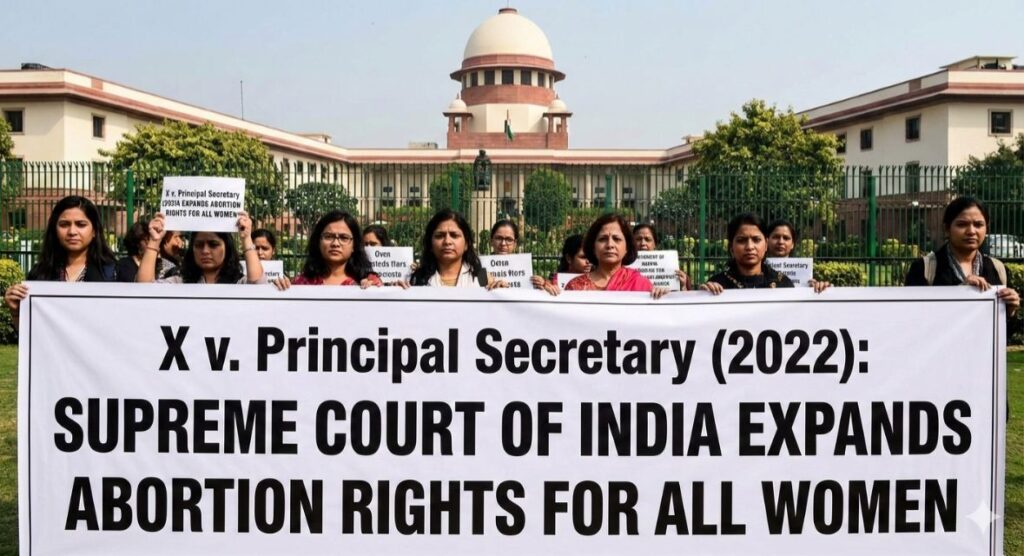
In 2022, the Supreme Court heard an urgent plea from a 25-year-old unmarried woman from Manipur living in Delhi. She was 22-24 weeks pregnant from a consensual relationship but wanted to end it when her partner backed out of marriage. Lower doctors and Delhi High Court denied permission, saying MTP Act rules covered only married women or special cases like rape victims. She filed a Special Leave Petition under Article 136 and the top court stepped in. The Medical Termination of Pregnancy (MTP) Act, 1971, lets abortion up to 20 weeks for health risks or rape/child pregnancies. The 2021 Amendment raised it to 24 weeks for certain women via Rule 3B like rape survivors, minors, or those with changed marital status (widow/divorce). But it seemed to exclude unmarried women in consensual cases, sparking equality fights.
On July 21, 2022, the Court gave an interim nod for medical board check. Final judgment on September 29 by Justices D.Y. Chandrachud, A.S. Bopanna, and J.B. Pardiwala was game-changing. They called marital distinction “artificial and discriminatory,” violating Article 14 equality. Unmarried women get the same choice as married under Article 21 life/dignity/privacy. The woman’s view on continuing pregnancy counts heavily no extra proofs or family nod needed. This ruling came via Article 136 discretion, as the High Court wrongly read rules narrowly. It boosts bodily autonomy, ends stigma and aligns law with reality millions seek abortions yearly, many unmarried. But limits remain beyond 24 weeks needing court nod.
Legal Framework of MTP Act
The MTP Act started in 1971 to legalize safe abortions after global pushes like India’s family planning drive. Section 3 sets limits: Up to 12 weeks, one doctor okay; 12-20 weeks, two doctors on health/rape grounds. 2021 Amendment added 20-24 weeks for “specified categories” under Rule 3B minors, rape/disabled victims, fetal issues, or “change in marital status.” But the rule’s wording sparked fights: Did “marital status change” mean only widows/divorcees?
Pre-2022, many courts said yes, leaving unmarried women out. This clashed with Constitution Article 14 bans unequal treatment without reason, Article 21 covers life with dignity including choices over body. Puttaswamy (2017) made privacy fundamental, paving way. X case fixed this by reading “change in status” broadly: Includes breakups, failed consents turning unwanted.
The government argued rules protect fetal life post-20 weeks. Court agreed limits needed but not via marital bias. It stressed women’s suffering weighs more than literal words’ purposive interpretation wins. This framework shift aids 15 million annual pregnancies, cutting illegal abortions’ risks.
Case Laws
X v. Principal Secretary (2022)
A woman (X) learned of a 22-week pregnancy late. The partner refused marriage; she feared mental/physical harm from continuing. Delhi HC rejected under Rule 3B, limiting “change in marital status” to widows/divorcees, excluding unmarried. SLP granted; Court allowed termination post-board okay.
Ratio: Purposive read “change in status” includes single women facing unwanted pregnancy via contraceptive fail or consent breakdown. Discriminating unmarried breaches Article 14; all women equal till 24 weeks. Marital rape counts as “sexual assault” for rules (without striking IPC exception).
Suchitra Srivastava v. Chandigarh Administration (2009)
Early boost: Court allowed 24-week abortion for mental trauma in unwanted pregnancy. Stressed woman’s environment in health risk check under Section 3 fetus viability alone not bar. X case builds here, prioritizing woman’s estimation.
Pre-2022 Limits and High Court Denials
Many HCs denied unmarried women pre-X, sticking to literal Rule 3B. E.g., Delhi HC in this case saw no “contraceptive failure” cover for singles. SC slammed as “restrictive,” pushing inclusive view.
Post-X Developments
- X v. Union of India (2023): Tested limits; Court denied 26-week abortion despite mental illness claims, stressing no auto-right beyond 24 weeks. Board viability ruled; undid some X gains per critics.
- MTP Amendment Rules (2024 updates): Formalized X unmarried now explicitly under 24-week categories. But a fetal anomaly needs two boards.
These show evolution: From married-only to all-women equality, via Article 136 correcting lower errors.
Broader Societal Impact
The X ruling didn’t just change courtrooms it rippled out into real lives. Health reports show unmarried women getting abortions jumped 20-30% after 2022, as old stigmas started fading a bit. City women found it easier, but rural ones still face tough odds. Just one in five districts has a proper MTP center, leaving many traveling far or risking backyard clinics.
This case lit a fire under activists. Groups like the Centre for Reproductive Rights cheered it as a win for women’s choice, while some critics worried aloud about “moral decline.” Hard numbers tell a clearer story though: Safe abortions save lives. Before MTP laws, around 10 million unsafe ones happened yearly, claiming thousands. X lines up India better with world standards like CEDAW and fueled 2025 pushes for MTP updates.
Problems linger, sure. We’ve got only about 12,000 certified doctors for the whole country, fake setups pop up everywhere, and teens often hit walls getting care quietly. The government stepped up with e-MTP apps and training camps post-ruling, which helps. Bottom line: It hands women real power over their bodies, but we need more clinics and docs to make it work everywhere.
Conclusion
The X v. Principal Secretary ruling stands as a beacon of progress, sweeping away marital status barriers to grant all women safe abortion access up to 24 weeks under the MTP Act, while breathing life into Articles 14 and 21 by honoring bodily autonomy and equal dignity. Through Article 136’s swift intervention, the Supreme Court righted a High Court error, not just saving one life but lighting a path for countless others. Updated rules now ease access, stigma fades, and women’s choices reclaim center stage. Yet real hurdles remain: post-24-week denials like in 2023, rural deserts without centers, and hesitant doctors call for bolder steps: a full MTP overhaul with on-demand options till viability, widespread training, and helplines to turn promise into everyday reality. In this quiet revolution, the judiciary proves its timeless role as guardian of autonomy, transforming courtroom denials into bridges of dignity, ensuring no woman bears the weight of outdated chains alone.
Frequently Asked Questions
- What was X v. Principal Secretary about?
Delhi HC denied 24-week abortion to unmarried women; SC via Article 136 ruled marital status irrelevant under MTP Rule 3B. - How did it impact unmarried women’s rights?
Expanded access up to 24 weeks equally for all women, enforcing Article 14 equality and Article 21 autonomy. - Why Article 136 SLP?
Enabled quick Supreme Court fix of High Court error on discriminatory reading, setting binding precedent. - How has the ruling shaped future MTP reforms?
Pushed 2024 rule updates explicitly including unmarried women, sparked activism for decriminalizing marital rape and extending limits. - What changed for unmarried women post-ruling?
They gained equal access till 24 weeks; rules amended to end marital discrimination explicitly.
References
- PRS Legislative Research – MTP (Amendment) Bill 2020: https://prsindia.org/billtrack/the-medical-termination-of-pregnancy-amendment-bill-2020
- Suchitra Srivastava v. Chandigarh Administration (2009): https://indiankanoon.org/doc/123985596/
- X v. Union of India (2023) INSC 919: https://www.casemine.com/commentary/in/supreme-court-upholds-24-week-threshold-for-medical-termination-under-mtp-act:-x-v.-union-of-india-(2023-insc-919)/view
- Puttaswamy v. Union of India (2017): https://indiankanoon.org/doc/1500783/
- Delhi HC Order in X case (2022): https://indiankanoon.org/doc/127517806/