This article is written by Rashmi Devendra Brahmadandi, a student of LL.B. III at N. B. Thakur Law College, Nashik, Maharashtra, India
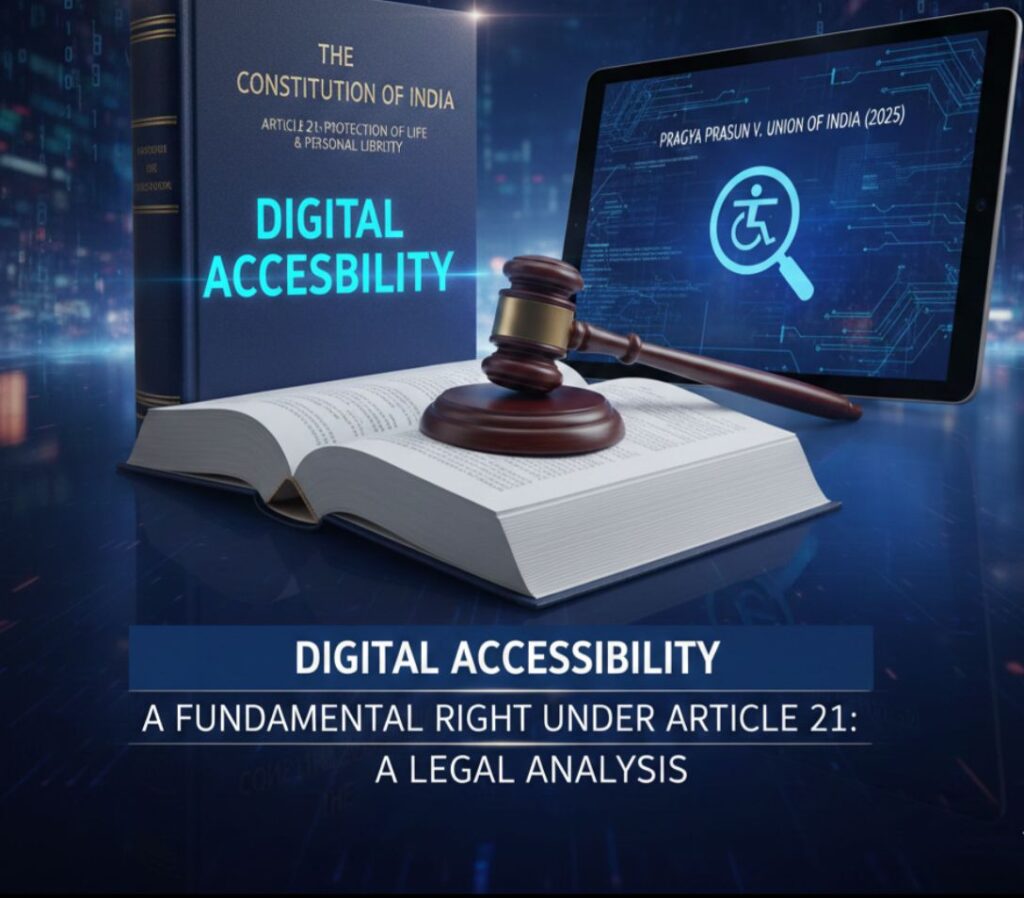
Digital services have become an essential element of life in India. Starting from opening a bank account to availing government benefits, all services rely on online verification and digital KYC processes. However, such processes are hard to access or simply inaccessible to people with disabilities. This issue was addressed by the Supreme Court in the case of Pragya Prasun v. Union of India (2025). The Supreme Court explicitly clarified that access to digital services is linked to the right to life under Article 21 of the Indian Constitution. The Court explained that if digital services are inaccessible, they cause damage to dignity and generate inequality. This is a significant ruling because it establishes that digital accessibility is a legal right and not a mere luxury.
Background of the Case
India has been progressing at a fast pace towards digital governance in the last few years. Digital services such as Aadhaar authentication, online banking, digital KYC, and welfare services are now largely delivered through digital means. Although digital governance has improved the efficiency of services, it has also led to severe difficulties for the disabled. Digital services are largely inaccessible to assistive technologies such as screen readers. In this case the petitioners argued that the disabled are being denied access to essential services due to the inaccessibility of digital KYC services. This case presented a significant question of constitutional law.
Why in the News?
The first and foremost issue that came before the Supreme Court was whether the inaccessible digital system is violative of the basic rights provided for in the Constitution. The Supreme Court analyzed whether the denial of an accessible digital KYC system is violative of the right to life and liberty guaranteed under Article 21 of the Constitution.
The second significant issue was whether the inaccessible digital system results in discrimination and inequality, particularly for persons with disabilities who rely on accessible digital systems to lead a life of equality in society.
Interpretation of Article 21 in the Digital Era
Article 21 of the Indian Constitution provides for the right to life with dignity. Over the years, the Supreme Court has given this provision a wide interpretation to cover other rights that a person is entitled to in order to live with dignity. In this particular matter, the Court held that digital accessibility has become the need of the day if a person is to live with dignity in today’s world.
If digital systems are not made accessible, persons will be denied access to basic services such as banking and social security. The Court held that if digital platforms become the main means of providing services, then access to these platforms becomes a part of Article 21.
Equality and Dignity of Persons with Disabilities
The Court has given great importance to the principles of equality and dignity. The Court held that the digital technology that fails to address disabilities leads to indirect discrimination. The Court held that persons with disabilities are discriminated against as compared to other persons. The Court held that dignity is not only confined to physical accessibility but also extends to digital accessibility. The State fails to provide accessible alternatives and also to provide equality and dignity.
Legal Precedent and Larger Implications
The legal precedent established by the case of Pragya Prasun vs. Union of India is significant. This is one of the first instances where the Supreme Court of India has established a clear connection between digital accessibility and fundamental rights.
This precedent sets a positive obligation on the State to make digital design inclusive. This precedent will have larger implications in future cases related to digital rights, disability rights, and governance reforms. This is a major move towards inclusive constitutionalism in the digital age in India.
Role of the State and Public Authorities
The role of the State in making digital accessibility has been emphasized by the Supreme Court. The Court said that when the State resorts to digital platforms as the main means for delivering services, it cannot disregard the requirements of the disadvantaged section of society.
The State is obliged to make digital platforms accessible to all, including persons with disabilities. This includes alternative verification processes, accessible interfaces, and reasonable accommodations.
Impact on Digital KYC and Policy Framework
The impact of the judgment is direct on digital KYC systems being used by banks, financial institutions, and government bodies. The Court has understood that inaccessible KYC systems can be a barrier to the exercise of the right to take part in economic and social life. After this judgment, it is expected that the government will assess and alter the existing digital systems to make them accessible. The judgment is a call to policymakers to implement universal design principles and accessibility standards right from the planning stage.
Contribution to Digital Rights Jurisprudence in India
This case is a valuable addition to the jurisprudence of digital rights in India. The Court’s attempt to connect digital accessibility with Article 21 has broadened the scope of fundamental rights in the digital era. This judgment goes beyond the boundaries of rights and is an answer to the challenges of the contemporary era. It further reinforces the notion that rights under the Constitution need to keep pace with the times.
Case Laws
In arriving at the decision in Pragya Prasun v. Union of India (2025) INSC 599, the Supreme Court of India used the precedent of several previous decisions to establish the connection between digital access and dignity.
Among the decisions cited was the case of Maneka Gandhi v. Union of India (1978) INSC 16, where the Court widened the scope of Article 21 to include living with dignity and equality. This was used to establish the fact that access to basic digital services is part of living with dignity.
The Court also cited the case of Francis Coralie Mullin v. Administrator, Union Territory of Delhi (1981) 1 SCC 608, where the Court held that the right to life is not just the right to survive but includes the right to live with human dignity. Digital access was therefore established as a basic human need.
In the case of Jeeja Ghosh vs. Union of India (2016) 7 SCC 761, the Supreme Court emphasized the need for dignity and equality for persons with disabilities. Likewise, in Vikash Kumar vs. UPSC (2021) 12 SCR 311, the Court asserted the need for reasonable accommodation as a constitutional imperative under Articles 14 and 21.
The decision was also based on the precedent set in Anuradha Bhasin vs. Union of India (2020) 3 SCC 637, in which the Court recognized the need for access to the internet in order to exercise one’s fundamental rights. Collectively, these precedents assisted the Court in arriving at the decision that inaccessible digital KYC systems violate Article 21 and the principles of equality.
Conclusion
The Supreme Court ruling is clear on the fact that digital access has become the need of the day in the right to life under Article 21. If digital systems are not accessible, they generate exclusion and impact the dignity and equality of persons with disabilities. The Supreme Court ruling is correct in holding the State responsible for ensuring that digital platforms are made accessible.
The Supreme Court has made digital accessibility a constitutional requirement, which has enhanced the protection of fundamental rights in the digital age. The Supreme Court ruling has set a great precedent and will help shape future laws and policies for a fair digital system.
Frequently Asked Questions
What was the key question in this case?
The key question was whether digital systems such as online KYC are required to be accessible to the disabled under the Constitution.
Why is digital accessibility relevant to Article 21?
Because digital accessibility has a direct bearing on dignity, autonomy, and the ability to live a normal life in the digital age.
What is the Court’s stance on inaccessible digital systems?
The Court said that inaccessible systems lead to inequality and the violation of the right to life and dignity.
References
[1] Pragya Prasun v. Union of India (2025) INSC 599 – https://indiankanoon.org/doc/68332080/
[2] Maneka Gandhi v. Union of India (1978) INSC 16 – https://indiankanoon.org/doc/1766147/
[3] Francis Coralie Mullin v. Administrator, Union Territory of Delhi (1981) 1 SCC 608 – https://indiankanoon.org/doc/78536/
[4] Jeeja Ghosh vs. Union of India (2016) 7 SCC 761 – https://indiankanoon.org/doc/175579179/
[5] Vikash Kumar vs. UPSC (2021) 12 SCR 311 – https://indiankanoon.org/doc/157396742/
[6] Anuradha Bhasin vs. Union of India (2020) 3 SCC 637 – https://indiankanoon.org/doc/82461587/