This article is written by Khushi Tayal, of Jiwaji University, Gwalior.
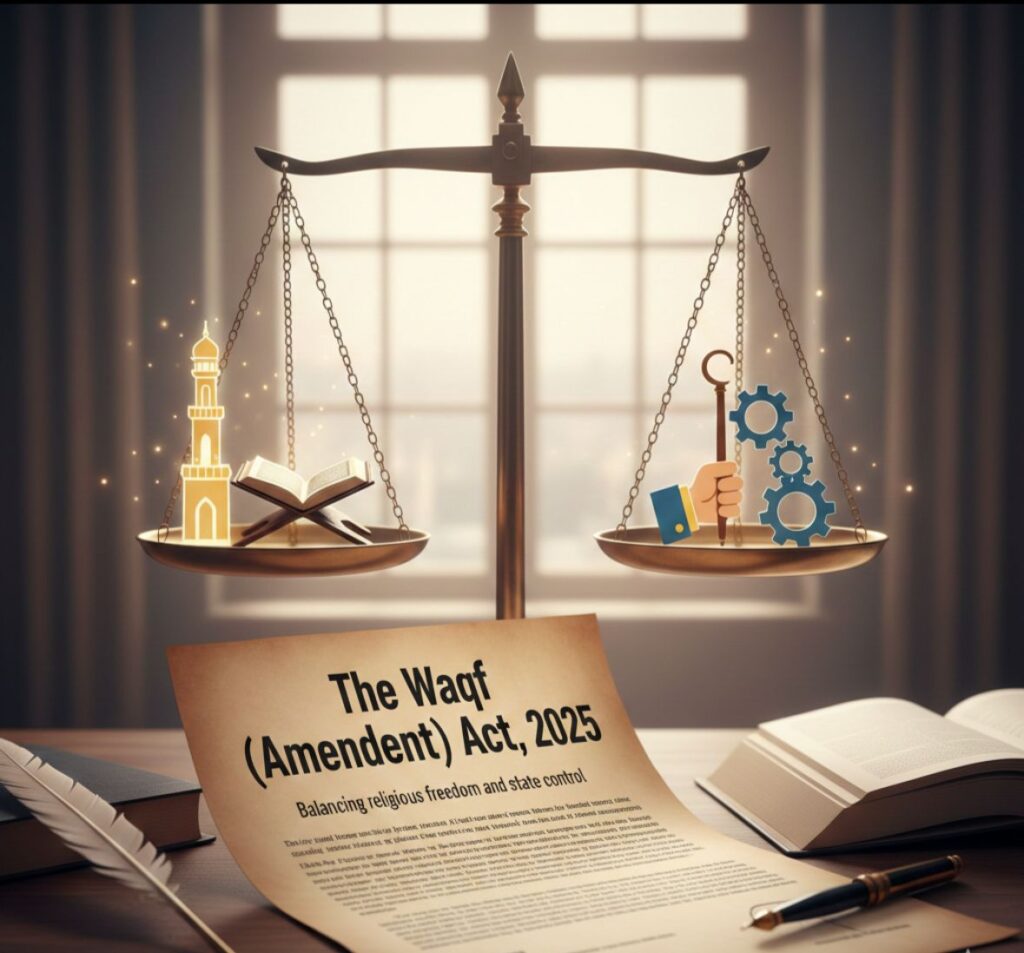
The Waqf (Amendment) Act, 2025 signifies a paradigm shift in the existing legal and administrative apparatus governing Muslim religious endowments in India. Though enacted with the avowed purpose of rendering transparency, accountability, and protection to waqf properties, the amendment has nonetheless evoked unprecedented adversary responses from various Muslim organisations, legal experts, and civil rights groups. This article critically assesses the major changes effected by the amendment in respect of the abolition of waqf by user, enhanced government and bureaucratic control over waqf administration, mandatory central registration, and the inclusion of non-Muslims in Waqf Boards. It examines how such changes have been perceived as divesting religious autonomy protected under Articles 25 and 26 of the Indian Constitution while creating corresponding problems under Articles 14 and 15 on equality and freedom from discrimination. The article further evaluates the relevant judicial developments and case laws, including interim observations of the Supreme Court, to judge the constitutional validity of the amendment. The study, by locating the legal debate within broader socio-political and constitutional perspectives, underscores why the amendment has been viewed by Muslims at large as an onslaught on minority rights and communal property, rather than as a neutral piece of administrative reform.
Introduction
Recently, there has been much discussion about the Waqf (Amendment) Act of 2025. This act has been one of India’s more talked-about pieces of legislation since it came into effect earlier this year (April 2025) after being signed into law by the President and has been officially passed by Parliament. The Waqf (Amendment) Act modifies provisions in legislation regarding the management of waqfs; properties held as religious/charitable/community assets for the benefit of Muslims.
Proponents believe that the passage of this act will modernise the processes and procedures employed to administer waqfs, create a more robust mechanism to deal with the encroachment of waqf property, and provide greater transparency in the operation of waqf properties. Opposition to the legislation primarily comes from members of the Muslim community, as well as legal scholars and members of the political opposition, who believe the changes made by the Waqf (Amendment) Act are an attack on constitutional protections for minorities, eliminate the right of Muslims to manage their own waqfs without interference by government and political interests, and enable greater government and political control over waqfs. The public debate surrounding the changes made by the Waqf (Amendment) Act is ongoing and has resulted in protests, litigations and continuing media coverage.
Core Changes in the Waqf Amendment Act
Before diving into case laws and criticisms, here’s a summary of key legal changes that have triggered the controversy:
- Inclusion of Non-Muslims on Waqf Boards: The Act allows individuals who do not identify as Muslim to be a member of both Central and State Waqf Boards, with a requirement for a minimum of two non Muslim members to be appointed per State Board. Critics claim this will change the character of these boards that were created for the purpose of managing Muslim religious endowments.
- Abolition of Waqf by User: Historically, properties long used for religious or charitable purposes could attain waqf status based on usage even without formal documentation (waqf by user). The amendment removes this concept, potentially jeopardising the status of longstanding religious sites built before formal deeds were common.
- Government Control in Property Disputes: The updated legislation has provided increased power to district collectors, state officials and others to make a determination as to the classification of land as waqf or not, moving certain responsibilities away from independent adjudication bodies.
- Mandatory Central Registration: All waqf properties are required to be registered centrally within a fixed period, with the aim of better tracking and management but also raising concerns about state oversight.
Case Laws and Judicial Challenges
Since its enactment, the amendment has faced multiple legal challenges and judicial interventions in Indian courts:
- Supreme Court Interim Orders: The Supreme Court of India has given a partial stay to some sections of the Waqf Amendment Act, most significantly the section that required an individual to have been a practicing Muslim for five years before he or she can create a waqf. This was based on the likelihood of a constitutional issue with requiring such a religious qualification. Nevertheless, the Supreme Court did not put a hold on the entire Act, since all parliamentary legislation is presumed to comply with the constitution unless proven otherwise. Sections of the law remain in force which allows non-Muslims to serve as Chief Executive Officers of Waqf Boards, among other things.
- Multiple Petitions Before the Apex Court: Muslim organisations, activists, and leaders have filed petitions challenging the constitutional validity of the law:
- Article 26 Challenge: The law violates the rights of every Muslim denomination under Article 26 of the Indian Constitution which provides that every denomination enjoys the authority to manage its own affairs in relation to their religion. The petitions state that government intervention, as required by the new law, reduces the rights of a Muslim denomination by dictating non-Muslim representation.
- Equality and Non-Discrimination: There are also petitions challenging the law’s infringement upon the principle of equality set forth in Articles 14 and 15, which offer equality for all religious groups. These petitions assert that when waqf laws are less protected than other religious endowment laws (Hindu, Sikh, Jain), this amounts to discriminatory treatment.
- Federal Structure and Separation of Powers: Other petitions contend that concentrating authority in the hands of executive officers infringes upon independent judicial review and is contrary to the federal structure and principles of sovereignty.
- Scholarly Critiques of Judicial Reasoning: There is already criticism about the interim orders of the High Court. Several legal academics have submitted written comments regarding the decision-making process in New Zealand. In their opinion, some of the conclusions arrived at in the interim decisions may have distorted the underlying legal issues or made unwarranted assumptions about the stated views of the courts rather than conducting a detailed examination of their constitutionality.
Criticism by Muslim Organizations and Community Leaders
The bulk of resistance to the Waqf Amendment Act comes from Muslim organisations, scholars, and civil rights advocates:
- Autonomy and Religious Freedom: Proponents of the All India Muslim Personal Law Board (AIMPLB) and of the Waqf system have maintained that these changes undermine the independence of Waqf institutions, which are not simply legal entities but rather encompass the cultural heritage and history of the community. Proponents of this viewpoint have stated that the introduction of state-appointed members and/or officials will detract from the definition of what waqf is and thus will have a negative impact on Waqf itself.
Several leaders of the AIMPLB and Waqf system also argue that requiring an individual to provide proof of their religious practice to form a new waqf is an unreasonable and discriminatory requirement, and it creates an arbitrary and excessive burden to bear to participate in a religious practice.
- Threat to Historical and Community Sites: The user-based termination of waqf will have particularly adverse effects on the historically significant masjid’s, maqamat, madrasah and charitable properties created long before any formal registration documentation was commonplace, calling into question the legal status of many of these properties which must remain essential to the lives of Muslim communities.
- Allegations of Political and Majoritarian Motivations: According to numerous Muslim organisations, the law represents the continuation of an ongoing process of furthering the exclusion of minority populations via both legislative and administrative tiers, citing as examples the Citizen Amendment Act (CAA), as well as NPC debates, both of which have communal implications.
Other critics of the amendment view it as another governmental takeover of land through claims of acquiring ‘waqf,’ subject to the premise of a public purpose, thereby establishing a precedent for further encroaching upon substantial amounts of religiously significant land.
- Protests and Public Outcry: Now that the bill has been passed, mass protests occurred in many of the states in India. In some areas, public order issues led to security forces being sent by state authorities to assist local governments in managing these protests. Many different political leaders from a variety of political parties have expressed concerns regarding the impact of this new law on communal harmony and the rights of minorities.
Conclusion
The Waqf (Amendment) Act of 2025 has created significant division within Indian society. The government has claimed that it must modernise the current laws concerning Waqfs and the public’s ability to oversee and monitor the encroachment/damage inflicted on Waqf properties; however, many Muslim leaders, lawyers and human rights advocates view these changes as an attack on religious freedom, minority rights and the management of Waqfs without government intrusion.
The ongoing court cases regarding this Act, and the continued public discourse and demonstrations illustrate that the resolution to this Act is still unresolved. The way in which the Supreme Court of India weighs the religious rights of minority groups against the expressed need of the State to bring about legal reform in this area will be one of the most pressing legal matters in the coming years.
Frequently Asked Questions
What exactly is a waqf property?
A waqf is an endowment typically land or property donated permanently for religious, charitable, or community purposes in accordance with Islamic law. Once designated as waqf, such property cannot be sold or transferred outside its beneficial use.
Why has the Waqf Amendment Act sparked controversy?
Some critics of the waqf law believe that it adversely affects the independent operation of Muslim waqf institutions through the addition of State authority; permitting non-Muslim representation on waqf boards; and eliminations of the traditional protections such as waqf by user, as well as the shifting of powers related to resolving disputes from waqf management to State officials.
Are there ongoing legal challenges to the Act?
Yes. Multiple petitions have been filed in the Supreme Court alleging that the law violates constitutional protections for religion and equality, including Articles 14, 15, and 26.
Has the Supreme Court stayed the law?
The court granted a partial stay on specific provisions, such as the requirement about religious practice duration, but did not stay the entire law.
What do supporters of the amendment claim?
Supporters say the Act will bring transparency, strengthen governance, reduce encroachments, and help utilize waqf assets better for community development.
References
- https://www.minorityaffairs.gov.in/WriteReadData/RTF1984/1743763149.pdf
- https://en.wikipedia.org/wiki/The_Waqf_(Amendment)_Act,_2025
- https://www.drishtiias.com/daily-updates/daily-news-analysis/waqf-amendment-bill-2024
- https://api.sci.gov.in/supremecourt/2025/18261/18261_2025_1_1501_64403_Judgement_15-Sep-2025.pdf
- https://www.scobserver.in/cases/constitutionality-of-the-waqf-amendment-act-2025-asaduddin-owaisi-v-union-of-india/
- https://static.pib.gov.in/WriteReadData/specificdocs/documents/2025/apr/doc202543531901.pdf